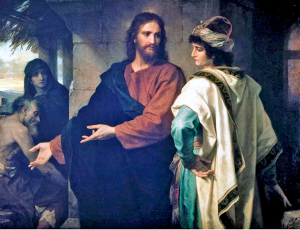
Christus und der reiche Jüngling (Christ and the Rich Young Man), Heinrich Hoffman 1889, Riverside Church, Manhattan, New York, USA.
Click here to read today’s Sunday Mass Readings.
[Jesus said], “You are lacking in one thing. Go, sell what you have, and give to the poor and you will have treasure in heaven; then come, follow me.” Matthew 10:21.
Click on words highlighted in red for further information.
Your first reaction to today’s gospel, I suspect, is one of outrage, or guilt, or astonishment, or confusion, or disbelief, or agreement…. either take your pick or add another. It would seem that each one of us will have some sort of reaction as no reaction at all would not seem to be possible. Is Jesus in fact asking for the impossible? If we all did this, what would happen to all those sold goods (and who would buy them?) and the money given to the poor, who presumably would not be poor anymore – but those who had given everything away would be the new poor! The consequences would at least be catastrophic for most if not all of us. Does Jesus really mean all that? Well I believe, yes, he does. I did exactly all that when I joined the Society of Jesus in 1973. I got rid of my beloved custom-built HiFi (it was 1973!) and all my worldly belongings fitted into one trunk which I set off for the USA (I was in England). So, yes, it happens, especially to those who join religious communities to this day. Given my one room in the novitiate, there would be no way any new member could surround him/herself with worldly belongings. So I believe that Jesus was calling the rich young man to follow him as, presumably, one of his disciples. Since I left the Jesuits, I am now once more surrounded by various things, because a regular priest, assisting in a normal parish, does not have to disburse everything, he does not take a vow of poverty – but he still has to help the poor, as we all must.
Jesus makes the further point of saying “It is easier for a camel to pass through the eye of a needle than for one who is rich to enter the kingdom of God.” At this point, understandably, his disciples seemed to have hit the roof; remember that in Jewish thought, at least back then, wealth was considered to be a sign of God’s favor. Hence their desperate question: “Then who can be saved?” they asked. Good point. Then the mysterious response: “For human beings it is impossible, but not for God. All things are possible for God.” And we are left with trying to figure out what the Master meant. It certainly represents a softening in the extreme teaching, and perhaps Jesus does think of the differences between being called to the religious life (his disciples) and not. But certainly we are all ordered to help the poor, the destitute. They certainly are always with us. It also recalls the episode where Abraham’s wife, at a great age, was promised a child. She laughed. Then God asked Abraham why his wife laughed, stating “Is anything too hard for the Lord? (Genesis 18:14) in other words, all things are possible for God.
Who can discern the mind of God? No-one really. So, in the end, we have to trust in God, we must try to fulfill his commands, though often failing, but trying again. We must trust in God because God can do anything, including seeing into our minds, our deepest feelings, beliefs, motivations….. We can’t do that, save for ourselves (though sometimes not even then). God sees inside everyone and knows who is trying the best to follow the commandments, and who is not.
The other two readings seem to support these thoughts. In the first reading wisdom is to be preferred even to gold (and note, once more, that Holy Wisdom is feminine in Hebrew, from which our Old Testament is translated, not Greek). The second reading says that God, present in Holy Scripture, penetrates “soul and spirit, joints and marrow” and knows all there is to know about each one of us: “able to discern reflections and thoughts of the heart”. So the final question is, what do I really hold dear? What, to me, is the most important aspect of life here? And what am I doing about it? Now God may be able to help here, as God knows the answers to those questions. However, we may not like the answers if we are being honest with ourselves. After all, helping the poor as truly and best we can, is expensive and often anonymous as to who exactly who is being helped, so we often trust others to use our money wisely and honestly. But if we do, and that is what the Lord wants us to do, then surely we are nearer to that ideal set before us today: we keep the commandments as did the young man, we are a little poorer for helping those with nothing, and each time we help them, then our heavenly inheritance receives a deposit, which the young man’s apparently did not. And if it was only a small deposit, then there is this consoling thought: “great oaks from little acorns grow!”

God Knows, Cares and Loves You, Donald Perry 2023, Boswell Book Company.
IF YOU FIND THIS REFLECTION RINGING TRUE, PLEASE SHARE IT WITH OTHERS. THANK YOU.
Reflections on next Sunday’s Mass Readings will be posted on Wednesday.
Please send your reactions to: RogerJohn@aol.com
© SundayMassReadings.com
 Sunday Mass Readings