SUNDAY 11 JANUARY 2026: THE BAPTISM OF THE LORD.

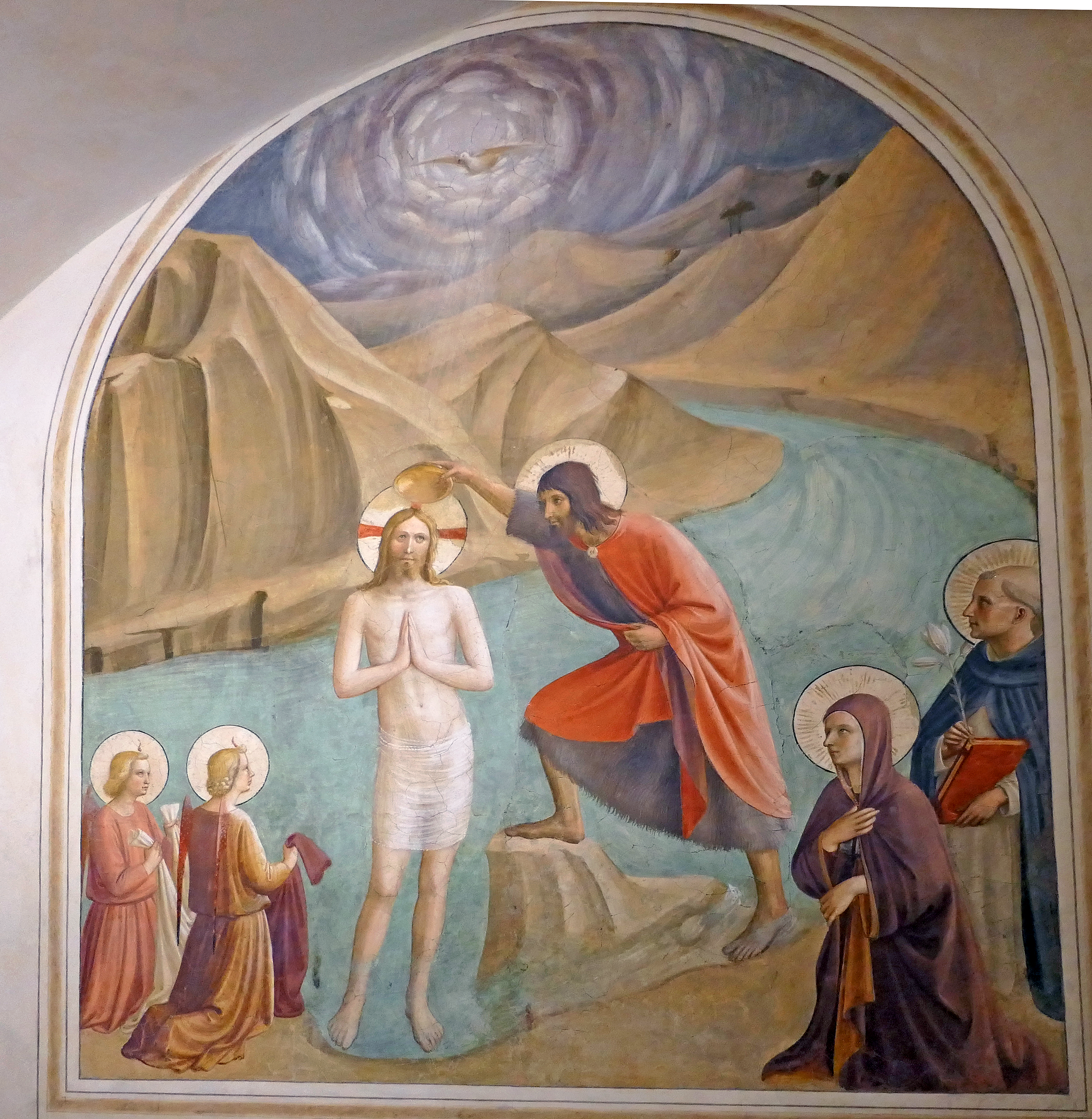
The Baptism of the Lord, Fra Angelico c.1440, Convent of St. Mark, Florence, Italy.

After Jesus was baptized, he came up from the water and behold, the heavens were opened for him, and he saw the Spirit of God descending like a dove and coming upon him. And a voice came from the heavens, saying, “This is my beloved Son, with whom I am well pleased.”    Matthew 3:16-17.

Click here to read today’s Sunday Mass Readings.

Click on words highlighted in red for further information.

The baptism of the Lord marks the beginning of his ministry, the reason why God had sent him to earth. It is possible that Jesus until then had no real idea what God expected of him. He was probably a carpenter as was the man who had adopted him; that would be normal. But on hearing the activities of John, the wild one living on “locusts and wild honey” both specifically permitted in the book of Leviticus 11:22: All kinds of locusts, bald locusts, crickets, and grasshoppers and Leviticus 20:24, God’s promise of a land flowing with milk and honey. But it was unusual, even then. So I imagine that people became intrigued at this strange man, and came just to see what all the fuss was about, perhaps even Jesus (after all, John was his cousin!). Some must have thought John was the promised Messiah, as he was so intent on making sure that they did NOT think that by saying “I am not the Messiah” (John 1:20). But some did indeed follow him even down to today, an ethno-religious group called the Mandaeans. But Christian scripture is quite clear that he was not the Messiah, but all this does suggest that he did have a following. Into this mix of the curious came Jesus from Nazareth. And when John baptized him, everything changed, as you can see above, in the quotation from Matthew, today’s gospel. Two things happened. God’s Holy Spirit descended on him “like a dove”. And there came a voice from the heavens proclaiming that this man was “My beloved Son with whom I am well pleased.” Two events then, each highly significant. The Spirit of God anointed Jesus. In Hebrew the word is Messiah, and in Greek the word is Christos, both meaning “Anointed One”. Jesus therefore received his Vocation at that moment – he was the Messiah! Now it was his vocation to fulfill all the prophecies concerning the Messiah as proclaimed down through the centuries. The Messiah had, at last, appeared. Not only that, but the Voice from Heaven, clearly God’s voice, declared him to be his Son… Jesus then received his Identity. He was God’s Son clearly with the powers of God prove it! Not surprisingly Jesus had to figure out what had happened to him and what it all meant, hence the desert experience of 40 days and 40 nights. 

Among the thoughts and feelings and revelations and realizations that he must have gone through at that time, today’s first reading from Isaiah must have become real:

I, the LORD, have called you for the victory of justice,
I have grasped you by the hand;
I formed you, and set you
as a covenant of the people,
a light for the nations,
to open the eyes of the blind,
to bring out prisoners from confinement,
and from the dungeon, those who live in darkness.

– today’s first reading. And all the other prophecies must have presented themselves to him, including those of the Suffering Servant also in Isaiah. The glory and the suffering, the challenges and the fulfillment are all to be found in Scripture, and for a man tutored in the Scriptures of the Old Testament, such as Jesus, he would now apply them all to himself. His vocation, given to him by his Father and now strengthened by the Holy Spirit, was clear. 

One further revelation was present at Jesus’ baptism, that of the Blessed Trinity. Until that moment God was thought of as a single Omnipotent Being clearly responsible for all creation. At the moment of Jesus’ baptism, three clear elements appear, utterly unknown until that time: Father (the Voice from heaven), Son (declared to be such by the heavenly Voice, hence had to be the Father) and the Third Person, “as of a dove” descending upon the Lord, the Holy Spirit of God, anointing him as the Messiah. Thus began two thousand years of debate, controversy and argument as to the Nature of God following this event and the other allusions to it in Jesus’ history. Suddenly, God was revealed to be Three Persons, yet One God. This was an utterly new reality, unique in Judeo-Christian thought, rejected by the other Abrahamic faiths, but completely intelligible, though challenging, to Christian reality. The God of Love was at last revealed, the all-powerful generative essence of the Almighty. And we are, each and every one of us, is invited to respond in kind.

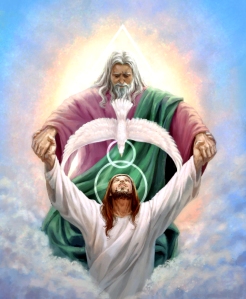
The Holy Trinity, ©LPi

IF YOU KNOW SOMEONE WHO WOULD APPRECIATE THIS REFLECTION, PLEASE FORWARD IT TO THEM.

THANK YOU.

©SundayMassReadings.com


SUNDAY 15 JUNE 2025: THE SOLEMNITY OF THE MOST HOLY TRINITY.

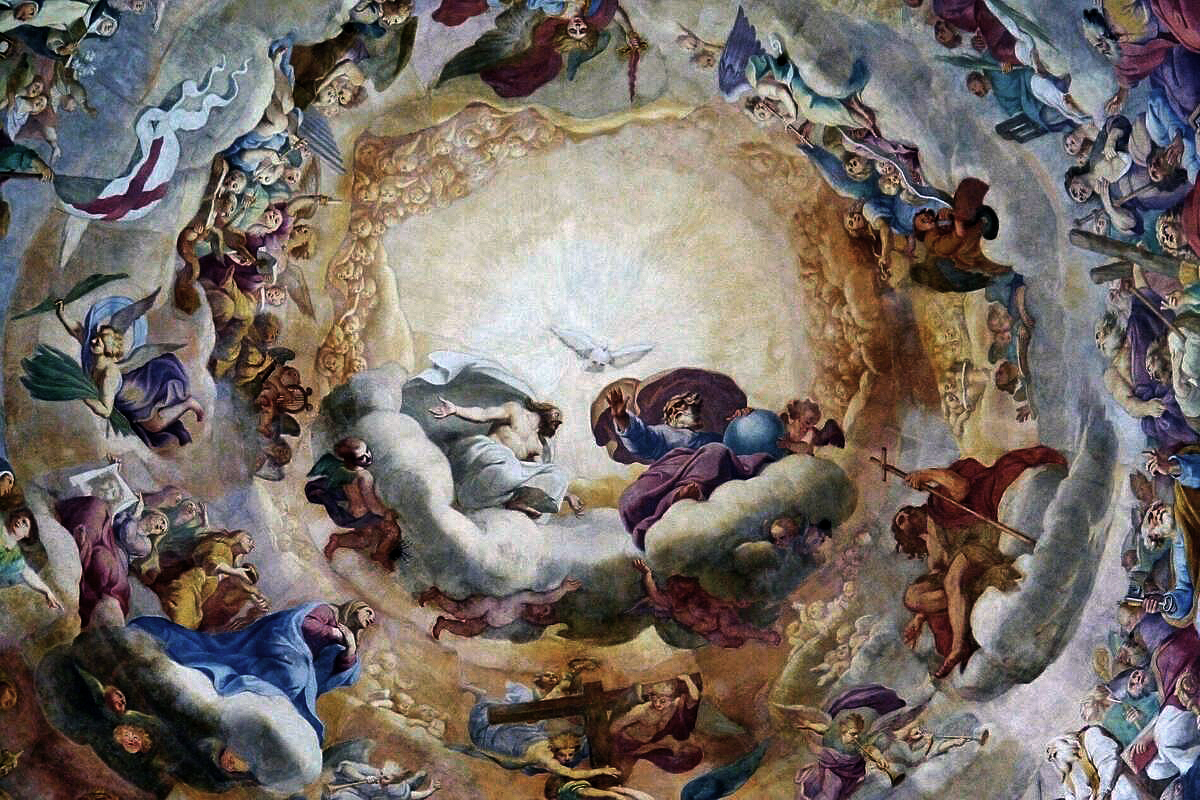
The Holy Trinity, Pierre Mignard c.1663, Church of the Val-de-Grâce, Paris, France.

[The Holy Spirit] will glorify me, because he will take from what is mine and declare it to you. Everything that the Father has is mine; for this reason I told you that he will take from what is mine and declare it to you.”     John 16:14-15.

Click here to read today’s Sunday Mass Readings.

Click on words highlighted in red for further information.

At the very deepest level of the beating Christian heart is its most profound mystery, the Holy Trinity of God. Christianity is a monotheistic faith, meaning a belief in one God, yet at its heart there are three persons, Father, Son and Holy Spirit – yet one God. Artificial Intelligence assures us that “thousands” of books have been written about this profoundest Christian mystery, theological, devotional, historical and academic. So it is, in a word, inexplicable. It rests on faith alone. If Jesus said it, it’s true. And he did. And buried right at the center of this mystery is its power: love. Now note that carefully; love requires, demands even, at least one other. Unrequited love is agonizing. It certainly isn’t love as it is understood. But when it is returned, the drab world is filled with color, you feel as though you are walking on air, there is one other person who means everything to you. The other person completes your life. It is perfection. For many it is God, the unfathomable depth of love present for all eternity, always present and always constant. And for many it is the person in this life with whom you want to spend the rest of your life. This love is life-enhancing, making everything in it tolerable and meaningful. It is the power which created everything, sustains it and gives it hope. It is the only reasonable explanation of how everything came to be, as love opens us up to the world and everything in it. If something is not perfect, love urges us to transform it into something acceptable and good. And only togetherness can do that. Hence the Holy Trinity must be at the heart of all that is good and beautiful. Yes, one God, so united that the three persons had to share their love with others – with us. They provide the template of perfection against which we can measure everything. And if lacking, it is to the Trinity that we can call and receive guidance and help. True love freely gives, asking nothing in return. 

It was through the centuries that God slowly revealed this profoundest mystery of the Christian faith. The Father intervened in human history with the call of Abram/Abraham. Through the centuries we humans slowly understood that this God was open to relationship, beginning with the revelation of the God’s holy name, Yahweh, I Am Who Am to Moses (Exodus 3:14). The arrival of Jesus in our midst exemplified all the qualities revealed as divine through the pages of the Old Testament. Taking the ideal of relationship, for example, to a numinous level, Jesus at the Last Supper declared basic human food, bread, to be his body, and we were to take and eat it. This was relationship at its ultimate: we take the Lord into ourselves! Complete union! The Holy Spirit is the power which has enabled everyone since that time to participate in the Lord’s Supper, beginning with the miracle of Pentecost, celebrated last week, down to today. And at each Mass, God’s Holy Spirit is called to descend on the gifts of bread and wine so that they become the body and blood of the Lord himself. It is the ultimate sharing, the love of God coming to us, transforming the simple realities of bread and wine into the real presence of God. God gives his very self to us! 

Now at this point I ask you to look at the notes from last week, the feast of Pentecost, which refer to the gender of the words which refer to the Holy Spirit. All of them are feminine in the language of Jesus, Aramaic (as well as in Hebrew). Whenever the Holy Spirit of God is invoked in the Hebrew Testament, she is always referred to as she! Now I say this to make a point. We, each and every one of us, were conceived in the womb of our mother. Most of us grew up amid a welcoming and loving family which nurtured us and created the foundations on which we stand for life. I know this does not apply to everyone, but I think my point still holds. The Holy Trinity without the feminine principle present seems hollow to me. Our whole experience of life requires a feminine presence. We all of us exhibit male and female traits. Consequently the question arises, where did they all come from? If the Holy Spirit is constantly referred to as “he” there is an awning empty space somewhere. Look at today’s gospel and compare it to this:

But when she comes, the Spirit of truth,
she will guide you to all truth.
She will not speak on her own,
but she will speak what she hears,
and will declare to you the things that are coming.

She will glorify me,
because she will take from what is mine and declare it to you.

And when Jesus spoke these words, he used the Aramaic word for Spirit (also meaning breath and wind), רוּחַ pronounced “roo-akh” which is feminine in gender, so Jesus’ words would have sounded like the revised gospel above! And if you add that feminine presence or reality to the Holy Trinity, surely it must reflect our experience much more realistically. The Father and the Spirit forever creating the Son, the incandescent eternal presence of creative, sustaining love. And that is the reality we are celebrating today! And one final word: in Hebrew the word for truth, אֱמֶת, emet, is feminine, and is composed of the first, middle and last letter of the Hebrew alphabet; but in Aramaic, it is שְׁרָרָא, sherara, meaning tightly bound, and is masculine. But it also means umbilical cord… 

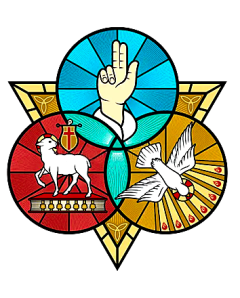
The Holy Trinity, Most Holy Trinity Catholic Church, Covington, Louisiana, USA.

© SundayMassReadings.com

SUNDAY 26 MAY 2024: THE SOLEMNITY OF THE MOST HOLY TRINITY.

Holy Trinity, Feael, no date.

Click here to read today’s Sunday Mass Readings.

[Jesus said], “Go, therefore, and make disciples of all nations, baptizing them in the name of the Father, and of the Son, and of the Holy Spirit…”    Matthew 28:19.

Click on words highlighted in red for further information.

In the year of Our Lord 325 in the ancient city of Nicaea, now the city of Iznic in Türkiye (the new name for Turkey), to the south-east of Istanbul, the Emperor Constantine, recently converted to Christianity, called a meeting of the Christian bishops of the whole church to settle certain questions which were tearing the new church apart. He wanted a peaceful Christianity where all believed the same thing, and worked and worshipped peacefully together (which would also allow him to rule more comfortably and strongly). Paganism was still a major force, and a divided Christianity might well collapse faced with any renewed pagan strength. One of, if not the, principal questions to be asked and answered was Who is God? Although that might seem to be an easy question, it was not. Take, for example, God’s statement in the 26th verse of the first chapter of Genesis: “And now we will make human beings; they will be like us and resemble us” So the question is, who are they if there is only one God? Then there was the question of the Son, Jesus. Was he created by the Father and so had a beginning, or was he “begotten” by the Father from his own being, therefore having no beginning. That dispute, actually a major fight, led to a heresy called Arianism, which claimed Jesus had a beginning rather than being eternal. That was the sort of dispute Nicaea was called to settle. The final document was called the Nicene Creed, the one recited at every Sunday Mass to this day. The question of the Holy Spirit was left to later councils, though considering the final words in today’s gospel reading, there is a clear equality with all Three Persons. That marked the beginning of the doctrine of the Holy Trinity. Last week’s readings were all about love. The nature of love is to be returned. Unrequited love, which is love not returned, is a very painful experience. So the Three Persons in One God are able to love, because it can be returned. With a One-Person God exclusively, that would be impossible: the thought of I love Me (One God) is something we Christians would have much trouble with. It is the nature of love to be returned from another person, certainly possible with one God of more than one Person, impossible otherwise. In fact, that love is so strong that it gave birth to all of us, children of God. Consequently, we are each asked to return that love to our Creator. There is a song which echoes that idea: Love isn’t love ’till you give it away – but true love really has to be returned! There is one other element to be considered when thinking of the Holy Trinity (and those of you who have followed this webpage know what is about to be said). The word spirit in English comes from the Latin word spiritus. The -us ending in Latin means the word has a masculine gender. The Christian Scriptures were all originally written in the Greek that was spoken by everyone in the first century, called koine Greek. In that language, the word, translated as spiritus in Latin, is pneuma, πνεῦμα. We get words such as pneumatic (filled with air) from it. But in Greek that word is neuter, not masculine, not feminine, but neuter. So in English, we would refer to πνεῦμα as “it”. Not acceptable when referring to the Third Person of the Blessed Trinity! Πνεῦμα is a translation of the Hebrew word for spirit, רוּחַ, pronounced ruach (the ch pronounced as in Scottish “loch”). Now, note, in Hebrew the gender of this word is feminine, as is the Hebrew word for wisdom. The word also means breath or wind. So, for example, if Jesus heard us saying “he” for God’s Holy Spirit, he would be as astonished as us hearing “she” for the Holy Spirit! But doesn’t “she” sound better, fuller when considering the Holy Trinity than simply three “he’s”? And that’s the way it should really be. Consequently, the Holy Spirit of God can be considered a she!  With that in mind, look with new eyes on the greatest Christian mystery of One God, Three Persons. Father and Spirit eternally uniting to beget the eternal Son. That makes much more sense, especially as each of us is invited into that eternal loving circle, as true love is never exclusive; it spreads out and invites all to enter in. Although God really cannot be tied down to our human definitions, it does help to link our human experience to the nature of God, and see that even with such limited eyesight, we are perhaps more able to enter the mystery of the Trinity. With that, it is so much easier to consider the complete unity of the Trinity, bound together in love, inviting each of us into that embrace. And the Spirit, revealed in the gospels both as “like a dove” at the baptism of Jesus, and “as of flames of fire” at Pentecost, gives us a total horizon of the nature of God’s Holy Spirit, strong, life giving and gentle, easily uniting the nature of femininity with the Father of creation and the Son of redemption. Glory be to the Father and to the Son and to the Holy Spirit inviting each of us to enter that embrace of love and light and remain in eternal happiness there forever.

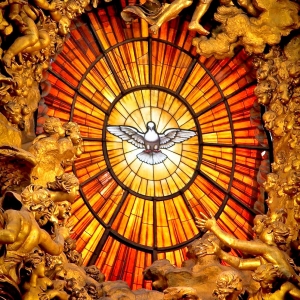
The Holy Trinity, Dreamstime.

PLEASE FORWARD THIS REFLECTION TO THOSE YOU THINK WOULD APPRECIATE IT.

THANK YOU.

Reflections on next Sunday’s Mass Readings will be posted on Wednesday.

Please send your reactions to: RogerJohn@aol.com

© SundayMassReadings.com