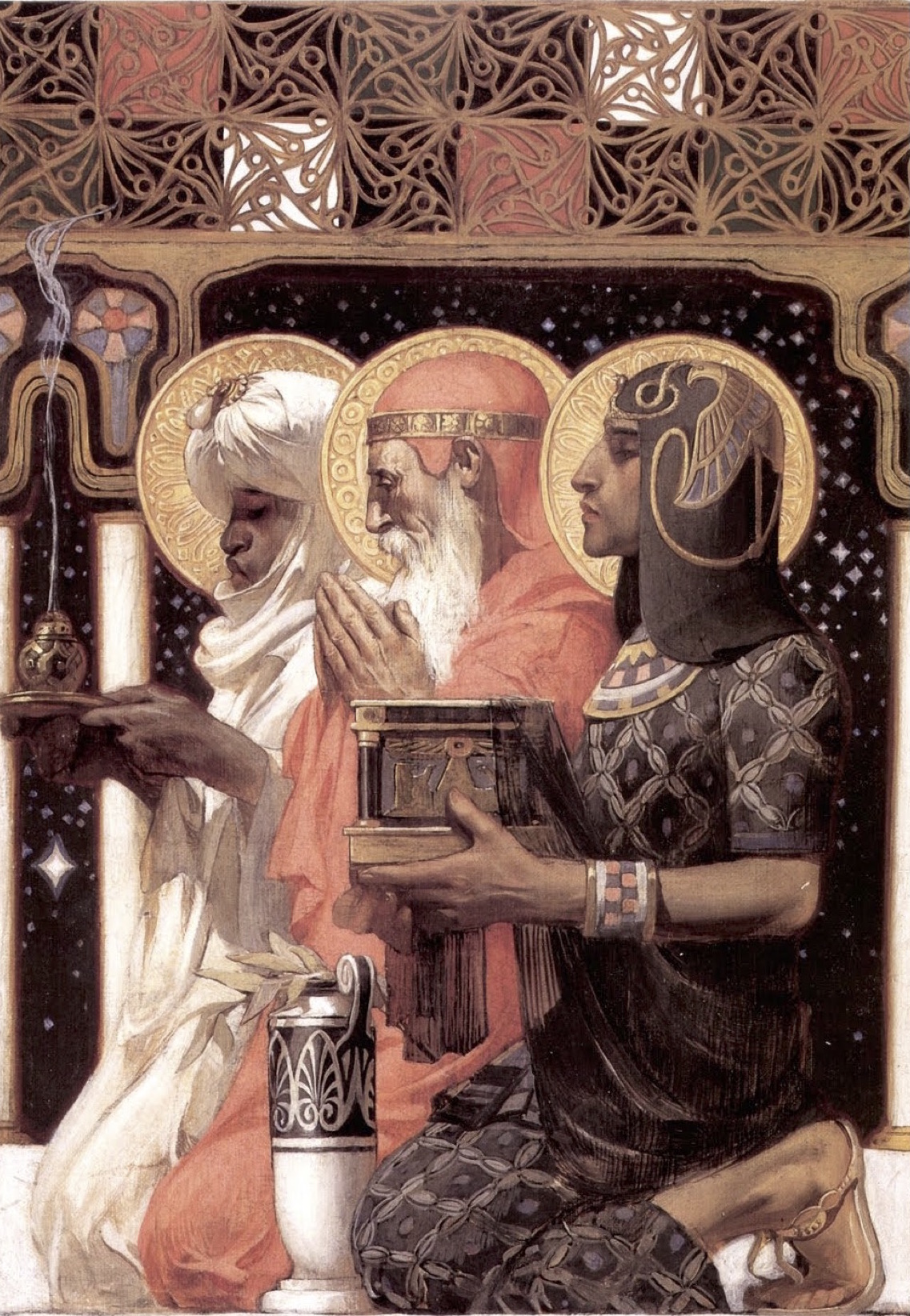
The Three Magi, J.C. Leyendecker, Success Christmas 1900, Diocesan Library of art.
When Jesus was born in Bethlehem of Judea, in the days of King Herod, behold, magi from the east arrived in Jerusalem, saying, “Where is the newborn king of the Jews? Matthew 2:12.
Click here to read today’s Sunday Mass Readings.
Click on work highlighted in red for further information.
The question which might spring to mind today could be: “What on earth are Magi”? Every year on this feast day we might well ask the same question. That word never seems to come up in any other context except today’s feast. You might think that today is the only time such a question arises. But that would be technically wrong. The word “magic” comes from the same source! The word crept into English through a complicated history. The origin is not Latin or Greek; it comes from an ancient Persian word maguš, pronounced magus, or, some scholars say, mayus. It originally referred to the priestly caste in the ancient religion called Zoroastrianism, currently called Parsees, possibly meaning a sense of power or ability. Read all about that here. So it seems as if the event of the Three Wise Men has been taken from an eastern tradition of wisdom and, as with many things centuries ago, astrology. Certainly with them following a star which rested above the stable where Jesus was born, strongly suggests a thorough knowledge of astronomy and the sky at night, plus a tradition of interpreting it all to a contemporary audience. And this is pretty remote from “Three Kings” story in the Gospel. But clearly there was an expectation, which exists to this day, of “wisdom from the East” and, incidentally, to the clear, uncanny and evident skill of a good magician, able to do things which are apparently impossible and point to a skill and talent not often met with. And note in all this not a mention of kings! That seems to have come from the apparent cost and quality of the three gifts (from which also comes the tradition of three visitors to the stable but not actually mentioned in the Bible, and as for their gifts, look here). One more point; the visitors were clearly not Jewish and scholars have linked this to the universal message of Christ, open to all and inviting to all, from the very moment of his birth, from the best educated, the wise men, to the lowest station in society, the shepherds. No-one is excluded from the message of the Lord!
These themes are echoed in the other readings today, from Isaiah:
Nations shall walk by your light,
and kings by your shining radiance.
Raise your eyes and look about;
they all gather and come to you:
your sons come from afar….
to Paul’s letter to the Christians in Ephesus that God’s grace:
has now been revealed
to his holy apostles and prophets by the Spirit:
that the Gentiles are coheirs, members of the same body,
and copartners in the promise in Christ Jesus through the gospel.
So all are welcome at the table of the Lord, no exclusions, no conditions, even the illiterate to the brightest in the land! It is an open invitation, but it does need those of us who cherish this life-saving call to goodness to spread the Word. We can do this above all by the example we set in daily living, in what we say, in what we do and in being generous and open to all. If you want magic today, that is the way to do it, but not through trickery, but by the real demonstration of goodness in our life. And we are never alone in doing that. We have the Lord at our side, the Lord in our mind and heart, and in the strength we show in living as He wants us to live and gives us the strength to do it.
Anne Rice.
DO YOU KNOW SOMEONE WHO WOULD LIKE THIS? PLEASE FORWARD IT TO THEM.
THANK YOU.
Reflections on next Sunday’s Mass Readings will be posted on Wednesday.
Please send your reactions to: RogerJohn@aol.com
©SundayMassReadings.com
 Sunday Mass Readings