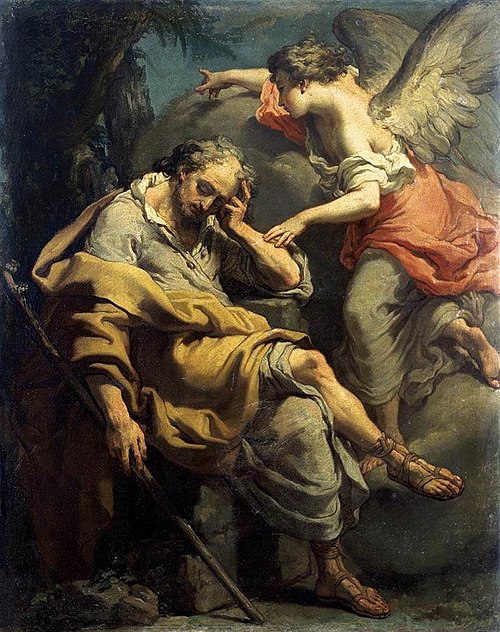
Joseph’s Dream, Gandolphi c.1790, Private Collection.
…the angel of the Lord appeared to him in a dream and said, “Joseph, son of David, do not be afraid to take Mary your wife into your home. For it is through the Holy Spirit that this child has been conceived in her. She will bear a son and you are to name him Jesus because he will save his people from their sins.” Matthew 1:20-21.
Click here to read today’s Sunday Mass Readings.
Click on words highlighted in red for further information.
This is the first mention of our Savior’s name in the gospel, and it was a frequent and acceptable name for a boy. In the original Hebrew/Aramaic that Jesus spoke, his name is יֵשׁוּעַ transliterated to Yeshua (Ioshua or Joshua in English). Our name Jesus comes through the Greek, in which the entire New Testament is written. Yeshua becomes Ἰησοῦς or Iēsous, as the “sh” sound is unknown in Greek. The nearest equivalent was “s”, from which we get Iēsus in English. I and J are historically close in English; the first edition King James version of the Bible called him Iesus and even Shakespeare originally called his play Romeo and Iuliet. However, the consonant I became J at that time, hence Jesus. The name means God Saves. In today’s gospel, Joseph had discovered that Mary was pregnant and was about to separate from her quietly, hence the heavenly messenger. That changed everything, as Joseph was prepared to accept the unique situation he found himself in and act accordingly. He possibly thought that this had been prefigured in the 7th chapter of the Book of Isaiah, read at today’s Mass: “Therefore the Lord himself will give you this sign: the virgin shall conceive, and bear a son, and shall name him Emmanuel”. Hence he accepted his role in the fulfillment of this prophecy, and responded to God’s call fully and without hesitation. It is interesting that biblical scholars note that prophecies might have had at least two meanings, one dealing with the immediate time and place it was proclaimed, and then another, such as here, centuries later.
So this 4th Sunday in Advent would seem to be an occasion of prophetic fulfillment. Isaiah talks of the maiden giving birth to a son, Paul talking about the Son of God descended from David long promised by the holy prophets, and the gospel emphasizing the Isaiah prophecy once more, as if to underline the fulfillment of those words in Mary, to be protected and supported by Joseph. In other words, the birth to be celebrated this week is the culmination of centuries of waiting and centuries of prophetic utterance at last to be realized.
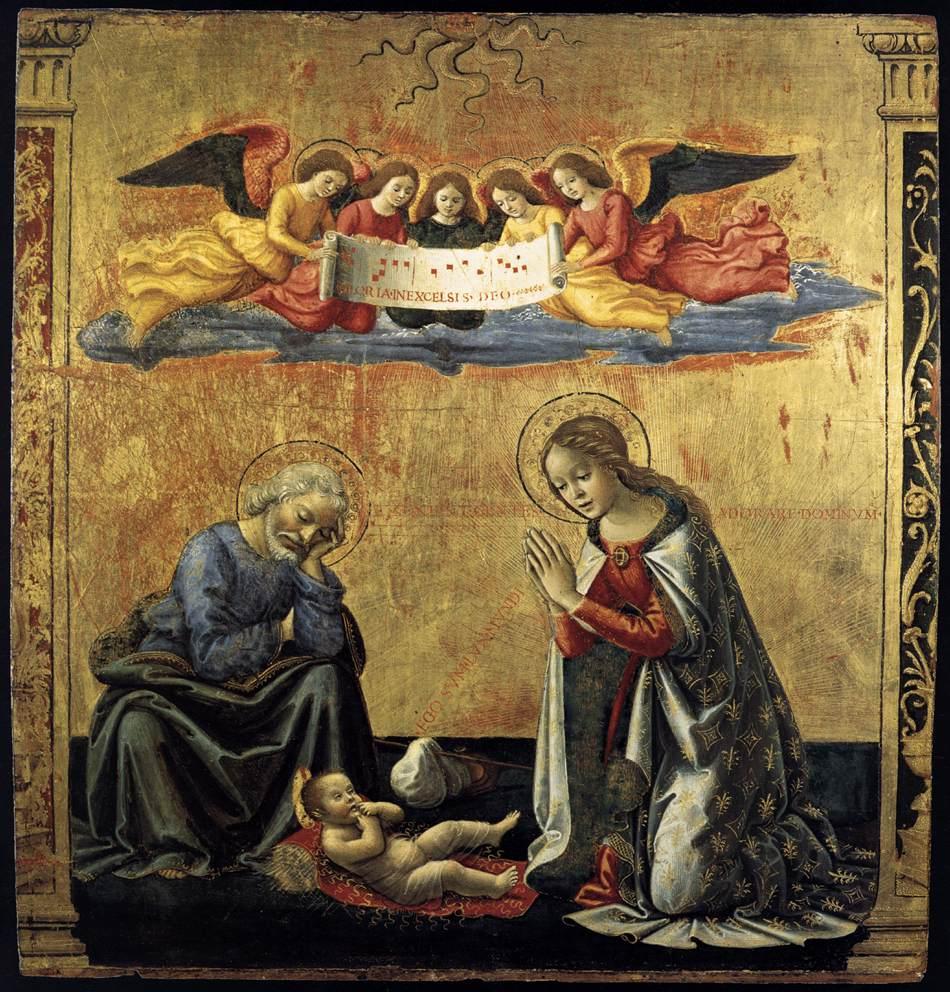
The Nativity, Domenico Ghirlandaio c.1492, Vatican Museums, Vatican City State.
THURSDAY 25TH DECEMBER 2025: THE NATIVITY OF THE LORD (CHRISTMAS).
CLICK HERE TO READ TODAY’S CHRISTMAS DAY MASS READINGS.
And the Word became flesh and made his dwelling among us, and we saw his glory, the glory as of the Father’s only Son, full of grace and truth. John 1:14.
Click on words highlighted in red for further information.
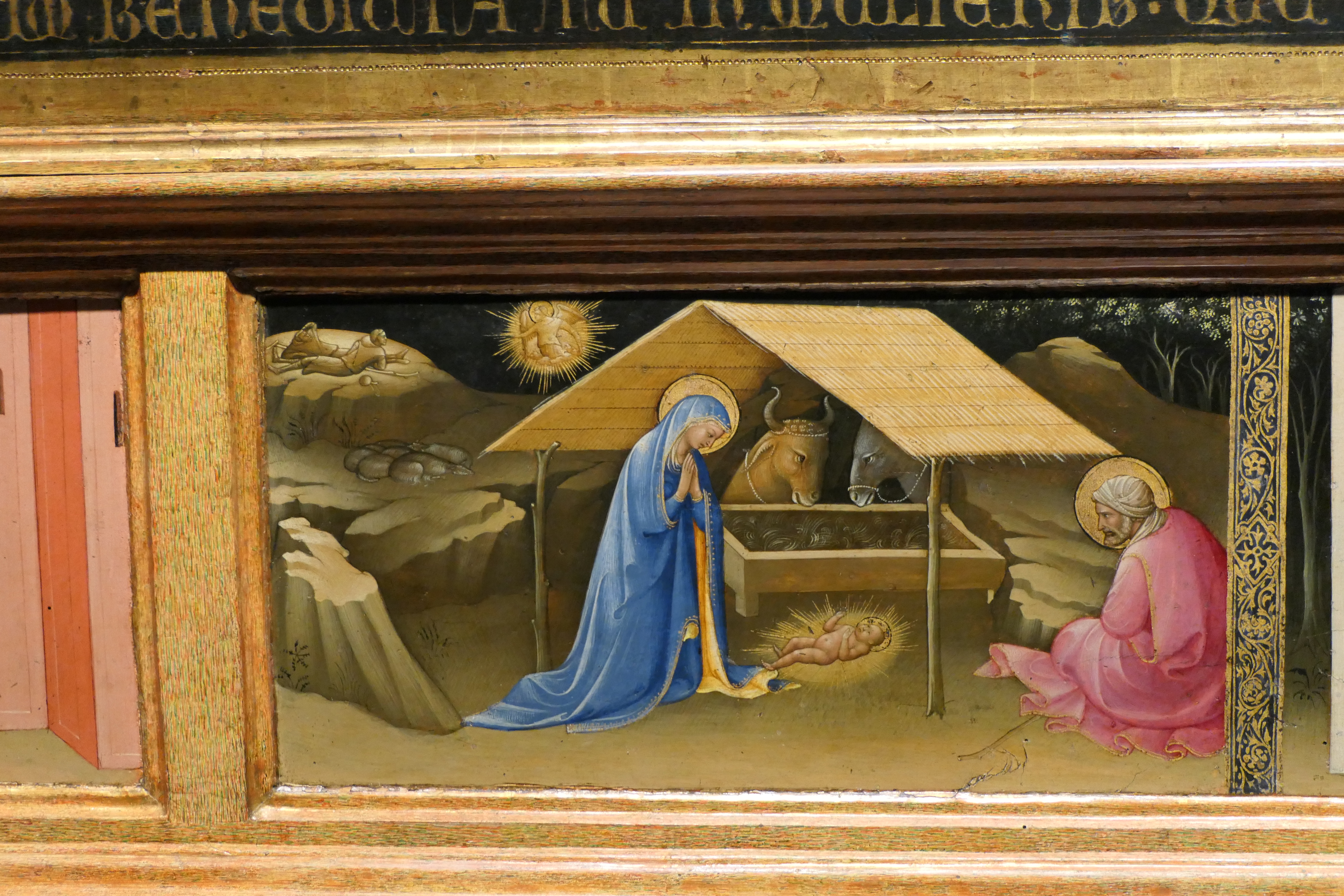
And so, on this wondrous night, the heavenly angels sang, the shepherds were overwhelmed, and the unbelievable happened: the Son of God became flesh. After 2000 years of preparation, the Hebrew people found in their midst the Son of God, born of a Virgin, yet in poverty. His cradle was a feeding trough, the witnesses humble shepherds of the fields and beasts stabled in a barn. Yet here was the baby whose birth was to transform the world, give it hope, inspire countless millions to aim for perfection and adopt a lifestyle of care for others. From the time of Abraham, the Hebrew people, who originally had no idea who and what God was like, had become aware of a God who was powerful, from the very beginning seen in a very old Sarah giving birth to Isaac at the age of 90. God was revealed to be loyal, even to Hagar after she was expelled from Abraham’s camp (Genesis 21:9-21) ; forgiving even to Jacob who cheated his way to getting his father’s blessing meant for Esau; a listener who heard the cries of the Hebrew people enslaved in Egypt arranged for their release. God revealed mercy, seen when the Hebrews, wandering in the wilderness for 40 years and complaining and moaning about their lot (they had been released from slavery in Egypt, hence revealing that God was also a lover of freedom) were still protected by God, and eventually arriving in the Promised Land which was to be their home. And above all, something which separated Israel’s God from all others, the God of the Hebrews was open to relationship, seen in the mutual pact between God and Moses at the Burning Bush. So by the time of the birth of Jesus, the Jewish people knew a great deal about God, but in the ups and downs of their history needed to know how to live the life which reflected all those qualities. Indeed they might have thought it was impossible to live such a life! And hence the arrival of the Lord, who did exactly that. He showed us all how to incorporate all of God’s qualities in our own life, and gave us the Holy Spirit as the ultimate source of strength to accomplish that. And this day saw the start of the final story, with Jesus, the Son of God preparing the way for the Spirit of God to guide us down to today. Alleluia! May God bless us, every one. Have a very merry and blessed Christmas.
IF YOU KNOW SOMEONE WHO WOULD APPRECIATE A CHRISTMAS THOUGHT, PLEASE SEND THIS TO THEM.
THANK YOU
Reflections on next Sunday’s Mass Readings will be posted on FRIDAY.
Please send your reactions to: RogerJohn@aol.com
©SundayMassReadings.com

 Sunday Mass Readings
