
The Good Shepherd mosaic, 5th century, Mausoleum of Galla Placidia 2015, Ravenna, Italy.
Jesus said: “My sheep hear my voice; I know them, and they follow me. I give them eternal life, and they shall never perish.” John 10:27-28.
Click here to read today’s Sunday Mass Readings.
Click on words highlighted in red for further information.
The image above, created in the 5th century, making it over 1500 years old, shows a beardless Christ amid a pastoral scene of peace and abundance. Christianity was made legal in 313AD with the promulgation of the Edict of Milan. Between the time of Jesus and 313, the Christians had been hounded, persecuted, torn to pieces by the teeth of lions, and occasionally left in peace, so that, once the Edict was proclaimed, there was little idea of what a Jewish Jesus would have looked like. Hence he is seen here as a beardless young man, the Roman fashion of the time, amid a peaceful, luxuriant landscape completely removed from the Holy Land which is more desert than abundantly green! Also, Jesus as the Good Shepherd was by far the most popular image of the Lord for the next 100 or so years. Almost all the first representations of Jesus that we know of him are as the Good Shepherd. A crucified Lord was not the image those recently legalized Romans wanted to proclaim. A bearded Jesus began to appear later, possibly connected to the appearance of the image on the Shroud of Turin in the Byzantine Empire in the 6th century. But the point of all this is to cast light on the image created by the Lord in today’s gospel: Jesus said: “My sheep hear my voice; I know them, and they follow me.” In other words, Jesus is the Good Shepherd. Now for years I have been writing about how dumb sheep are, unable to learn to avoid mishaps, blindly following the leader, timid and easily frightened, and so on. Well, I was wrong. Although not as bright as dogs or pigs, they are, apparently, the equal of cows and other domesticated animals. So when Jesus called us his flock of sheep, there was no scantily disguised insult there. We are bright, other oriented, mutually helpful, even empathetic and exhibiting all the other qualities that the first hearers of today’s gospel would be familiar with, but we, today, are not. So it comes as a relief to know that we are intelligent creatures, treasured by our Shepherd who protects and loves us are cares about us to the extent of giving his very life for us.

Christ the Good Shepherd
And then there is the Lamb of God. It was John the Baptist who identified Jesus as such (John 1:29). There is a touch of pure innocence and life in a multitude of lambs together. Then there is the theological significance of the lamb slaughtered to ensure the protection from the angel of death, the 10th plague of Egypt, its blood therefore signifying life, not death. The blood on the Hebrew doorposts meant death would not enter their households. And the early Christians quickly came to the understanding of the full meaning of John the Baptist’s recognition of Jesus as the totally innocent lamb who would take away the sins, the corruption and death of the world. Its innocence would conquer everything! “Behold the Lamb of God, behold him who takes away the sins of the world….” That innocent Lamb’s blood washes our sinful souls white. And this from today’s second reading: For the Lamb who is in the center of the throne will shepherd them and lead them to springs of life-giving water, and God will wipe away every tear from their eyes.” Plenty for us to consider this Sunday, much to understand and apply to ourselves, and much to be thankful for.
The symbolism of sheep and lambs is very old in Scripture. Apart from dogs, apparently domesticated 20,000 years ago, sheep are thought to have been among the next animals to be domesticated, perhaps about 10,000 years ago, probably in Mesopotamia. They were noted for their lack of aggression, they were of a size which was easily manageable, they had fast sexual maturity, a noticeable preference for good social behavior and a high reproduction rate, all of these being desirable qualities for domestication. Of course, their fleece and as a source of food made these animals highly desirable on many levels. Hence they became a symbol of wealth for their owners. Remember the legend of the Golden Fleece from ancient Greece, a symbol of wealth and strength, and the source of one of the most ancient honors in Europe:
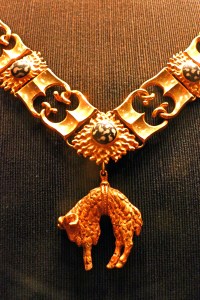
The Order of the Golden Fleece, founded 1430, Schatzkammer, Hofburg Palace, Vienna, Austria.
But those who cared for them, the shepherds, were considered to be among the lowest in society. Remember that the prophet Samuel, sent by God to Bethlehem to seek a king to succeed Saul from Jesse’s sons, did not find him among the seven young men presented to him. Samuel, probably rather sheepishly, as it were, asked Jesse if he had any more sons. Yes, David, the youngest, who therefore had been sent to take care of the sheep, the traditional job of the youngest. And God chose him. So shepherds in the Bible were both lowly and yet kingly! And then there is Jesus, both lamb and shepherd: “For the Lamb who is in the center of the throne will shepherd them and lead them to springs of life-giving water…” from today’s second reading from the Book of Revelation. Here is the summation of the image, sacrificial Lamb and Shepherd protector and guide, both images found in the Lord Jesus. He is the perfect shepherd, willing even to give his life for the redemption of his flock’s souls, such is his love for us. No greater love can be conceived.

Ghent Altarpiece: The Adoration of the Mystic Lamb, Hubert and Jan van Eyck 1432, St. Bavo’s Cathedral, Ghent, Belgium.
LET US GREET OUR NEW POPE, Pontifex Maximus, Servant of the Servants of God:
Robert Francis Prevost:
POPE LEO XIV

We are in the first days of the new pope, and we eagerly await the signs of what the new pontificate will be like. We probably will not have to wait long! Leo XIII, who seems to be the inspiration of our new pope, was a courageous man. He championed the cause of the worker, demanding just wages for honest work. He approved of trade, labor, unions, something unheard of from a Catholic leader. And he was the first pope to be filmed. And looking at these two men, they could well be identical twins! Let us pray for the new pope and ask God to strengthen and guide him as he takes on this most challenging rôle.
IF YOU KNOW SOMEONE WHO WOULD FIND THIS REFLECTION ON TODAY’S READINGS TO BE HELPFUL, PLEASE FORWARD IT TO THEM. THANK YOU.
Reflections on next Sunday’s Mass Readings will be posted on Wednesday.
Please send your reactions to:
© SundayMassReadings.com


 Sunday Mass Readings