SUNDAY 7 APRIL 2024: THE SECOND SUNDAY OF EASTER: SUNDAY OF DIVINE MERCY.

The Incredulity of Thomas, Caravaggio c. 1601, Sanssouci Picture Gallery, Potsdam, Germany.

Click here to read today’s Sunday Mass Readings.

[Jesus] said to Thomas, “Put your finger here and see my hands, and bring your hand and put it into my side, and do not be unbelieving, but believe.” Thomas answered and said to him, “My Lord and my God!”       John 20: 27-28. 

Click on words highlighted in red for further information.

How appropriate that Divine Mercy Sunday and today’s gospel go together! Thomas, in this gospel, stands for almost every one of us. Who would not have said “I don’t believe it” when told Jesus had been seen alive? He had been crucified, a spear slammed into his side, gubernatorial permission had been given to take the body down and it had been sealed in a stone tomb. Jesus was, quite simply, dead. Now it is not uncommon for someone crushed with grief will experience bereavement hallucinations, an acute sense that the deceased is present in some way. It is possible Thomas thought that his colleagues were undergoing exactly that. And frankly, who can blame him? It was utterly unknown for anyone to come back from the dead. It was unthinkable. Desirable – yes – but impossible. So Thomas was thereby given the epithet “Doubting” ever afterwards, or, more intellectually, incredulous. I suspect most of us would be able to stand in his shoes without much difficulty.

My preferred definition of mercy is “compassion on someone who does not deserve it”. There are more intellectual definitions, but that is my favorite. Jesus’ treatment of his doubting follower is exactly that. If Thomas truly believed that Jesus was the Son of God, which was confirmed by God’s voice at Jesus’ Transfiguration before his closest followers, he could at least have declared that to be desirable but remote possibility. But no: “Unless I see the mark of the nails in his hands and put my finger into the nail marks and put my hand into his side, I will not believe.” Pretty clear, and, indeed, understandable, but…. Then the Lord appeared in their midst, and without any hesitation went directly to Thomas and invited him to test the reality of his physical presence. Now Scripture is silent about Thomas’ response to Jesus’ invitation (unlike just about every artist who has depicted this scene). I rather think he did not examine Jesus’ terrible wounds. The simple presence of the Lord, whom he basically claimed was dead moments before, must have overwhelmed him. Indeed, he then declared Jesus to be his Lord and his God. That is the one and only time Jesus is so addressed in all Scripture. Jesus’ silence declares his assent to such a declaration. But there he was, the Son of God, physically present with his followers after having been laid, dead, in a tomb only days before. The Resurrection the bedrock of our faith, the sine qua non of our religion. Without that unique event, there would be no Christian religion. Everything depends on it. So, in a sense, we are all Thomas, wondering, perhaps doubting, but in the end accepting this divine reality of God’s direct intervention in our world, in our life, in our soul. And we follow the one person who conquered death itself, and invites us to do as he did, and in so doing, gaining eternal happiness and fulfillment. So let us all declare, with Thomas, Jesus to be Our Lord And God. And on this Divine Mercy Sunday, let us ask God for the patience, love and strength to be as merciful as he was, and is, to all who seek him, that we might do likewise.
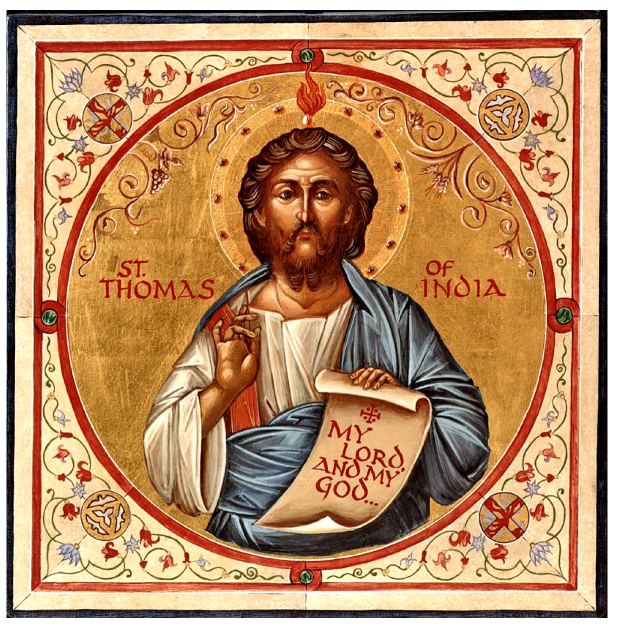
St. Thomas of India, Trinity Iconography Institute, Portland, OR, USA.

There is a very old tradition that St. Thomas brought the Christian religion to India.

Read here for more.

PLEASE FORWARD THIS REFLECTION TO THOSE YOU THINK WOULD APPRECIATE IT.

THANK YOU.

Reflections on next Sunday’s Mass Readings will be posted on Wednesday.

Please send your reactions to: RogerJohn@aol.com

© SundayMassReadings.com

SUNDAY 31 MARCH 2024: EASTER SUNDAY: THE RESURRECTION OF THE LORD; THE MASS OF EASTER DAY.

The Face on the Shroud of Turin: Taken by many to be the face of the Lord at the moment of Resurrection.

[Peter said], They put him to death by hanging him on a tree. This man God raised on the third day and granted that he be visible, not to all the people, but to us, the witnesses chosen by God in advance, who ate and drank with him after he rose from the dead.     Acts of the Apostles 10:39-41.

Click here to read The Easter Sunday Mass Readings.

Click on words highlighted in red for further information.

On this day our Greek Christian brothers and sisters do not say “Happy Easter” to each other, rather they say Christos Anestē (Χριστός ἀνέστη) Christ is risen! To which the response is Alēthōs Anestē (Aληθῶς Aνέστη), He has truly risen! So much closer to the most tremendous event in human history than the lame, non-Christian, word, Easter which parallels the German word Ostern, and is of uncertain origin. (One view, expounded by the Venerable Bede in the 8th century, was that it derived from Eostre, or Eostrae, the Anglo-Saxon goddess of spring and fertility!). Almost all the other languages have a version of the Jewish feast of the time of the resurrection, Passover: Pasen (Dutch), Páska (Icelandic), Pâques (French), Pasqua (Italian). But not us English speakers! Ah well. Whatever it’s called, it is still the foundational event of Christianity, without which, nothing. Something happened in that enclosed tomb which changed the world. After suffering the most brutal death imaginable, Jesus conquered death and rose to live forever. And, what is more, he invites us all to follow him, no matter what death we go through. And consult the literature based on the Shroud of Turin, the most heavily studied artifact in history. I believe its revelations have even moved some scientists to convert! It’s almost as if the Lord knew that, at come point in history, its mysteries would be uncovered, such as its three-dimensional properties.

All that is very interesting, but what is this feast day all about? It is, perhaps, the reversal of the opening story in the Book of Genesis. The story of the first humans, Adam and Eve, and how they destroyed the perfect world they were invited into, and how they brought sin and death into the world. That strongly suggests that we humans are not designed for death, but for life! We are not supposed to die but to live in God’s presence forever. But being who and what we are, that was not to be. Given the greatest of gifts, our total freedom, we have chosen many times to use that gift in ways which are destructive and plain evil. Each one of us. So our freedom equated with death, the end of freedom. But that was not God’s plan. Originally the Garden of Eden was for us to be totally free, happy and fulfilled – and eternal! Having destroyed that possibility, the eternally merciful God in whom all our trust is placed, decided on another course. This can lead us all, should each one of us choose, to eternal life and happiness, back to the Garden of Eden. Through the centuries, first of the slow revelation of the nature of our God, seen in the Old Testament, the revelation of God the Father, and then with the actual presence of God’s Son among us, demonstrating how God wishes us to use our freedom with the gifts given us, we have a blueprint of human life in the present time of God the Holy Spirit, which can lead us to eternal happiness, should we choose. And today the author of that blueprint confirmed everything by rising from the dead, to prove that his example is definitive. No matter what is thrown in our way, no matter how much evil we have to face, if we follow his example in all things, we will join him for all eternity in joy.

So this day is the crucial proof of Jesus’ example of how to live our life. It’s not easy – look at what happened to him! But most of us will be spared such suffering, but even if not, perseverance is key. The vision of that serene face (above), triumphant over utter evil, should guide us through everything. We have the strength, through his body and blood given freely to us, to conquer death, as he did, on this day of days.

The Empty Tomb, Joseph Juvenal, no date.

PLEASE FORWARD THIS REFLECTION TO THOSE YOU THINK WOULD APPRECIATE IT.

THANK YOU.

Reflections on next Sunday’s Mass Readings will be posted on Wednesday.

Please send your reactions to: RogerJohn@aol.com

© SundayMassReadings.com