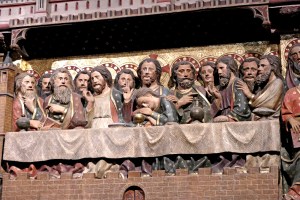
 The Last Supper, Cathedral of Notre-Dame de Paris, Paris, France.
Click here to read today’s Sunday Mass Readings.
Then he took the bread, said the blessing, broke it, and gave it to them, saying, “This is my body, which will be given for you; do this in memory of me.” Luke 22:19.
Click on words highlighted in red for further information.
The beginning of Passiontide, Holy Week, commemorates the triumphal entrance of Jesus into Jerusalem. Just as the prophet Zechariah had foretold, “Rejoice greatly, Daughter Zion! Shout, Daughter Jerusalem! See, your king comes to you, righteous and victorious, lowly and riding on a donkey, on a colt, the foal of a donkey” (9:9). The stories that had preceded Jesus, above all the raising of Lazarus from the dead just a few miles away in Bethany, seemed to put a seal on it; here, at last, was the Messiah long promised by God, come to rescue God’s people from oppression and evil. And Jesus was greeted as a king, with today’s special entrance gospel reporting the people as proclaiming, “Blessed is the king who comes in the name of the Lord. Peace in heaven and glory in the highest”. Their joy and hope could not be any greater! This was the man who would restore the kingdom of David and at last expel the hated, pagan Romans. And Jesus knew this and also knew what was to follow, and yet he allowed this delirious crowd scene to take place.
The Entry into Jerusalem, Lippo Memmi 1335-1345, Santa Maria Assunta, San Gimignano, Italy.
It is important to remember this scene, as it accounts for what happened next. After this event the people were waiting to be called to arms and led by God’s Messiah to military triumph and victory. It was the universal understanding of what the Messiah would do. All he had to do was summon them, and victory was theirs. Except, of course, he didn’t. In Zeffirelli’s rendition of Jesus of Nazareth, he has an imagined meeting of Jesus with Barabbas in the Temple a few days later, who asks him when the uprising will begin. Jesus says those who live by the sword will die by the sword, and more. The bewildered man does not see the Messiah he has imagined, but a man of forgiveness and mercy. And he rejects Jesus, as does the whole city who now begin to call for his death, so bitter is their disappointment in this man who had fooled them all. To have a fever pitch of enthusiasm crushed to a feeling of betrayal accounts for the call for his death, all in the space of a few days, especially as it was so close to Passover. Recall that Passover commemorated the release from slavery in Egypt, just as the Jews longed for release from the power of the Roman Empire over them. And the Lord knew this, yet he also knew that he had to remain true to his vocation, being Christ to the world, even if that meant proclaiming a message of love and forgiveness rather than a call to arms and warfare. It was a message that condemned him to a brutal death, driven by the bitter sense of betrayal held by the people of Jerusalem, encouraged by the chief priests who feared him. His image of the Messiah was the opposite of what everyone expected. So he had to die.
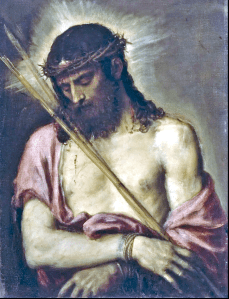
Ecce Homo (Behold the Man), Titian 1558-1560, National Gallery of Ireland, Dublin, Ireland.
So today marks the start of Passion Week, when each year we contemplate the fate of this wonderful man who had done nothing wrong and everything right, yet who was reviled, scourged and brutally nailed to a wooden cross because he did not fit the image of the Messiah that everyone expected. He was God’s Messiah, not the craven image of a man of warfare, physical strength and military victory. Jesus’ total commitment to his vocation – to show the real and true meaning of what it is to be human – resulted in disaster; until it became clear that it was all true. That to live as he did and act the way he acted results in a life of eternal happiness with God. And that is worth everything.

The Cross, pixers.
IF YOU KNOW SOMEONE WHO WOULD APPRECIATE THIS MESSAGE, PLEASE FORWARD IT TO THEM. THANK YOU.
Reflections on Mass Readings for the Sacred Triduum will be posted on Wednesday.
Please send your reactions to: RogerJohn@aol.com
© SundayMassReadings.com

 Sunday Mass Readings

