
Christ’s charge to Peter, Raphael 1516, Cartoon on Paper and Canvas, Victoria and Albert Museum, London, UK.
And [Jesus] asked them, “But who do you say that I am?” Peter said to him in reply, “You are the Christ.” Mark 8:29.
Click here to read today’s Sunday Mass Readings.
Click on words highlighted in red for further information.
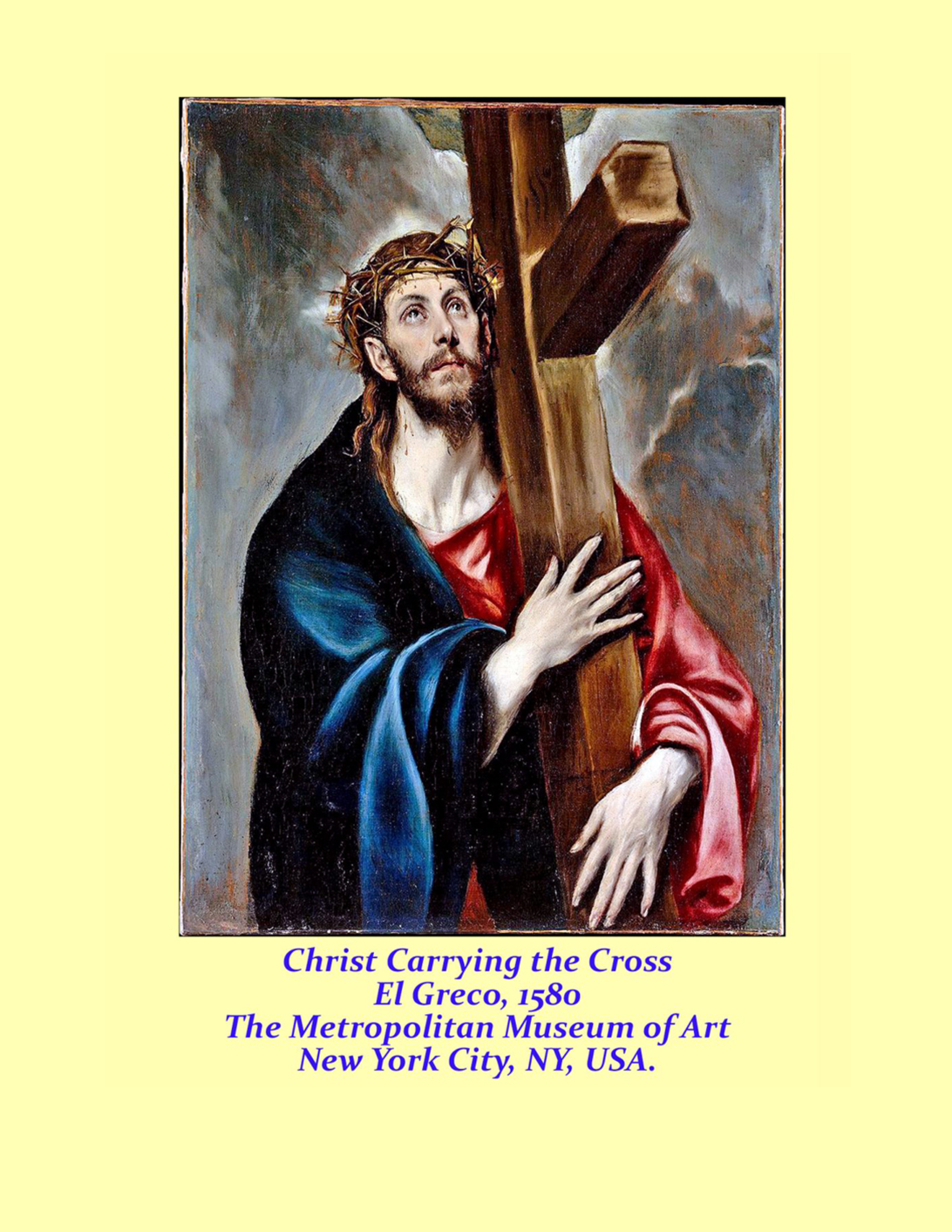
Remember that the words Christ and Messiah mean the same thing, translated as “Anointed” in English. So when Peter announced that he believed Jesus was the Anointed One, he meant that Jesus was the long-promised savior sent from God. And in the minds of almost all Jews at that time, he would be the one who would lead them back to the glory days of King David, evict the Roman, pagan, unclean occupiers of the Promised Land and inaugurate a glorious new era. After all, with a short interlude of independence, the Jews had been a conquered people for about 500 years by the time of Jesus. They were aching for a deliverer to throw off the yoke of their pagan conquerers. All that is important to understand the dramatic discourse between Peter and Jesus in today’s gospel. After all, Jesus’ silence after Peter’s recognition signaled agreement with Peter. But when he declared that he, Jesus, would suffer and be killed at the hands of their priestly leaders, Peter rebuked him and was then labelled “Satan” by Jesus! So clearly there was a severe clash of expectations here, Jesus predicting disaster, and Peter the glory that everyone expected of the promised Messiah. Jesus stating clearly that he “must suffer greatly and be rejected by the elders, the chief priests, and the scribes, and be killed…” was absolutely NOT what his followers were expecting. And Peter stated that clearly, though apparently out of the hearing of everyone else. But Jesus called him “Satan” for so doing. There was a striking difference in expectations here, one which would almost destroy Jesus’ ministry. But it is clearly what he envisioned for himself, and something he had to prepare his followers to anticipate.
What Jesus’ followers – and indeed almost the entire Jewish people to this day – did not accept can be seen in today’s opening reading from Isaiah, labelled the “Suffering Servant”. When Jesus examined the role of the Messiah during his sojourn in the desert following the revelation that he was the Messiah, and indeed the Son of God, at his baptism, he accepted that along with the powers of the godhead, seen in his power to cure suffering, the prophecies of Isaiah were integral to his vocation as Messiah. It was that revelation to his followers that caused such consternation. The Messiah was destined to suffer. Hardly anyone had linked the Suffering Servant prophecies of Isaiah to the long-promised Anointed One. To this day, our Jewish brothers and sisters reject that interpretation, and state instead that it is the nation of the Jewish people who must suffer (and indeed suffer they have). For them it is a communal prophecy, the personification of the Hebrew people, and not concerned with the One who is to come. Hence they still await the arrival of the Messiah. Yet from a Christian point of view, the parallels with Jesus’ suffering at the hands of the Roman guards and Isaiah’s words are unbearably close. But one can understand Peter’s total abhorrence as Jesus’ words which conflicted so strongly with the Jewish people’s hope for delivery from the Roman yoke. And Jesus’ reaction was just as strong: “Get behind me Satan!” It meant that despite everything, Jesus’ followers had not a clue about his understanding of who the Anointed One was, and what was going to happen to him. To believe as Peter did, Jesus would have betrayed his vocation. It was the same temptation he had experienced in the desert with the Devil offering him the glories of the world for a simple bow to the Prince of Darkness, the opposite of God’s will.
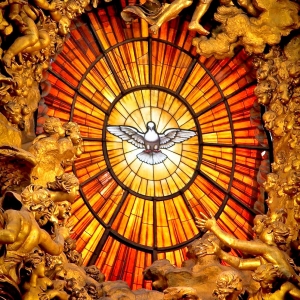
Then what of us all today? What does all this have to do with living in the here and now? Well, we know that life has its major ups and downs. We know that death rears up in terrible fashion both in the newspapers and occasionally in our own life. We know pain is ever round the corner or perhaps even closer. There is darkness amid the light, sin and grace, failure and success. All of that means we either emerge all the stronger, sure of our strength as children of God. Or we are tempted to give up and, sometimes, despair, also known as the absence of God’s Holy Spirit, always there but dependent on us whether we open up or not. Jesus, as ever, must be our model. Given the horror of what he went through, with no sign of a loving God anywhere, he still believed and obeyed and, three days later, triumphed. That must be our model now and always. We are never alone.
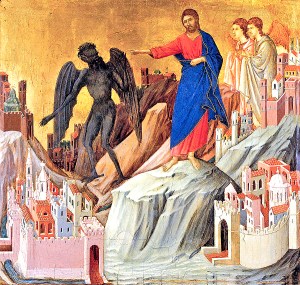
Temptation of Christ, Duccio c. 1311, Maestà in the Cathedral of Santa Maria Assunta, Siena, Italy.
PLEASE LET OTHERS KNOW OF THIS REFLECTION OR, PERHAPS, FORWARD IT TO THEM.
THANK YOU.
Reflections on next Sunday’s Mass Readings will be posted on Wednesday.
Please send your reactions to: RogerJohn@aol.com
© SundayMassReadings.com


 Sunday Mass Readings