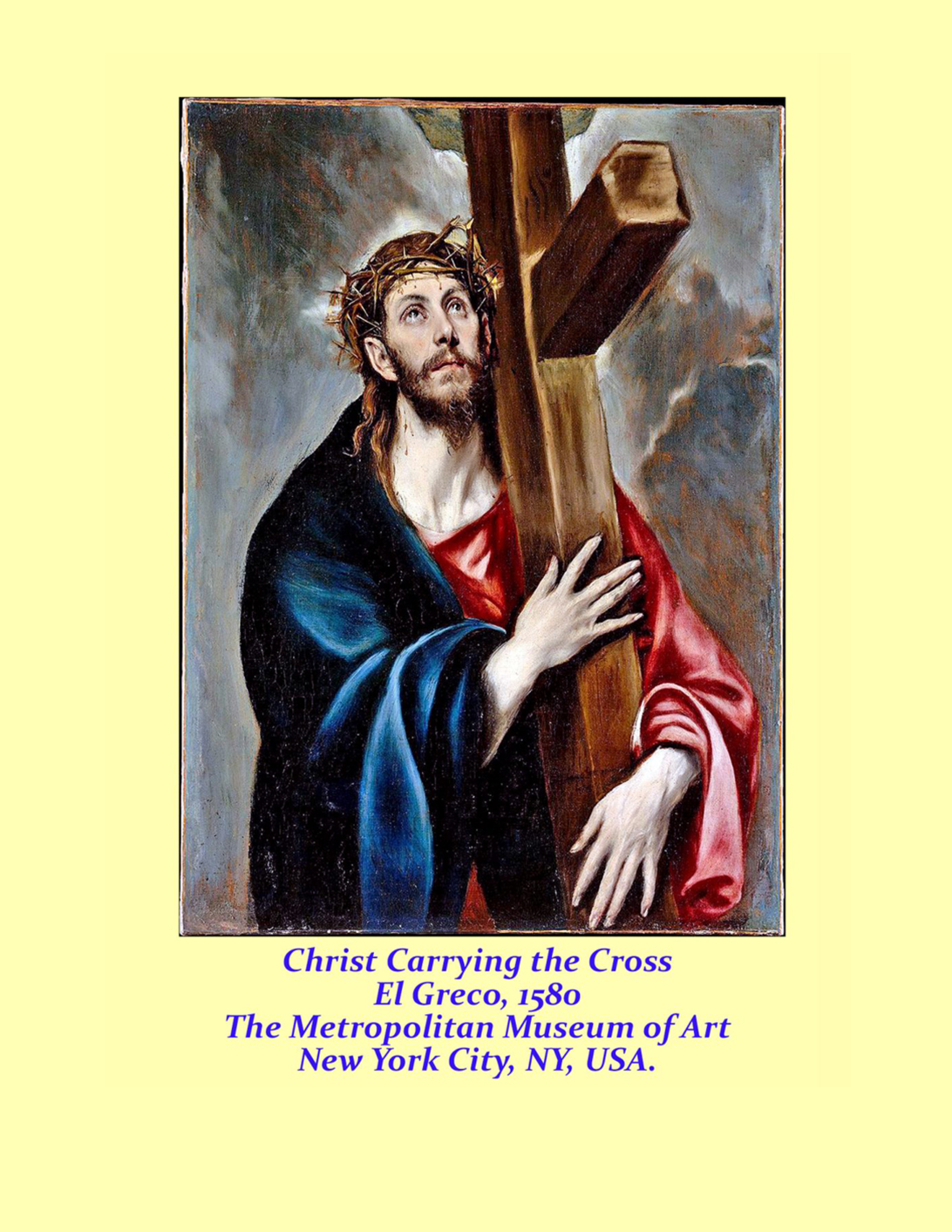
SUNDAY 28 DECEMBER 2025: FEAST OF THE HOLY FAMILY OF JESUS, MARY AND JOSEPH.

Divine Harmony – The Holy Family, Sanctified Souls, Etsy.

Click here to read today’s Sunday Mass Readings.

[Joseph].…..departed [from Egypt] for the region of Galilee. He went and dwelt in a town called Nazareth, so that what had been spoken through the prophets might be fulfilled, He shall be called a Nazorean.      Matthew 2:22-23

Click on words highlighted in red for further information.

Family: A very common word in English. It has come down to us from Latin (familia) and then French (famille). In fact most western European languages are based in this Latin root: familj in Swedish, familie in German. So clearly there was something about this word which resounded true through many different types of people, at least in that area. And guess what; the root meaning comes from a word for servant or slave (famulus). And that, interestingly, has to resound with the Christian idea of service, each member of a family serving the others, and the youngest learning to do the same. Remember those words of Jesus: “I came to serve, not to be served” (Matthew 20:28; Mark 10:45; John 13:1-17). And we can take the example of Joseph, the head of the household where the child Jesus lived. He clearly took his divine vocation very seriously, seen in today’s gospel. He now devoted himself to his new vocation, protecting his young (foster) son from Herod’s son Archelaus. King Herod had died and this, his son, became ethnarch (that is, leader of a people) at age 18. It soon became clear that this was not an improvement in the running of the state. In the first year of his reign there was a slaughter of 3000 people within the Temple precincts. You can find out all about that here. It becomes very clear why our Joseph wanted to be very wary of this man. Nazareth was in Galilee where Herod Antipas, one of Herod’s younger sons, had been made tetrach (ruler of a smaller land), outside the rule of his brother Archelaus. Hence Nazareth was seen as a much safer place than, say, Jerusalem. So Jesus became Jesus of Nazareth. Now today’s gospel says this was in fulfillment of the prophecy “He shall be called a Nazorean”. Interestingly, there is no such prophecy in Scripture! Scholars have labored over this, and again look here to see what they say about this whole episode. 

And so the Holy Family settled in Nazareth in Galilee for Jesus’ childhood and early adulthood. Joseph’s care is seen in today’s gospel. Mary’s love was certainly evident in the episode when she and Joseph, returning to Nazareth from pilgrimage to Jerusalem, realized he was not with the usual crowd of youngsters and rushed back to the city to find him with the elders in the Temple: “Son, why have you done this to us? Look, your father and I have sought you anxiously” she exclaimed, clearly expressing her relief, frustration and upset almost all of us can recognize from our own moments of childish mishaps. It was a community of love in which our Savior grew up. 

And it is that thought I want to leave you with. Do you recognize this:

A bell is not a bell ’till you ring it. A song is not a song ’till you sing it. Love in your heart isn’t put there to stay. Love isn’t love ’till you give it away.”

They were written by Oscar Hammerstein II, he the lyricist of Rogers and Hammerstein. It is said they were written for the actress playing Maria in The Sound of Music on a piece of paper by Hammerstein himself, presumably in rehearsal. Do you agree with the sentiment? It seems to talk of potential – we all have the potential for love, but it’s not love until another receives it, and returns it. For Jesus it was clearly his Father in Heaven – everything he said and did was for God his Father, following God’s clear desire that he act always and in every way as the Son of God. That is not to say he ignored everyone else. Hardly. It was the will of his Father that he show his love in every conceivable way, even on the cross itself, forgiving his murderers and the thief next to him, and even ensuring his mother was entrusted to St. John. We believe he is the Second Person of the Holy Trinity. With the Holy Spirit (who in Scripture is on almost every occasion of which I am aware, represented by feminine nouns in Hebrew) the Father’s and Spirit’s love eternally generates the Son. The Trinity is the ultimate sign of love, and it is out of that love that each one of us exists today. How on earth could a single god ever love us into existence if that god did not have it to give? Love isn’t love ’til you give it away…. And that same God gave us his most precious gift of all – his Son. That is the great mystery we celebrate in these days. And so we say ευχαριστώ, eucharistō, eucharist – “Thank you” in Greek… 
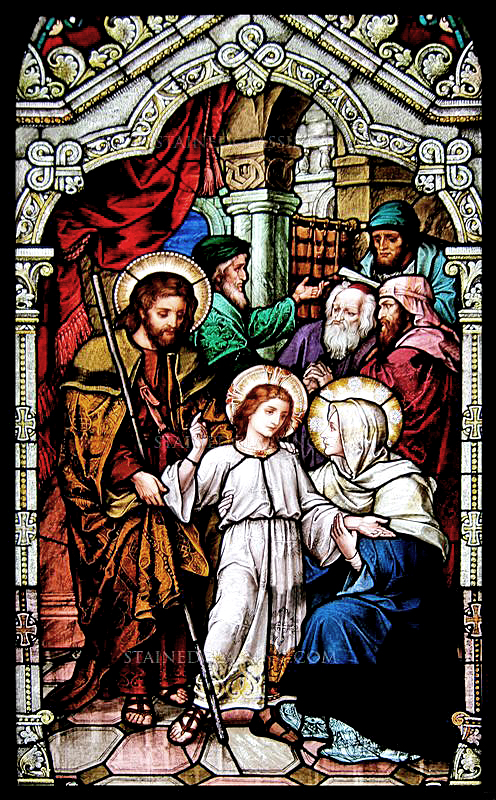
About My Father’s Business, Stained Glass Inc., Panel #5251.

DO YOU KNOW SOMEONE WHO WOULD LIKE THIS? PLEASE FORWARD IT TO THEM.

THANK YOU.

©SundayMassReadings.com

SUNDAY 13 JULY 2025: THE FIFTEENTH SUNDAY IN ORDINARY TIME.

The Good Samaritan, John Adam Houston, Royal Scottish Academy of Art & Architecture, Edinburgh, UK.

Click here to read today’s Sunday Mass Readings.

[Jesus asked] Which of these three, in your opinion, was neighbor to the robbers’ victim?” He answered, “The one who treated him with mercy.” Jesus said to him, “Go and do likewise.”     Luke 10:36-37.

Click on words highlighted in red for further information.

Possibly the most famous parable in all the gospels, the Good Samaritan is an iconic example of Jesus’ teaching, clear, direct, and utterly convincing. To our ears, the message is totally clear and readily understood. Not so the first audience who heard it: very far from our understanding in fact. The biblical scholars call it the “Sitz im leben”, a German expression (as many early 20th century critical scholars of the Bible were German), meaning an attempt to set the passage in its original time and place. It seeks to recreate the understanding of a certain story or saying as it would have been heard and understood the first time it was proclaimed. And the part which would have stood out with greatest force on that original occasion would not have been ...they stripped and beat him and went off leaving him half-dead but would have been the word Samaritan. That would have been the part which brought those who first heard the story to full attention. It would have been an “Uh oh!” moment to them. They would probably have expected the Samaritan to finish the poor man off, give him a final kick and take what was left of his belongings! Instead, of course, the opposite was the result, the Samaritan going way beyond what might be expected, even to the extent of paying for the care of this wounded, despairing, unknown (and probably Jewish) man. So what was Jesus doing? The Samaritans were the people who lived in Samaria, the area of the Holy Land at that time just north of Jerusalem, and south of Galilee where Jesus grew up. They were Jewish too, but….

The parallel which occurs to me is the way Catholics and Protestants viewed each other when I was growing up in the 1940s. It was not pretty. All Protestants were going to hell if you were Catholic, and vice versa. This never sat well with me as my dear mother was Anglican, that is, Protestant (Episcopalian in the USA). There was no way she would end up in hell! But that perception was everywhere at that time. I even had to get permission from the priest in confession for permission to go to my cousin’s marriage in an Anglican church (the answer was yes, but I bet it was grudging). Well, transfer that way of thinking to 2000 years ago and to the Jews and Samaritans. They basically hated each other. The Samaritans even had their own holy hill (compare that to Mount Zion in Jerusalem), and their own temple on it. There was a whole history of distrust and conflict which has no place here, but, if you wish, you can find it here. They even played pretty horrible tricks on each other, just like scams do on us today. (There is still a small Samaritan community in the Holy Land). So when Jesus had the Samaritan discovering the man beaten up and left to die, completely ignored, rejected, by the much worthier priest and Levite (who would have been a servant in the Temple in Jerusalem, the holiest place on earth for the Jews), they expected even worse from the Samaritan. But no, they did not get that. And note at the end of the story when Jesus asks who was neighbor to the man – what would you say automatically? Now look at what the scholar of the law, the one whose question sparked the parable, said in answer to that question. Look at my caption above. Who was neighbor to the man….? Did you answer that way? The man could not even bring himself to say the word “Samaritan”!

There are other telling things about this parable. The traveler was on his way from Jerusalem to Jericho. Now did you know this: many scholars believe Jericho is one of, possibly the, oldest human settlements in the world, over 9000 years old! So it could be said that it represents mankind in its source and longevity. Then there is Jerusalem, now sacred to the three great monotheistic religions in the world. So if one would ask which is the holiest city in the world, it could possibly be Jerusalem, the city of God! Additionally, Jericho is about 800 feet below sea level, whereas Jerusalem is about 2500 feet above sea level. In other words, metaphorically, the traveler was going in the wrong direction! And it is a bleak landscape there. I took this picture near Jericho in 2018:

Excavations in Jericho, Palestine Authority, 2018.

And consequently it is an uphill trek to get to the City of God, but much easier to get to the city of (fallen) humanity. So this simple story is multifaceted, with each angle having its own story to tell. But ultimately, it is the Lord who is the Samaritan, and each one of us fallen and barely able to ask for help. Yet we need it so badly. But today at least we Christians of whatever tradition enjoy a much more healthy relationship with each other. We acknowledge that we all believe in fundamental truths, that Jesus is the Lord of all, who is always ready to help us when we ask for it. That love is the power of God, into which we are all invited. So, based on that, we can transform ourselves into that Good Samaritan, able to help whoever needs help. For our help comes from the ultimate Good Samaritan, always there and always ready. As we should also be. But that is no easy matter. The example set in this parable calls us to help on many levels, including financial, and are we ready to do that? For many of us today, that would be the acid test – the money in our pocket. But, of course, our Samaritan went way beyond that level of generosity. When Jesus was asked to deny his identity as God’s Son, and his title, Messiah – the Anointed of God – he declared this was who he truly was, and  as a result was martyred for our benefit – so that we would believe in his mission and example! He died defending this so that we would believe in him. Our Samaritan loved us so much that he was not prepared to save himself by denying who and what he was, and what his vocation was, instead offering to save each and every one of us. So we have the ultimate example here of what each of us is called to be. Not to ignore the suffering around us, but to do what we can to minimize it. That would be a great step for us to become the Good Samaritan! And one final exercise: If you have a pet irrational dislike of some nationality or race or skin color or indeed anything which another person has been born with and has no control over, substitute that for the Samaritan and give yourself an “Uh oh” moment to make this parable come really alive!

The Good Samaritan: A Children’s Catechism, Fr. Michael Shanbour, Ancient Faith Store.

©SundayMassReadings.com

SUNDAY 6 JULY 2025: THE FOURTEENTH SUNDAY IN ORDINARY TIME.

Rejoice with Jerusalem and be glad because of her, all you who love her; exult, exult with her, all you who were mourning over her! Oh, that you may suck fully of the milk of her comfort, that you may nurse with delight at her abundant breasts!    Isaiah 60:10-11.

Click here to read today’s Sunday Mass Readings.

Click on words highlighted in red for further information.

The quotation above is possibly one of the earthiest passages in all Scripture! On another level, I haven’t put a second picture above today, because my lead picture “Virgin and Child Enthroned”, I think tells it all. I have found over the years that it is very difficult to find a Virgin and Child picture where both look happy! But wandering through the lovely National Museum in Gdansk (Dantzig), Poland, in March of this year, I saw that statue carved in wood and took a picture of it. Although dating from the 14th century, it looks very human and up to date. The child looks goofy (which seems perfectly natural to me) playing with a ball, in the lap of his happy mother, and both look like normal people, not dazzlingly beautiful, not agonized, not anticipating the worst, but simply content and normal. Quite clearly a happy couple. And I think that speaks to today’s readings. Isaiah seems to be talking about such a couple as shown here, and each of us can imagine ourselves as the happy child, being dangled and jiggled around in the same perfect union of the Christ Child and Our Lady, our protective mother also (and remember we are all called to be Christ to the world). Our Blessed Mother must have had moments like that! Then in the second reading Paul talks of “a new creation. Peace and mercy be to all who follow this rule and to the Israel of God”, again talking of a happy time, and then the gospel describes that “the seventy-two returned rejoicing, and said, “Lord, even the demons are subject to us because of your name”. Put them together and we are in a world of fulfillment and peace, which, of course, should always be the case.

“Every Child Needs to be Happy…..”, Cathy Yeulet, Psychology Today, June 2016.

All of which talks of a happy life, and how to achieve it. Hopefully we all began with a mother who was perfect, bringing us up with the expression we see on the Virgin’s and the children’s faces above. If not, then to the Virgin we go and request a loving, maternal and guiding hand, even if we are, like me, in our 80s. It’s never too late, though luckily for me I had a mother who was exceptional, despite extreme financial challenges after the war. Then the rejoicing of the 72 in today’s gospel should be reflected in our own life’s work, identifying, developing and utilizing the gifts God gave to each one of us in the service of others. I recall when I was still a Religious Studies teacher, each year I would ask my students in Junior year (it was a Catholic girls’ high school in Brooklyn, New York) to interview their parents and their parents’ friends about their life work. They had to ask if they were happy and fulfilled in that (most were) and then ask why. Overwhelmingly the answer was because, in one way or another, they said my job helps other people. It was hardly ever because “I make the best money there”. In fact, I vividly recall one student who had interviewed her uncle, the wealthiest member of the family; he worked on Wall Street. She asked “Are you happy in your work?” “No”, he said. “It takes all my energy to get up on a Monday morning and get into the city” She was astonished, didn’t have a clue. I had cautioned students to be very careful if you got a response like this. It would mean you are dealing with someone in pain. Be gentle. So when she managed to ask what the reason was, the answer was “I have wanted all my life to be a chef, but when this banking offer was made, everyone said I’d be an idiot if I didn’t take it. So I did.” Now, of course, for him, there was no question of turning back. A chef with a family makes very little in comparison to a Wall Street tycoon! Then came the agonizing last line in her essay: “I now know why, when we have a family cookout, my uncle is there, with his chef’s hat on, cooking and serving, the happiest I ever see him”. 

I did all this hoping to let them trust that God calls us to the happiest life, with full utilization of our gifts in some general field of activity. We should recognize that, accept it and respond with hope and trust, and try hard not to let money be our one and only guide.

And then there is Paul’s reading today, briefly talking about “a new creation”. In the context of these readings, I think we can say that this is a reference to the new life which awaits us at the final call. He says that if we have lived with the example of the Lord before us at all times, then when called from this life we can expect that the “new creation” will be really all we had hoped for. And so, let it be. 

“True Moment of Happiness”, iStock by Getty Images.

©SundayMassReadings.com

SUNDAY 15 DECEMBER: THE THIRD SUNDAY OF ADVENT: GAUDETE SUNDAY.

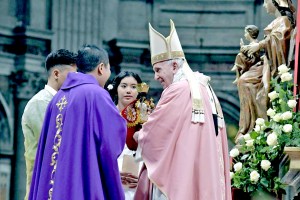
Pope Francis Celebrates Gaudete Sunday with the Filipino Community in St. Peter’s in 2019.

Click here to read today’s Sunday Mass Readings.

Have no anxiety at all, but in everything, by prayer and petition, with thanksgiving,
make your requests known to God. Then the peace of God that surpasses all understanding will guard your hearts and minds in Christ
Jesus.
  Letter to the Philippians 4:6-7.

Click on words highlighted in red for further information.

“Gaudete” means Rejoice in Latin. Look at today’s readings. The first, from the prophet Zephaniah, begins, “Shout for joy, O daughter Zion! Sing joyfully, O Israel! Be glad and exult with all your heart, O daughter Jerusalem!” The second, from St. Paul’s letter to the Philippians, begins, “Brothers and sisters: Rejoice in the Lord always. I shall say it again:  rejoice!” And in the gospel, John the Baptist “Preached good news to the people”. Why all this rejoicing? Because we are roughly at the half-way mark to Christmas, the ultimate good news, when God became one like us, when we were considered to be good enough to have God come dwell with us and be one with us. Even the celebrant at Mass may wear rose-colored vestments, one of only two Sundays that is permitted (the other is Laetare Sunday, the fourth Sunday of Lent. That Latin word also means “rejoice” but to express it externally; gaudete means to rejoice internally). Even the third candle on the Advent wreath is usually rose colored! It all signifies a lightening in the somber atmosphere of Advent and we should all reflect the joy and conviction that the incredible is about to happen, as it does each year, that God – God! – wanted to be one like us in all things but sin.

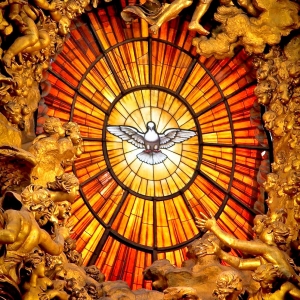
So what does that all mean? Do we jump up in the air and dance around like Scrooge in the classic 1951 version of Christmas Carol when he realizes his true identity – vocation even – of being fully human with all its implications. Well, maybe, if we fully realize and accept that we are all considered to be good enough and worthy enough to have God come live among us out of pure love. That would certainly invite us all to be truly happy and even excited to be a child of God! What more could one ask? Well, patience to wait for the real day, and the time left to prepare for it in the best possible way. Joy does not have to expressed in outward, extravagant ways, though at Christmas time it is almost required! But we are just half way there. For us, the joy expressed in today’s name and readings should perhaps be the joy of preparing for the arrival of the Christ Child. There is a special joy in such activity. Imagine a most welcome Christmas visit of a beloved relative from afar; all must be ready. The house must be clean, the crystal immaculate, the china sparking – everything. Apply that each to ourself, our soul, our innermost self. Getting rid of the nonsense – the stuff which clogs things up for no good reason – and clean the inner crystal and gold, the inner soul, the real me. The thought that I – you – we are doing all that brings with it a joy which is palpable. It is the “I can’t wait” moment we felt as a child, especially when allied to the major effort to bring ourselves into a state of grace ready for the arrival of the author of all joy. What a welcoming person each of us will be. It is a golden opportunity once more to restart anew. Under the loving eye of the Father, let us ask the Holy Spirit of God to infuse us with the energy, the strength, the excitement to be completely ready for The Day.

The Blessed Trinity with Saints, Durante Alberti 1581, The Venerable English College, Rome, Italy.

IF YOU KNOW SOMEONE WHO WOULD ENJOY THESE REFLECTIONS, PLEASE LET THEM KNOW. THANK YOU. 

Reflections on next Sunday’s Mass Readings will be posted on Wednesday.

Please send your reactions to: RogerJohn@aol.com

© SundayMassReadings.com 

SUNDAY 3 NOVEMBER 2024: THE THIRTY-FIRST SUNDAY IN ORDINARY TIME.

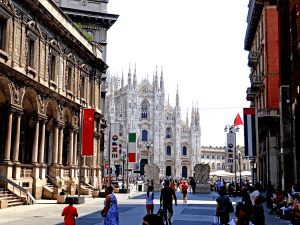
Milan Cathedral, 1386-1965, Milan, Italy 2012.

[Jesus said to the scribe], “You are not far from the kingdom of God”.   Mark 12:34.

Click here to read today’s Sunday Mass Readings.

Click on words highlighted in red for further information.

Those words of Jesus must have been music in the ears of the scribe, bursting with love of God, recognized by the Lord of Life, and told he was on the right way to the welcoming arms of God. Isn’t that what each of us longs to hear as we navigate our way through the thorns and confusion of this life, doing the best we can to be a true followers of the Lord? And today’s gospel is so clear as to what we must do in this life to hear those words: You shall love the Lord your God with all your heart, with all your soul, with all your mind, and with all your strength and you shall love your neighbor as yourself”So what we must all do is translate that wonderful statement into action, live it out as best we can, and hope we too are close to the kingdom of God with a clear conscience and with a history of love of God, neighbor and self lived to the fullest. And note the timing of this gospel, deliberate or accidental I know not, but it’s close to the end of the church’s year. It is clearly a clarion call to each of us either confirming  our lifestyle, or calling our attention to a need to change it! 

Let’s take a look at today’s first reading from Deuteronomy. This was clearly the inspiration of the scribe’s joyous outburst is the presence of Jesus. It is thought that this passage was written just as the Hebrew people were about to enter their long-promised Holy Land. It sets the scene for what God expects of them once they are settled, and in no uncertain terms, God expects their total love, and God will return it. Love is the driving force of this relationship, not rules and regulations. Remember St. Augustine’s exhortation: “Love and do what you will”. If we do everything as an act of love for the other – or others – then God is present, because God is love. As St. Paul says in his first letter to the Christians in Corinth, “Love is patient, love is kind. Love is not jealous, it is not pompous, it is not inflated, it is not rude, it does not seek its own interests, it is not quick-tempered, it does not brood over injury. Love does not rejoice over wrong-doing, but rejoices with the truth. It bears all things, believes all things, hopes all things, endures all things” (1 Corinthians 4-7). And I suspect everyone, the good and even the bad, will see the truth in that exhortation. There is something life-giving there, something of the eternal, something of pure truth. Such a life, not without challenge, is a happy life, as it is constantly focussed on the other, not the self. Happiness is to be found there, especially in the love that is freely and happily returned. For there will God be. Finally, the letter to the Hebrews, our second reading, contrasts the spiritual leaders of the Hebrews, even the very best, are still poor sinners like the rest of us, and so have to make amends for their own sins as well as those of the community. Christians, on the other hand, have the sinless Lord Jesus as their high priest, who conquered even death itself to be our sinless leader and our life. There is someone in whom we can place our total trust and hope, one who will also help us, if we ask, when we fall. For that is what the shepherd does. That is his job to which he is utterly devoted. So each of us is called by name to the flock of the faithful and trusting. There is nowhere safer.

Christ the Good Shepherd, Engebrechtsz c.1510, Museum Boijmans Van Beuningen, Rotterdam, Netherlands.

IF YOU FIND THIS REFLECTION RINGING TRUE, PLEASE SHARE IT WITH OTHERS. THANK YOU. 

Reflections on next Sunday’s Mass Readings will be posted on Wednesday.

Please send your reactions to: RogerJohn@aol.com

© SundayMassReadings.com 

SUNDAY 6 OCTOBER 2024: THE TWENTY-SEVENTH SUNDAY IN ORDINARY TIME.

Adam and Eve in the Garden of Eden, Johann Wenzel Peter c. 1820, Pinacoteca Vaticana, Vatican City State. 

Click here to read today’s Sunday Mass Readings.

The LORD God said: “It is not good for the man to be alone. I will make a suitable partner for him.”  Genesis 2:18.

Click on words highlighted in red for further information.

This is one of those Sundays which presents a real challenge to an unmarried person, such as me. Far be it for me to expound on the perfect married life! So I will talk of something which should be a part of any profound and dedicated marriage, which is friendship. This I do understand and try to live. True friendship demands, I would suggest, almost the same challenges which the married life demands. If you look online for a moment concerning that topic, headlines such as Friendships: Enrich Your Life and Improve Your Health (The Mayo Clinic),  and The Science of Why Friendships Keep Us Healthy (American Psychological Association), and Benefits of Friendship (Care Counseling) tend to leap from the page. So clearly those who know about physical and mental health agree that friendship is life-affirming and, in some way, essential to one’s well-being. It seems even God thought so, looking at the quotation from Genesis above! The reverse of the statement would be It is bad for the man to be alone. I even remember reading years ago about a life insurance company which asked potential clients if they had good friendships, especially a friendship where nothing was concealed, and premiums apparently went down if they did! Look at this, for example. And, of course, don’t forget the people Jesus gathered around him, though one wonders about Judas… Clearly Jesus was totally human in his ability to make a mistake concerning that man. And remember we, and Judas, all have the freedom to behave in any way we wish; that is part of the glory and challenge of being human! Jesus clearly did not control any of the people around him; he hoped and prayed for them, but their fates were clearly in their own hands. 

But true friendship has both benefits and costs. The costs, of course, are when things go wrong, and the statement A friend in need is a friend indeed comes into play. Life is not always pleasant. Each of us encounters challenges at times, and that is when true friendship manifests itself. I recall the time when I was in hospital three years ago recovering from triple by-pass open heart surgery. My doctor walked into the room when I happened to have three friends visiting. He looked around and said “This is the best therapy you can get”. It is never fun visiting a hospital. It involves inconvenience, special journeys, time, commitment and a host of other unwelcome requirements. But the benefits to the patient which come from such costs can be immeasurable. I was, and remain, deeply grateful for such true friendship and I trust and pray you feel the same way. And it is at such times that true friendship manifests itself. It is not to say that other friends are lacking. Remember how many of Jesus’ friends were present at his death… They made up for it later. The bitterness of Peter’s betrayal of the Lord in the high priest’s garden when Jesus was being insulted and  unjustly accused, when Peter did nothing to support him – and even denied knowing him! –  then his remorse, which must have been immeasurable. That is the shadow side of friendship, the consequences of betrayal. Remorse at such times is, I believe, a foretaste of hell.

So, true friendship is the solid ground on which, I hope, we all stand. It is life giving, life enhancing and life fulfilling. It should be at the heart of all marriages, partners who can trust each other totally, no matter what. And supremely, it is at the heart of our relationship with the Lord, the ultimate friend, the giver of life and love. Christ’s three questions to Peter later, “Do you love me?” will be demanded of us also. Let there be unbounded joy at that moment, when we enter upon unending love and life eternally.

“Simon, son of John, do you love me?” Mosaic in the Church of St Peter Gallicantu, Jerusalem, Israel (2018).

IF THIS REFLECTION RINGS TRUE, PLEASE SHARE IT WITH OTHERS. THANK YOU. 

Reflections on next Sunday’s Mass Readings will be posted on Wednesday.

Please send your reactions to: RogerJohn@aol.com

© SundayMassReadings.com

SUNDAY 22 SEPTEMBER 2024: THE TWENTY-FIFTH SUNDAY IN ORDINARY TIME.

One Minute Reflection, AnaStpaul.com

“Whoever receives one child such as this in my name, receives me; and whoever receives me, receives not me but the One who sent me.”    

Click here to read today’s Sunday Mass Readings.

Click on words highlighted in red for more information.

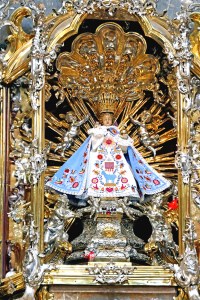
Reading through today’s Scripture passages, a mixture of emotions might rise up. From the Book of Wisdom comes anger (a plan to bring down the righteous through the actions of sinners), possible guilt from the Letter of James, where we might have been jealous or angry about someone or something, and, putting ourselves into the shoes of Jesus’ disciples, guilt over admitting they were figuring out who was the greatest among them, and confusion and possibly even fear over Jesus’ prediction of his own death at the hands of evil men. In other words a real slice of fallible human nature! Who hasn’t fallen victim at one time or another to one or more of those faults? Which leads to the question of Why? Why aren’t we satisfied with all God has given us, beginning with life itself? Once upon a time, when I was in studies in the 1960 working to my Economics degree, I asked the teacher, relating to the basic law of supply and demand, what happens if you have all your material needs satisfied, and your demand no longer exists – you don’t want anything else! The professor solemnly opined that you had reached the state of “hither bliss”. I guess that meant heaven here and now, total material satisfaction. Is such a state ever possible? We can always see others with more money, talents, self-confidence, or whatever, comes to mind, and feel oppressed or short-changed in some way. Which is all grist to the Devil, pure catnip to the Evil One, who will make merry with our doubts and jealousies. Hence the concluding thought in today’s gospel, that the one who is last, least, among us is the first, and to be that, Jesus shows, we must be like a child, innocent of everything, open and trusting and eager to trust and love and experience the joy of life. 

Yes, I can hear myself say, and be open to being robbed, the butt of jokes, the easy touch, the sitting duck for just about anything. Do I really want that? Does anyone want that? So, I ask myself, what does the Son of Man, God among us, really mean when he seems to be demanding such risky attitudes and behavior? Does Jesus suggest that we all should be gullible and offer ourselves on the sacrificial block to the first one who comes to take advantage of us? Clearly not, but what then? After all, look what happened to Him! Intriguing readings today therefore, with much food for thought. One cannot believe that the Lord is asking us to be defenseless and open to hucksters of all kinds. Again, then what? Well, just remember a few other words of the Lord. From Matthew 10:16: “Behold, I am sending you out as sheep in the midst of wolves, so be wise as serpents and innocent as doves”. St Paul says: “So then, be careful how you walk, not as unwise people but as wise” (Ephesians 5:15). And St. James in today’s second reading says we should attain “the wisdom from above [which] is first of all pure, then peaceable, gentle, compliant, full of mercy and good fruits, without inconstancy or insincerity”.

Not easy, true, but whoever said the virtuous life is easy? We have to work to be the kind of people God is asking us to be, even if it provokes the anger of the unrighteous (which it often does). But, as ever, we are not left alone to battle evil. We have the Lord with us always, the one who conquered evil; we have a voice which can ask for his help, and we have the faith which can get us through anything. Doesn’t all that mean we are, at that point, the child that Jesus is asking us to be? Then we should be always trust in God, and act accordingly.

The Infant of Prague, Church of Our Lady of Victories, Prague, Czech Republic (2024).

PLEASE LET OTHERS KNOW OF THIS REFLECTION OR, PERHAPS, FORWARD IT TO THEM.

THANK YOU.

Reflections on next Sunday’s Mass Readings will be posted on Wednesday.

Please send your reactions to: RogerJohn@aol.com

© SundayMassReadings.com

SUNDAY 5 MAY 2024: THE SIXTH SUNDAY OF EASTER.

]

[Jesus said,] “this my commandment: love one another as I love you.”

John 15:12.  Archdiocese of Malta.

Click here to read today’s Sunday Mass Readings.

Click on words highlighted in red for further information.

Now of all the statements uttered by our Savior, this may be perhaps the strongest, unquestionable and universal ever: that in all times and places (such as in the photo above), we must love everyone…. If taken to heart, who is there left that I should dislike, hate, abhor or loath? Clearly the answer is no-one! Jesus gave us not a single exception. We are very clearly commanded (note the word) to love one another. Forgiving his own executioners is perhaps the purest example of him practicing what he preached. Mahatma Ghandi in a memorable moment, is supposed to have said, “If it weren’t for Christians, I’d be a Christian.” Now, if true, it should give us something to think about. Our founder, the Son of God, clearly revealed his agenda in that one statement. All of us are created equal in the eyes of God – we are all children of God. Some choose to do the opposite, as seen in their actions demonstrating hatred, anger, prejudice, violence. Following the example of the Lord, these are to be accepted as God’s children even then, with us turning the other cheek, praying for them, refusing to return violence with violence, and so on. Not easy! Indeed many of us might seem to be incapable of such passive acceptance. But the ultimate judge, God, will see into us and easily discern that of which each one of us is capable.

Consider, for example, the story of Desmond Doss, a Seventh Day Adventist, who volunteered for the army at the start of World War Two, but absolutely refused to hold a rifle. He wished to serve in the Army Medical Corps as a non-combatant. That he did, despite monumental abuse from his unit who condemned him as a coward, thereby, they thought, disgracing his unit (the movie Hacksaw Ridge tells his story). Yet his actions in the war, never holding a weapon, earned him the Purple Heart, a Bronze Star, and being awarded the Medal of Honor from President Harry Truman. The Church has from the earliest days said that self-defense is an acceptable response to unprovoked aggression. However, I suspect that there is a deep sense of guilt there, as Jesus, in the way he reacted to his own meek acceptance of brutal, unjustified and deadly force, set an example of perfect acceptance and displayed a pacifism which is perfect in its utter acceptance of violent brutality. We have the example of how a Christian should behave in the way Jesus behaved, or Corporal Doss. It is, as they say, a counsel of perfection. The goal is clear, the means of achieving it stupendously challenging.

But Jesus tells us the means of achieving it: Love one another. Simple, direct, and even attainable, as we see in those heroic Christians who have defied brutality in all its manifestations, and achieved the presence of God for eternity. Jesus, our Lord, set the pattern for all time. We know what is required of us. We know how we sould behave and accept. It is up to each of us to follow the command to the best of our ability; God will know if we have achieved it, or not.

Well Done My Good and Faithful Servant, Dilly Designs Art.

PLEASE FORWARD THIS REFLECTION TO THOSE YOU THINK WOULD APPRECIATE IT.

THANK YOU.

Reflections on next Sunday’s Mass Readings will be posted on Wednesday.

Please send your reactions to: RogerJohn@aol.com

© SundayMassReadings.com