SUNDAY 2 FEBRUARY 2025: THE PRESENTATION OF THE LORD: CANDLEMAS.

The Presentation in the Temple, Alvaro Pirez 1430, Metropolitan Museum of Art, New York City, NY, USA.

Mary and Joseph took Jesus up to Jerusalem to present him to the Lord, just as it is written in the law of the Lord, Every male that opens the womb shall be consecrated to the Lord….”   Luke 2:22-23.

Click here to read today’s Sunday Mass Readings.

Click on words highlighted in red for further information.

The birth of a first-born son is a special event in a Jewish family. He, and all other boys born into the family, must be circumcised, according to the ancient tradition dating back to God’s direct instruction to Abraham: “You must circumcise every baby boy when he is eight days old…” (Genesis 17:11-12). But, as seen in today’s gospel, the boy must also be presented to God in the Temple and be “redeemed” by the sacrifice of an animal. Although scholars think that the tradition of presenting one’s first born son to God, and then redeeming him through sacrifice of animals, sprang from the death of the firstborn as the 10th plague resulting in the release of the Hebrew slaves from Egypt, Abraham’s sacrifice of his son Isaac represents another, perhaps more profound, possible source for this tradition. Whatever it was, a tradition developed among the Hebrew people to “redeem” their first born sons by offering something in his place. For Mary and Joseph it was two turtle doves when they presented Jesus in the Temple, as stated in today’s gospel. Acceptable sacrifices were oxen, sheep, goats, turtledoves or pigeons, depending on the ability of the family to afford the sacrifice. But the boy was clearly redeemed for God. You should also know that first-born male child sacrifice, which God originally ordered Abraham to do, had been a culturally and religiously acceptable, albeit very harrowing, tradition in ancient pre-Jewish Canaan. This was clearly abhorrent to God, and it is this author’s opinion that it is the reason God intervened in our history at all! The generally accepted root of this tradition, however, was the 10th plague in Egypt, the death of the first-born male, from the son of pharaoh to the lowest beast of the field. But the blood of a sacrificed lamb was to be placed on the doorposts of the Hebrew homes, and the angel of death would “pass over” those homes, and their first-born sons would live (Exodus chapter 12). Following on that event, all first-born sons, as Jesus was, were to be presented to God in the Temple and then redeemed. But whatever events triggered this tradition it was one of the oldest in the Christian calendar, being described by Egeria in the 4th century in Jerusalem. It was once called the feast of the Purification of Our Lady. All about that here. Clearly it was important enough for Joseph and Mary to take the long journey to present Jesus to his Father in the Temple in Jerusalem. And it was at this time that Simeon, the old man in today’s gospel, took the baby Jesus in his arms. He had been promised by God’s Holy Spirit that “he should not see death before he had seen the Christ of the Lord”. It was at that moment he said, “Now, Master, you may let your servant go in peace”, the famous “Nunc Dimittis” prayer traditionally sung at Evensong. He accepted that he would now be called by God from this life.

Also attached to this day is a festivity involving candles. In fact another name for today is “Candlemas”. That springs ultimately from another non-Christian tradition but this time taken not from a Jewish source, but from a pagan celebration at the time of the early church. You can find out about at least one possible source (there are several) here. The church has a long tradition of taking ancient pagan feasts and adapting them into a Christian celebration, most importantly Christmas itself! The connection with candles probably comes from Simeon’s prayer, which goes on to say, “…my eyes have seen your salvation, which you prepared in the sight of all the peoples: a light for revelation to the Gentiles, and glory for your people Israel.” Apart from the sun, moonlight at certain times of the month and fire, candles were the only source of bright light for most people. Hence the light of Christ became associated with that most familiar source. Whatever it was, the image of light to the world is an image of the Lord who lights the way for all of us, and as ever, it is up to us to follow that light, the surest pathway to God and eternal happiness.

Feast of our Lord Entering The Sanctuary, Bodour Latif and Youssef Nassief 1992, St-Takla.org.

PLEASE PASS THIS ON TO SOMEONE YOU KNOW WOULD LIKE IT. THANK YOU. 

Reflections on next Sunday’s Mass Readings will be posted on Wednesday.

Please send your reactions to: RogerJohn@aol.com 

© SundayMassReadings.com 

SUNDAY 21 APRIL 2024: THE FOURTH SUNDAY IN ORDINARY TIME: GOOD SHEPHERD SUNDAY.

Pope Francis Visits a Nativity Scene, Church of St. Alfonso Maria dei Liguori January 8, 2014, Rome, Italy.

Click here to read todays’s Sunday Mass Readings.

[Jesus said] “I am the good shepherd, and I know mine and mine know me, just as the Father knows me and I know the Father; and I will lay down my life for the sheep.     John 10:14-15

Click on words highlighted in red for further information.

Pope Francis uttered certain words on Maundy Thursday, March 28, 2013, at a Chrism Mass  (when the priests of his diocese, Rome, came together, as they do at that Mass in every diocese in the world) which quickly went viral: “The priest who seldom goes out of himself … misses out on the best of our people, on what can stir the depths of his priestly heart. … This is precisely the reason why some priests grow dissatisfied, lose heart and become in a sense collectors of antiquities or novelties — instead of being shepherds living with ‘the smell of the sheep.’ This is what I am asking you — be shepherds with the smell of sheep” (National Catholic Reporter, October 29, 2013). Well, the picture above shows him practicing what he preaches! Jesus used that image of himself in an agrarian world 2000 years ago. Everyone was familiar with sheep back then, their problems, the challenges facing shepherds taking care of them, the threats they faced and the hardships they endured. We, today, are not. I think the last time I saw a live sheep was years ago, through the window of a train. Certainly no smell was noticeable. But yes, I know that was not what the pope was talking about. We are the sheep, aren’t we? Priests are called to get so familiar with the joys, pains, challenges, happinesses and challenges of their flock that they become, in essence, their shepherd. The very word “pastor” is the Latin word for shepherd, so it will be clear what “pastoral care” means! So I did a little research on what it really means to be a modern day shepherd – the real thing – and tried to relate it to modern-day Christianity. Take a look at shepherding today as described by a real-life shepherd, Kim Goodling, and I really do mean take a look at this:

https://www.livingwithgotlands.com/2019/09/skills-of-a-shepherd/

It is one tough vocation! It is also, quite frankly, a guide to being that other type of shepherd, a pastor of a human flock. And, in a special way, what it means to be a genuine Christian, a child of God. Looking at Kim’s list of requirements in the clip above, they can all be applied to the real life of a Christian. They are all other-focussed, all requiring love and selflessness, whether it be family or neighbor, and how to act in an emergency, applying it to your – my – real world somehow. However, looking at today’s gospel, we are fortunate to have the Good Shepherd taking care of us – the sheep! All those skills and requirements listed above in actual, real-life shepherding are found in the life of Jesus, up to and including his own death. It was for us he died, taking the utter evil of our sins upon himself that we might live in grace and hope. So he goes way beyond even the real shepherd: Jesus is even prepared to die horribly to save us!

Note also one extraordinary element in today’s readings. St. Peter, in the first reading, is talking to the religious leaders who had succeeded in getting Jesus crucified. His words are: “It was in the name of Jesus Christ the Nazorean whom you crucified, whom God raised from the dead; in his name this man stands before you healed”. Now this is a man addressing a  fearsome group of leaders who seemingly had almost the power of life and death as they knew how to manipulate the Roman authorities. Peter should have been scared to death of them, but he was not. They were the ones who had heard Jesus say “I am” to the high priest’s question: “Are you the Christ (the Anointed), the Son of the Living God”. It was because of Jesus’ answer to that question that he was declared guilty and condemned to death (compare Mark 14:61-62 and Exodus 3:13-16). Peter in today’s first reading now seems to be completely beyond fear of any consequences. The power of the Holy Spirit had begun to be present in their midst. The Lord himself had said he had to return to the Father in order to send the Holy Spirit down upon them. So even down to our time, we have the power to stand up to the threats that might be thrown on us, just as Peter had – and this was the man to had denied even knowing Jesus three times! This clearly was one of the first such moments which has remained down to our own day, we have the Holy Spirit of God among us, with us and upholding us. And that is the power which can make us good Christians, even, when situations demand it, good shepherds. When we too, as Pope Francis says, would have the smell of the sheep, if we act as true, loving, reliable and trusted neighbors, friends, family – or even strangers!.

Jesus the Good Shepherd, Etsy.

PLEASE FORWARD THIS REFLECTION TO THOSE YOU THINK WOULD APPRECIATE IT.

THANK YOU.

Reflections on next Sunday’s Mass Readings will be posted on Wednesday.

Please send your reactions to: RogerJohn@aol.com

© SundayMassReadings.com

SUNDAY 21 JANUARY 2024: THE THIRD SUNDAY IN ORDINARY TIME.

Jesus calls the fishermen to follow him, stained glass, provenance unknown.

Click here to read today’s Sunday Mass Readings.

[Jesus said to them,] “Come after me, and I will make you fishers of men.”   Mark 1:16.

Click on words highlighted in red for further information.

According to the (United States) Occupational Safety and Health Administration (OSHA), in 2024 (and for many years before) fishing and hunting are the most dangerous jobs in the USA bar none. Lumberjacking is the second most dangerous. Bearing that in mind, and going back 2000 years, leaving all life-saving equipment and services back in the 21st century, the fatality rate among fishermen in Jesus’ day must have been horrendous. Given that I wonder if Jesus deliberately approached fishermen knowing they faced life-threatening situations on a regular basis, and in all probability were the strongest, not to say bravest, men in that community. Although at the beginning of his ministry, and knowing that the message he was going to preach was not about the All-Conquering Messiah that the Hebrews wanted to hear, I wonder if he deliberately looked to the toughest men in the community to recruit to his side. If he could swing them over, there was a pretty good chance his teachings would survive when he was just a memory. He was right, of course. But then there is the apparent instantaneous response to his call – they dropped everything to follow him! That is an almost incredible reaction. James and John even left Zebedee, their father, in the boat in their eagerness to join this holy man! Luke 5:1-11, dealing with the same scene, adds much more color to it. In his version, Simon Peter had been working all night and had caught nothing. So he was exhausted, tired, angry, frustrated and not in a good mood. Then this holy man came by and told him to pull out once more… Well, what would you have said? Luke gives Peter a very obliging and polite response, and he pulls out in obedience once more. I deeply suspect that that was an heavily edited version of Peter’s response, which probably told Jesus what he could do with his suggestion. But something in this holy man moved Peter to do what Jesus said. He caught a whole load of fish, was overwhelmed when he returned to Jesus, and said that he was a sinful man, and it would be better if Jesus simply left him. That is almost certainly verbatim, much more likely than his first obsequious reaction as stated in Luke, and of course it was exactly what Jesus was looking for. So Jesus must have had an air about him of total authority, goodness and conviction for the likes of these men to respond in the way that they did. He must have had an almost magnetic attraction, so much so that they could not imagine another instant not being in his company. He was the real thing. They were won over in an instant, and for the rest of their lives.

That being so, look at today’s second reading from Paul’s letter to the Christians in Corinth. He is telling them about a world turned upside down also. They should see things in an entirely new light with Jesus’ presence among them. Challenges are now opportunities to do good. Angry-making situations are now chances for understanding and reconciliation. Vengeance should now give way to forgiveness, and so on and on. In such matters, black does indeed  become white! And the first reading, although really unlikely at face value, does become believable if we can see Jonah as a really good prophet, a really good proclaimer of God’s word. It is probable that we too can tell a good person from a scoundrel, though that might be a little optimistic. But if, as apparently in Nineveh, everyone could tell that Jonah was the real thing, just as those fishermen in today’s gospel did when confronted by Jesus, then his words would really mean something. They believed and responded appropriately. In situations like that things can really change, as let’s hope they did in Corinth when they absorbed Paul’s teaching. Finally, let’s hope things can change within each of us, once we let God’s life and light enter in. And, as we can see from today’s readings, things really can be turned upside down, and for the better. Exciting? Maybe. Thrilling? Possibly. Challenging? Certainly. God-filled? Yes!

LIFE (AND) LIGHT – ΖΩΗ (KAI) ΦΩΣ – ZŌĒ (KAI) PHŌS

PLEASE FORWARD THIS REFLECTION TO THOSE YOU THINK WOULD APPRECIATE IT.

THANK YOU.

Reflections on next Sunday’s Mass Readings will be posted on Wednesday.

Please send your reflections to: RogerJohn@aol.com

© SundayMassReadings.com

SUNDAY 14 JANUARY 2024: THE SECOND SUNDAY IN ORDINARY TIME.

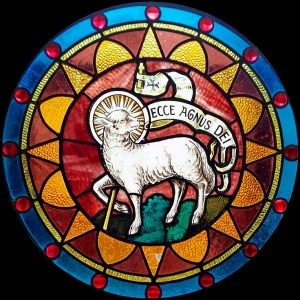
Ecce Agnus Dei (Behold the Lamb of God), unknown artist, Heritage Hall, Saint Meinrad Seminary and School of Theology, St. Meinrad, Indiana, USA.

Click here to read today’s Sunday Mass Readings.

John [the Baptist] was standing with two of his disciples, and as he watched Jesus walk by, he said, “Behold, the Lamb of God.”       John 1:35.

Click on words highlighted in red for further information.

All Catholics are very familiar with the words “Behold the Lamb of God, behold him who takes away the sins of the world”. They are said at every Mass, just before communion. It could be said that they represent a final reminder of God’s love, and our own willingness to ask forgiveness for sins, before receiving the Lord.  The Latin Mass states those words as “Ecce Agnus Dei…” and many of us will be familiar with that, found as mosaics or artwork in many Catholic churches to this day, and also in the picture above. John the Baptist was the first to confer that title on Jesus, the Lamb of God. So far, so good. But why “lamb”? It’s not the first image that occurs to one when seeing a holy man. In fact, it is strange applying this to any man. What was in John’s mind?

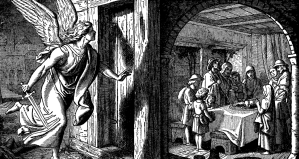
Not being a sheep farmer or anything like it, I rely like many others on the Internet. There I found this. You will find there a picture of utter innocence, energy and love of life, all of which certainly applies to our Savior. Then there is the lamb of the Passover. You will recall God’s instructions to Moses on the night before the death of all first born males, the 10th plague: An unblemished lamb was to be killed and its blood spread on the doorposts of all the Hebrew homes. In that way the Angel of Death would pass over their houses, hence protecting life. But also, they must eat the prepared lamb in readiness for their journey to the Promised Land, beginning that night, as sustenance. And finally there is the image of the lamb from Isaiah:  “He was led like a lamb to the slaughter. And as a sheep is silent before the shearers, he did not open his mouth.” (Isaiah 53:7). Remember that many lambs were slaughtered in the Temple in Jerusalem as an offering to God at Passover time. Indeed, it is thought that was happening as Jesus, Lamb of God, was hanging upon the cross, as Passover was beginning.  Remember that the previous night, at the Last Supper, Jesus had given them his own body as sustenance, under the guise of unleavened Passover bread, for the journey through this life. The parallels are simply breathtaking.

The Angel of Death and the First Passover, Foster 1897, Bible Pictures and What They Teach Us.

But the other readings follow a different route. The first reading, from the first book of the prophet Samuel, concerns his vocation, his literal call from God, which is the meaning of the word vocation. And the second reading, Paul writing to the Christians in Corinth, is a blueprint on how to run our lives, and so be open to God’s call, and to conduct ourselves based on the model of the life of the Lord himself. So today’s readings, taken together portray the perfect Christian life, well-lived, vibrant with goodness and purity, open to God’s call to each of us, and centering on the source of all life and happiness, the Lamb of God himself.

The Adoration of the Mystic Lamb, Hubert and Jan van Eyck 1432, St. Bavo’s Cathedral, Ghent, Belgium.

PLEASE SEND THIS REFLECTION TO THOSE YOU THINK WOULD APPRECIATE IT.

THANK YOU.

Reflections on next Sunday’s Mass Readings will be posted on Wednesday.

Please send your reflections to: RogerJohn@aol.com

© SundayMassReadings.com