SUNDAY 30 NOVEMBER 2025: THE FIRST SUNDAY OF ADVENT.

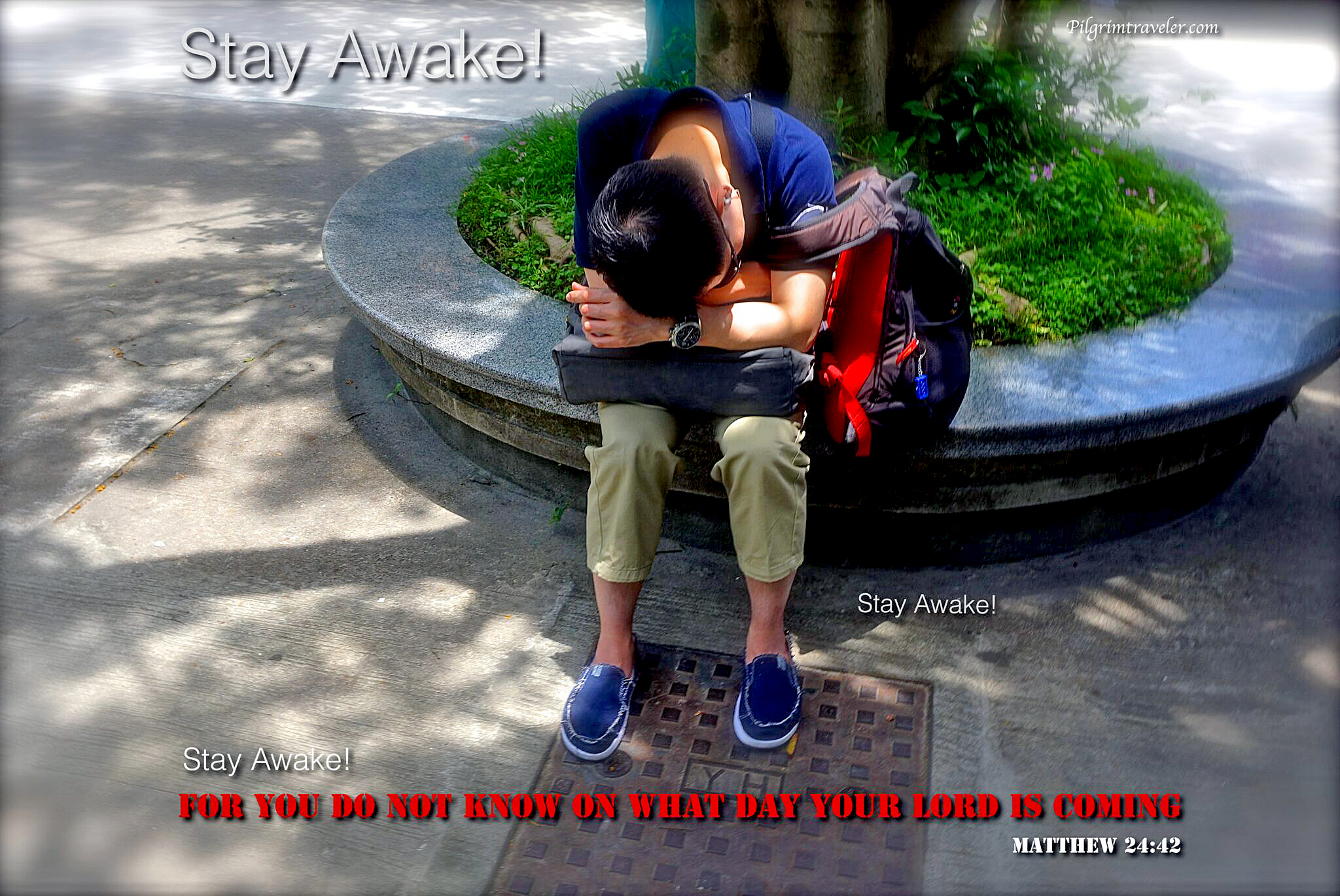
Pilgrim Traveler, Matthew 24, “Stay Awake!”

(Jesus said to his disciples) Therefore, stay awake! For you do not know on which day your Lord will come.     Matthew 24:42.

Click here to read today’s Sunday Mass Readings.

Click on words highlighted in red for further information.

The presence of the Advent wreath up at the altar today and the lighting of one candle of the four tells us immediately that Christmas is around the corner, and that we have four weeks or so to prepare for it. The tradition of the Advent wreath started with our Lutheran brothers and sisters in northern Germany in the first half of the 19th century. Pastor Johann Hinrich Wichern had the inspiration when working with poor children in Hamberg. He must have become so fed up by the children constantly asking “Is it Christmas yet?” (the 19th century version of “Are we there yet?”) that he created this:
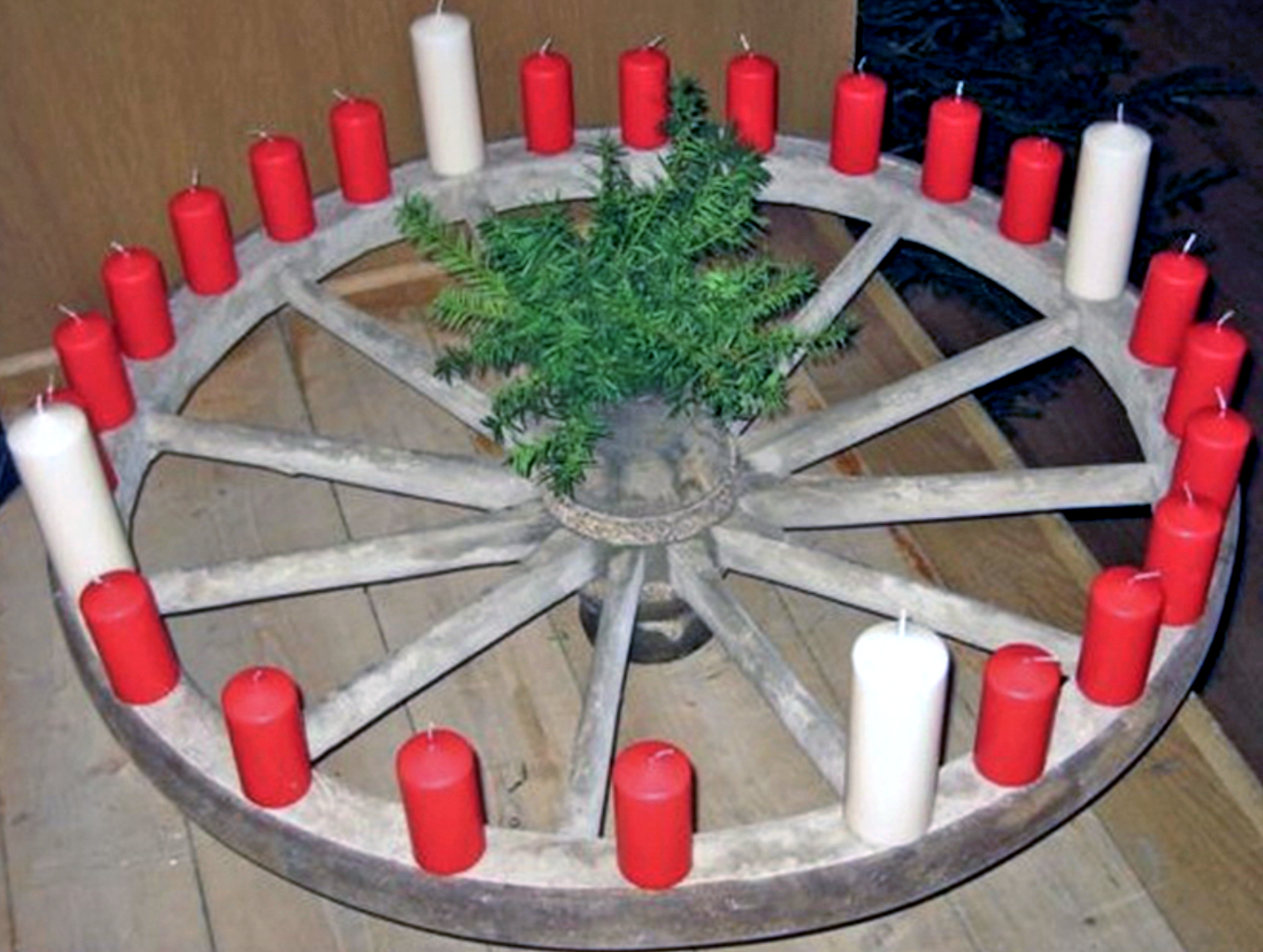
Recollections, Advent and Johann Hinrich Wichern, November 2017.

Not quite what we see today. The original wreath, with a base in an old cartwheel, shows all the days of Advent leading up to Christmas, with white candles indicating the Sundays. Quite elaborate compared to the present-day version! It’s a sort of 3D version of the Advent calendar!

This Sunday begins a new church year and with it our hopes and prayers for a year of peace and justice, of happiness and rejoicing, of goodwill among all people. Isn’t that what Christmas is supposed to be? Isn’t that what the angels themselves sang to the shepherds in the fields abiding? But as ever, we mustn’t get too carried away, with today’s gospel telling us to stay awake in a season when excess and collapse are more likely to be found than quiet reflection and attention. But we do have this season of Advent when we can do exactly that! Now is the time when we can reflect on the wonder of this season, when the almighty majesty of the Eternal Godhead took frail flesh and was born not into fame and glory but into a stable sheltering ox and ass! What a wonder, what an example; what a lesson. That we commemorate such a humble event 2000 years later is itself a wonder. It was, I believe, the culmination of God’s plan for us the human race and with whom, Genesis tells, God was “very pleased”. How so?

The greatest gift we have is free will. Unlike the beasts of the field, locked into the basics of getting through the day, we have choices. For whatever reason, we might forgo having a meal for some reason greater than responding to hunger. We might go and climb Mount Everest simply because “it is there”. We can create artwork to strengthen the beauty around us. Animals seem to have no idea or ability to do such. Only we can. But (as always) this greatest gift began to be used for the wrong purpose. We can cause grief, hatred, evil simply because we can. That was why, I believe, God entered human life. Ancient Canaan, the land promised to Abraham by God, practiced child sacrifice at that time. Even worse, the Canaanites thought they were doing the right thing. If they needed something tremendous, such as relief from famine, or the threat of invasion, such big requests of the gods (Moloch in particular), demanded a big price (which reflects normal human experience). But in this case it was child sacrifice. And I believe it was this that caused our God to intervene in human history. Abram/Abraham heard a tiny voice, believed it to be holy and obeyed it (Genesis 12). In that way, God found a believer, sent him into the heartland of this abomination, and so began the history of God’s people, beginning with the elimination of that terrible practice  (which took a long time). For about 2000 years God slowly revealed the divine nature: God was found to be  loyal, powerful, forgiving, a listener, merciful, a lover of freedom and open to relationship. With that finally established, God’s Son arrived and displayed those identical qualities in his lifework. Being fully human, Jesus showed us how to be fully human, acting and behaving in the way God has always wanted us to behave. And everything Jesus did in his ministry we can too, given the gifts which God has provided for all of us, without exception. And Christmas marked the arrival of this man who showed us the true meaning of being human utterly and completely. We can all be like him, he using his gifts, we using ours. 

And so how about an Advent resolution? To be as truly and completely human as Jesus was. So we can never excuse ourselves with the plaintive “I was only human” to explain a fault. No – had I been truly human I would never have done/said/thought the thing I should not have. It is to betray our humanity if we excuse ourselves in that way. To be completely human is to get as close to the Lord as we can, the One who made us human, and to ask guidance or forgiveness when we have failed, that is, become less than human. In this way we will be in great shape when the Great Day arrives, when Pastor Wichern gave a sigh of relief, and we sing Adeste Fidelis!

St. Mary’s Catholic Church, Navan, County Meath, Republic of Ireland.

THERE IS AN IMPORTANT MESSAGE HERE WHICH MIGHT BE GOOD NEWS TO SOMEONE YOU KNOW.

IF SO, PLEASE FORWARD IT TO THEM. 

THANK YOU.

©SundayMassReadings.com

SUNDAY 15 DECEMBER: THE THIRD SUNDAY OF ADVENT: GAUDETE SUNDAY.

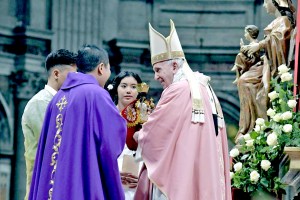
Pope Francis Celebrates Gaudete Sunday with the Filipino Community in St. Peter’s in 2019.

Click here to read today’s Sunday Mass Readings.

Have no anxiety at all, but in everything, by prayer and petition, with thanksgiving,
make your requests known to God. Then the peace of God that surpasses all understanding will guard your hearts and minds in Christ
Jesus.
  Letter to the Philippians 4:6-7.

Click on words highlighted in red for further information.

“Gaudete” means Rejoice in Latin. Look at today’s readings. The first, from the prophet Zephaniah, begins, “Shout for joy, O daughter Zion! Sing joyfully, O Israel! Be glad and exult with all your heart, O daughter Jerusalem!” The second, from St. Paul’s letter to the Philippians, begins, “Brothers and sisters: Rejoice in the Lord always. I shall say it again:  rejoice!” And in the gospel, John the Baptist “Preached good news to the people”. Why all this rejoicing? Because we are roughly at the half-way mark to Christmas, the ultimate good news, when God became one like us, when we were considered to be good enough to have God come dwell with us and be one with us. Even the celebrant at Mass may wear rose-colored vestments, one of only two Sundays that is permitted (the other is Laetare Sunday, the fourth Sunday of Lent. That Latin word also means “rejoice” but to express it externally; gaudete means to rejoice internally). Even the third candle on the Advent wreath is usually rose colored! It all signifies a lightening in the somber atmosphere of Advent and we should all reflect the joy and conviction that the incredible is about to happen, as it does each year, that God – God! – wanted to be one like us in all things but sin.

So what does that all mean? Do we jump up in the air and dance around like Scrooge in the classic 1951 version of Christmas Carol when he realizes his true identity – vocation even – of being fully human with all its implications. Well, maybe, if we fully realize and accept that we are all considered to be good enough and worthy enough to have God come live among us out of pure love. That would certainly invite us all to be truly happy and even excited to be a child of God! What more could one ask? Well, patience to wait for the real day, and the time left to prepare for it in the best possible way. Joy does not have to expressed in outward, extravagant ways, though at Christmas time it is almost required! But we are just half way there. For us, the joy expressed in today’s name and readings should perhaps be the joy of preparing for the arrival of the Christ Child. There is a special joy in such activity. Imagine a most welcome Christmas visit of a beloved relative from afar; all must be ready. The house must be clean, the crystal immaculate, the china sparking – everything. Apply that each to ourself, our soul, our innermost self. Getting rid of the nonsense – the stuff which clogs things up for no good reason – and clean the inner crystal and gold, the inner soul, the real me. The thought that I – you – we are doing all that brings with it a joy which is palpable. It is the “I can’t wait” moment we felt as a child, especially when allied to the major effort to bring ourselves into a state of grace ready for the arrival of the author of all joy. What a welcoming person each of us will be. It is a golden opportunity once more to restart anew. Under the loving eye of the Father, let us ask the Holy Spirit of God to infuse us with the energy, the strength, the excitement to be completely ready for The Day.

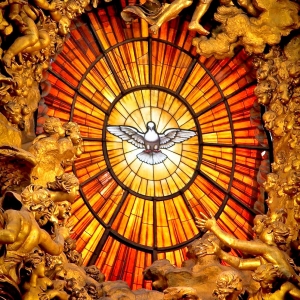
The Blessed Trinity with Saints, Durante Alberti 1581, The Venerable English College, Rome, Italy.

IF YOU KNOW SOMEONE WHO WOULD ENJOY THESE REFLECTIONS, PLEASE LET THEM KNOW. THANK YOU. 

Reflections on next Sunday’s Mass Readings will be posted on Wednesday.

Please send your reactions to: RogerJohn@aol.com

© SundayMassReadings.com 

SUNDAY 1 DECEMBER 2024: THE FIRST SUNDAY OF ADVENT.

Be Vigilant at All Times and Pray, The Lay Institute of Divine Mercy, California, USA. 

Click here to read today’s Sunday Mass Readings.

“Be vigilant at all times and pray….”    Luke 21:36.

Click on words highlighted in red for further information.

You know of course that our Christian scriptures were originally written in Greek, not Latin. So today, as we welcome the first Sunday of Advent, note that the word advent comes from the Latin word adventus, meaning “coming”. This Latin word is a translation of the original Greek word “parousia”, παρουσία, which more often than not in the New Testament means the second coming of the Lord at the end of time. Perhaps this should be the word used in today’s gospel as it is so focussed on that specific moment when Jesus will return in all his glory. But it certainly trains our sights on the whole intent of Advent – the arrival of the Lord. We would normally mean this as a preparation for Christmas Day, but today’s readings remind us that there is a much greater meaning here. We should never forget that we are all on a much greater journey, one which will conclude with each of us standing before the Lord of Light, either when we are called from this life, or on the Last Day, should we be witness to that. 

So there are, it seems, three possible arrivals in mind here. First, of course, is the 25th December (or January 7 for our Orthodox and some of our Eastern Catholic brothers and sisters), the commemoration of the arrival of Jesus in our midst, poor, laying in a food trough for animals and visited by the shepherds, the poorest of the poor in that society. It is hard to imagine a more challenging start to anyone’s life! Then there is the certainty of each of us being called to judgment when we leave this world. We should be prepared for that moment. As today’s gospel says, “Beware that your hearts do not become drowsy from carousing and drunkenness and the anxieties of daily life, and that day catch you by surprise like a trap”. Good advice for the Christmas season. Although this refers to the Second Coming, it can easily be applied to the last moments each one of us has on earth: are we ready, even if at Christmastide? But we should not forget that the reading’s intent is to remind us of the promise of the end of time, the parousia, the return of the Lord in majesty and power, to judge us all. Well, I know which one of those I am most comfortable with! The presents are being readied, the decorations are about to be put up, the special foods purchased, and on and on. As the song says, “It’s the most wonderful time of the year!” 

But these days everyone complains that the whole season is commercialized beyond imagination. Consider, for example, the humble Advent calendar on sale in many places. Some are “luxury” editions, with expensive gifts behind every day-gate. And that is just in anticipation of the day! Can’t help thinking that a donation to a favorite charity would be money better spent. Shouldn’t that be an automatic part of the season for all of us? I do remember that, as a child, Advent seemed endless, a long, long time waiting for Christmas to come. Perhaps there’s a lesson there too. It gives us time to prepare what’s in our mind and heart and set up the decorations to welcome the Lord into our very soul, the innermost me – you – us. The baby Lord should find there something better than a shabby dwelling in a cattle shelter, adequate to the need, but not suitable for the arrival of the King of the Universe, as last Sunday’s celebration says. Something beyond spring cleaning is called for here. So be it – let the preparation begin!

Christmas enacted in St. Patrick’s Church, North Little Rock, Arkansas, USA.

IF YOU FEEL MOVED TO SHARE THIS REFLECTION WITH ANOTHER, PLEASE DO SO. THANK YOU. 

Reflections on next Sunday’s Mass Readings will be posted on Wednesday.

Please send your reactions to: RogerJohn@aol.com

© SundayMassReadings.com 

SUNDAY 31 MARCH 2024: EASTER SUNDAY: THE RESURRECTION OF THE LORD; THE MASS OF EASTER DAY.

The Face on the Shroud of Turin: Taken by many to be the face of the Lord at the moment of Resurrection.

[Peter said], They put him to death by hanging him on a tree. This man God raised on the third day and granted that he be visible, not to all the people, but to us, the witnesses chosen by God in advance, who ate and drank with him after he rose from the dead.     Acts of the Apostles 10:39-41.

Click here to read The Easter Sunday Mass Readings.

Click on words highlighted in red for further information.

On this day our Greek Christian brothers and sisters do not say “Happy Easter” to each other, rather they say Christos Anestē (Χριστός ἀνέστη) Christ is risen! To which the response is Alēthōs Anestē (Aληθῶς Aνέστη), He has truly risen! So much closer to the most tremendous event in human history than the lame, non-Christian, word, Easter which parallels the German word Ostern, and is of uncertain origin. (One view, expounded by the Venerable Bede in the 8th century, was that it derived from Eostre, or Eostrae, the Anglo-Saxon goddess of spring and fertility!). Almost all the other languages have a version of the Jewish feast of the time of the resurrection, Passover: Pasen (Dutch), Páska (Icelandic), Pâques (French), Pasqua (Italian). But not us English speakers! Ah well. Whatever it’s called, it is still the foundational event of Christianity, without which, nothing. Something happened in that enclosed tomb which changed the world. After suffering the most brutal death imaginable, Jesus conquered death and rose to live forever. And, what is more, he invites us all to follow him, no matter what death we go through. And consult the literature based on the Shroud of Turin, the most heavily studied artifact in history. I believe its revelations have even moved some scientists to convert! It’s almost as if the Lord knew that, at come point in history, its mysteries would be uncovered, such as its three-dimensional properties.

All that is very interesting, but what is this feast day all about? It is, perhaps, the reversal of the opening story in the Book of Genesis. The story of the first humans, Adam and Eve, and how they destroyed the perfect world they were invited into, and how they brought sin and death into the world. That strongly suggests that we humans are not designed for death, but for life! We are not supposed to die but to live in God’s presence forever. But being who and what we are, that was not to be. Given the greatest of gifts, our total freedom, we have chosen many times to use that gift in ways which are destructive and plain evil. Each one of us. So our freedom equated with death, the end of freedom. But that was not God’s plan. Originally the Garden of Eden was for us to be totally free, happy and fulfilled – and eternal! Having destroyed that possibility, the eternally merciful God in whom all our trust is placed, decided on another course. This can lead us all, should each one of us choose, to eternal life and happiness, back to the Garden of Eden. Through the centuries, first of the slow revelation of the nature of our God, seen in the Old Testament, the revelation of God the Father, and then with the actual presence of God’s Son among us, demonstrating how God wishes us to use our freedom with the gifts given us, we have a blueprint of human life in the present time of God the Holy Spirit, which can lead us to eternal happiness, should we choose. And today the author of that blueprint confirmed everything by rising from the dead, to prove that his example is definitive. No matter what is thrown in our way, no matter how much evil we have to face, if we follow his example in all things, we will join him for all eternity in joy.

So this day is the crucial proof of Jesus’ example of how to live our life. It’s not easy – look at what happened to him! But most of us will be spared such suffering, but even if not, perseverance is key. The vision of that serene face (above), triumphant over utter evil, should guide us through everything. We have the strength, through his body and blood given freely to us, to conquer death, as he did, on this day of days.

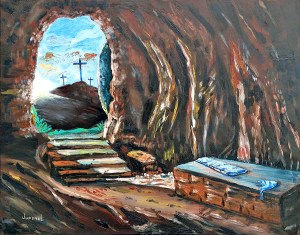
The Empty Tomb, Joseph Juvenal, no date.

PLEASE FORWARD THIS REFLECTION TO THOSE YOU THINK WOULD APPRECIATE IT.

THANK YOU.

Reflections on next Sunday’s Mass Readings will be posted on Wednesday.

Please send your reactions to: RogerJohn@aol.com

© SundayMassReadings.com