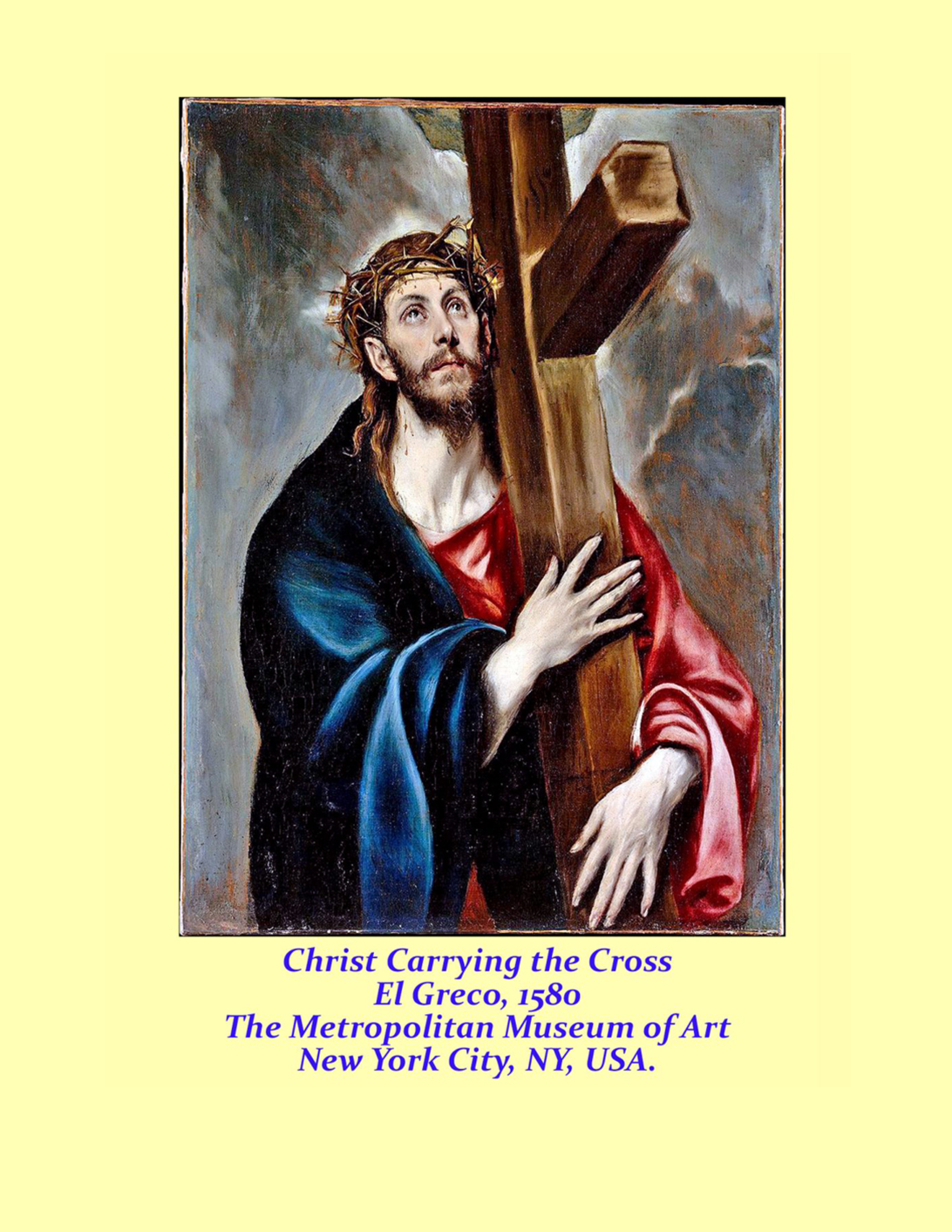

The Loaves and Fishes, Benedictine Church of the Multiplication, Tabgha, Sea of Galilee, Israel.
Click here to read today’s Sunday Mass Readings.
Click on words highlighted in red for further information.
The multiplication of the loaves and fishes remains one of the most famous of Jesus’ miracles. Next to the Sea of Galilee, it is recorded in mosaic in the Church of the Multiplication (as seen above), probably dating from the 5th century, possibly based on ancient memories of the event. Scholars love to try and explain Jesus’ miracles as events which can be explained easily and simply. Their take on this event is, in fact, quite plausible. No-one out for the day, in this case following the Lord in the hope of seeing him perform another “sign”, perhaps healing someone who was sick, would go without taking something with them for the journey, such as a picnic. The boy with the loaves and fishes might well have offered his picnic to Jesus’ assistants, possibly at the urging of his parents, who, in their turn, would have shared it with those all around them. This, scholars suggest, would have prompted a general outburst of sharing and solidarity among everyone, each family sharing what it had brought with others nearby. So it was a miracle of total generosity! Either way, it is a remarkable example of what the Lord’s presence meant in practice, and it parallels the event recorded in the Second Book of Kings, today’s first reading. And then the second reading sets the tone of these two events, with all of us being reminded “to live in a manner worthy of the call you have received, with all humility and gentleness, with patience, bearing with one another through love, striving to preserve the unity of the spirit through the bond of peace: one body and one Spirit…” A well nigh perfect call to live always with a spirit of generosity and willingness, always acting compassionately towards others.
Bearing all that in mind, this Sunday’s readings got me thinking about my trip to the Holy Land in July 2018. I stayed in a hotel inside the Old City, in walking distance of the Holy Sepulchre, which is often called the holiest Christian church in the world. It is claimed that here Jesus was crucified, died, was buried and rose from the dead.
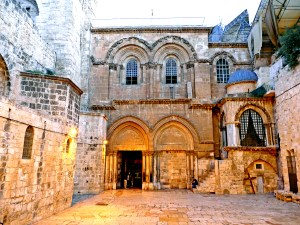
The single entrance to the Holy Sepulchre. Note the ladder against the upper middle window. It has been there since at least 1728! Disputes between the churches are responsible for that situation.
The site of the resurrection is contained in a small building within the bigger church, called the Aedicule (or Edicule). My first journey, at about 5 in the morning, was to the Sepulchre. Naturally there were few people there, but a service had already begun. Three caretaking churches are responsible for the main building: the Greek Orthodox church, which has the biggest share of all, the Roman Catholic Church, managed by the Franciscans (who I found were rather arrogant), and the Armenian Apostolic Church, which could claim to be the oldest Christian country in the world. That arrangement was established under the old Ottoman Empire, and has remained unchanged ever since. The churches in that time have NOT cooperated happily. There have even been fistfights between them inside the church! (they seem to be mostly between the Greeks with rounded hats and the Armenians with pointed headgear). They had to cooperate in the last few years because of a situation where the Aedicule was in danger of collapsing! Let us hope the spirit of cooperation continues. Returning later on my first day it was different. Crowds of people were trying to get in, there was a very long line to visit the Aedicule, and I had to push my way to get around. It was very difficult to respect the sanctity of the shrine at all.
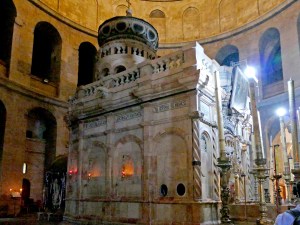
The Aedicule, site of the Resurrection.
I did manage to enter the Aedicule, but was scarcely kneeling down when I was told I had to get out! In fact, unlike the Sepulchre, the holiest place I found in Jerusalem was the Catholic Church of St. Anne, who was, by tradition, the mother of Mary. The church is next to the ruins of the Pool of Bethesda, found when the church was being restored. That was the scene in John 5:1-9 where a paralyzed man was healed by Jesus. It is claimed that Mary herself was born nearby and there is a tiny chapel in the church commemorating that wondrous event. The church was beautiful, silent (I was the only one present for a time), and holy. I was moved to sing the beautiful Basque carol The Angel Gabriel from Heaven Came there, in the wonderful acoustics. It was a moment of pure beauty, which I had expected of all the sites in Jerusalem, but rarely found.
I say all this because today’s Scripture calls for generosity, respect for others and cooperation between people. It is wonderful when you find it, and very uncomfortable when you expect it but do not find much of it, and horrible when it is completely absent. But today’s readings call us to be generous, caring and respectful at all times and in all circumstances, so that the Lord would be pleased and would gladly stand with us. That would be a genuinely Christian moment and a genuinely Christian event, and the possible lesson for us all.

The Church of St. Anne, Jerusalem.
PLEASE LET OTHERS KNOW OF THIS REFLECTION OR, PERHAPS, FORWARD IT TO THEM.
THANK YOU.
Reflections on next Sunday’s Mass Readings will be posted on Wednesday.
Please send your reactions to: RogerJohn@aol.com
© SundayMassReadings.com
SUNDAY 14 JULY 2024: THE FIFTEENTH SUNDAY IN ORDINARY TIME.

The Twelve Apostles, Greek City Times.
Jesus summoned the Twelve and began to send them out two by two and gave them authority over unclean spirits….. Mark 6:7.
Click here to read today’s Sunday Mass Readings.
Click on words highlighted in red for further information.
Last year, a friend of mine, in her 80s, decided to up and move from New York to Delaware to be closer to her family. Well, the stress involved in that was significant. She had so much “stuff” that the project was overwhelming. She almost abandoned the whole exercise! Then we come to today’s gospel, which could be considered as the mirror opposite of all that. Jesus ordered (I think you could say that) his followers “to take nothing for the journey but a walking stick- no food, no sack, no money in their belts. They were, however, to wear sandals but not a second tunic”. Would I be right in saying that that would be a major challenge to everyone reading this? Another friend once commented that the closets in apartments built before, say, 1940 are almost always too small for the “stuff” we accumulate today, being wealthier and living longer. And trimming all that down to manageable proportions for a house move becomes massive. So what is Jesus driving at with this order to his disciples to take essentially nothing with them? At first sight, it seems like an instruction to depend entirely on and to trust in God and, as it were, the generosity of strangers.
Almost certainly it is a repetition of a well known theme based on the idea that the wealth of this world as a massive hindrance to admission to the next. Jesus said that it is very difficult for a rich man to gain eternal happiness, that it is easier for a camel to go through the eye of a needle than for a rich person to enter the Kingdom of God (Matthew 19:24). Hence, it seems, the harder one’s life in this world is (and the way we deal with it), the more likely we will enjoy eternal happiness in the next. Remember also the reflection on the widow’s mite and the story of Lazarus the beggar. The poorer we are, the more we might rely on God. And the converse of that thought is that the more we have of the riches of this world, the less we might have of the thought of who is responsible for all that, and what our responsibility is with what we should do with it. So this warning of the perils of wealth in this world are very close to the heart of Jesus’ message. He had no condemnation of wealth as such in this world, I believe, but he had very much to say about what we must do with it if we have it.
So today’s gospel seems to be yet another call for self-examination, with a very critical eye to what we do with our money. We must, it seems Jesus is saying, do all we can to help those who are not as fortunate as us, where we can bring health in mind and body (today’s gospel) to the less fortunate through our generosity of those causes that seek to provide them. That might mean a modest decline in the ability we may have to spend on ourselves, but Jesus clearly states that it is worth it; we are all brothers and sisters in the eyes of God.
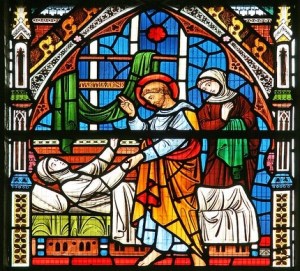
Anointing the Sick, Ely Cathedral, Cambridgeshire, UK
PLEASE LET OTHERS KNOW OF THIS REFLECTION OR, PERHAPS, FORWARD IT TO THEM.
THANK YOU.
Reflections on next Sunday’s Mass Readings will be posted on Wednesday.
Please send your reactions to: RogerJohn@aol.com
© SundayMassReadings.com
SUNDAY 7 JULY 2024: THE FOURTEENTH SUNDAY IN ORDINARY TIME.


How and Why Jesus Chose His Friends, Joseph Mattera 2023, Church Leaders.
PLEASE FORWARD THIS REFLECTION TO THOSE YOU THINK WOULD APPRECIATE IT.
THANK YOU.
Reflections on next Sunday’s Mass Readings will be posted on Wednesday.
Please send your reactions to: RogerJohn@aol.com
© SundayMassReadings.com
SUNDAY 30 JUNE 2024: THE THIRTEENTH SUNDAY IN ORDINARY TIME.
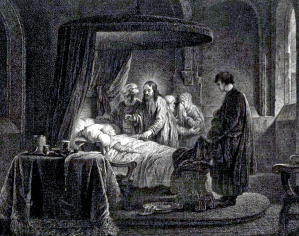 The Resurrection of the Daughter of Jairus, Gerbrand van den Eeckhout 1767, The British Museum, London, UK.
Click here to read today’s Sunday Mass Readings.
So [Jesus] went in and said to them, “Why this commotion and weeping? The child is not dead but asleep. And they ridiculed him. Mark 5:39-40.
Click on words highlighted in red for further information.
Note the curious parallels in the longer gospel today. The woman with the hemorrhages had suffered with them for 12 years. The daughter of Jairus was 12 years old. Jesus calls the woman “daughter” and the little girl is clearly Jairus’ daughter, but this is the one and only time Jesus calls anyone “daughter”, the same in the three synoptic gospels. So the intriguing question is, what does it mean? Note that the woman, suffering from the unnatural flow of blood, would be considered unclean and unworthy of living in the community – excommunicated, in other words, not unlike lepers. Remember there was an ancient belief back then that such individuals were being divinely punished as they were considered sinful in some way. Touching the hem of Jesus’ garment would make it unclean – but she was prepared to risk it; being discovered, however, was a very unpleasant surprise, hence the “fear and trembling” she exhibited. The community would turn on her as a result; remember anyone or thing she had touched would have been rendered ritually unclean. But Jesus knew power had gone out of him – to cure her. So he turned to find out who was responsible. Of course, far from condemning her, his compassionate response was, “Daughter, your faith has saved you. Go in peace and be cured of your affliction”. So one action resulted in a new life for an outcast, and the other, a new life for an infant, both of them owing their new life to the Lord, now his daughters.
Two other interesting points in today’s gospel. One, that Jesus knew the girl would be hungry, and told her parents to give her something to eat. People who are the happy recipients of a curing miracle, as recognized by the church, are frequently ravenously hungry (search for “hungry” or “hunger” in that long article from the National Library of Medicine on miracles). Not surprising as their bodies, now cured, have been starved of nourishment for a long time. The other point is the Aramaic quotation “talitha koum”(little girl, get up) as quoted in Mark’s gospel. Although the gospels of Matthew and Luke also talk of this miracle, only Mark quotes Jesus’ actual words in the language he spoke. It can also be translated “little lamb, get up” something you would expect of The Good Shepherd! As Mark is considered to be the earliest gospel to be written down, it is also closest to the actual event, and might well be quoting a witness to the event.
Now, finally, consider the people involved in this gospel passage. Jairus was a synagogue official, hence a leader of society, and presumably wealthy. The outcast woman was from the lowest of the low, unclean and no doubt familiar with rejection in all its terrible forms. Yet Jesus treated them equally, with compassion and care. He loved both ends of this societal spectrum. No-one is excluded from Jesus’ outstretched arms. We are all welcome: no exclusions anywhere. If you are ever tempted to think of yourself as too bad, awful, sinful, rejected, or anything like that, it is your own judgement, not the Lord’s. Jesus never rejected anyone – including those who killed him. All are welcome, anytime, anywhere. It is in his loving embrace that we are cured, restored to the dignity of God’s children.

The Sacred Heart of Jesus, Responding to Love with Love.
PLEASE FORWARD THIS REFLECTION TO THOSE YOU THINK WOULD APPRECIATE IT.
THANK YOU.
Reflections on next Sunday’s Mass Readings will be posted on Wednesday.
Please send your reactions to: RogerJohn@aol.com
© SundayMassReadings.com
SUNDAY 23 JUNE 2024: THE TWELFTH SUNDAY IN ORDINARY TIME.
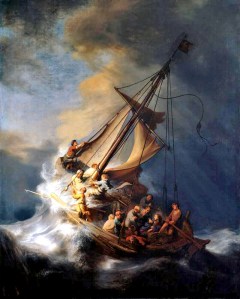
The Storm on the Sea of Galilee, Rembrandt 1633, stolenfrom the Isabella Stewart Gardner Museum, Boston, MA, in 1990.
Click here to read today’s Sunday Mass Readings.
Click on words highlighted in red for further information.
One of the greatest fears of the ancients was the sea. Remember the first statement in the Book of Genesis: “Now the earth was formless and empty, darkness was over the surface of the deep, and the Spirit of God was hovering over the waters.” Utter unpredictability and threat of chaos confronted anyone setting sail in those days. Typically ships sailed as close to the shore as possible to lessen the threat. 20 ancient sailing superstitions can be seen here. And in today’s gospel we have exactly that, a sudden squall, the disciples – many of whom had been sailors remember – were totally preoccupied with bailing water out of the boat, which apparently was in danger of sinking. And Jesus slept! And probably more in hope than expectation they woke him up, distraught at the possibility of drowning, as I suspect any one of us would be in those circumstances. Then, as the gospel says, Jesus told off the wind and basically ordered the sea to quieten down! And they did! 20 centuries later, we still cannot control the elements, and setting sail even now means we still have to be prepared for conditions which might well bode ill (think of the safety procedure today before every flight or at the start of a cruise). A sinking ship because of bad weather is unusual today – but not unknown. And today’s gospel event is classified as a “nature” miracle, one that is difficult if not impossible to explain by any known laws of nature (other than the possibility that the storm simply died away as quickly as it had sprang up), and this is possibly the reason that many biblical scholars are reluctant to admit to their possibility. But bare in mind that the Catholic church believes strongly in miracles to this day and insists on them as evidence that a person who has died and was renowned for holiness is close to God and consequently can be asked for favors…. And the result of today’s gospel miracle was the awe it inspired in Jesus’ followers, who certainly knew a life-threatening storm when they saw one and had probably had experience of it. It was another step towards their realization that this man was, indeed, the Son of God, to be trusted in any and all situations, a message which lives down even to our own highly-urbanized age. And although very few of us are involved in the maritime life, we are all of us familiar with the storms of life in its myriad forms. They can be just as deadly as the storm in today’s gospel, and each of us can wake up the Lord and ask for help! Faith is a very stable support in any situation. We may not receive that which we asked for, but somewhere in the mist there will be a silver lining which will herald the presence of God. It is that in which we may trust, come what may.
Trusting God in the Storm, Dr. Michell Bengtson.
PLEASE FORWARD THIS REFLECTION TO THOSE YOU THINK WOULD APPRECIATE IT.
THANK YOU.
Reflections on next Sunday’s Mass Readings will be posted on Wednesday.
Please send your reactions to: RogerJohn@aol.com
© SundayMassReadings.com
SUNDAY 16 JUNE 2024: THE ELEVENTH SUNDAY IN ORDINARY TIME.

The Cedar of Lebanon, Coniferous Forest 2024.
Thus says the Lord God: I, too, will pluck from the crest of the cedar the highest branch. From the top a tender shoot I will break off and transplant on a high lofty mountain. Ezekiel 17:22.
Click here to read today’s Sunday Mass Readings.
Click on words highlighted in red for further information.
Whenever Scripture mentions the cedar tree, you can be almost certain it is a reference to the magnificent cedar of Lebanon, as pictured above. Lebanon then as now was to the north of the Holy Land. It even has a cedar on its present-day flag:

And although in the Middle East there is a significant Lebanese Christian minority with an ancient tradition, the Catholic Maronites. The mention of the cedar in today’s first reading is from the Old Testament prophet Ezekiel and he was dealing with the convulsion of the defeat and exile of the Jews to Babylon and the total confusion as to what was going to happen to them. Hence the reference to the cutting and replanting of a symbol of strength from the north (and the Babylonian captivity was also to the north) and its endurance, but again all that takes a little bit of agricultural knowledge to understand. After a rapid tutorial on tree cloning, today’s reading allowed me to understand a little more of the metaphor being used here. First, cloning a tree is difficult, but possible. You should use a cutting from a young tree of perhaps the thickness of a pencil. Well, that requirement challenges the magnificent cedar parallel right there with God taking a clipping from the top of a full-grown tree, except, of course, it is the Lord God promising this, with whom anything is possible. God seems to be promising that the exiles in Babylon are still the Chosen of God and similar to the majestic Lebanese cedar. They were exiled in Babylon, north of the Holy Land itself, but were promised that they would be returned to their land and would once more be strong and magnificent in Jerusalem. All other cedars would then seem smaller in comparison, and the new Jerusalem after the return of the exiles would be much greater than before. Compare all that to today’s gospel.
Jesus was talking about the kingdom of God and how, like the tiny mustard seed, it would also grow, paralleling the growth of the mustard seed into the “the largest of plants”, or the seeds thrown from the farmer’s hand which will become rich sheaves of wheat from almost nothing. And, of course, he was talking to those who would know all about scattering seeds, though they were probably unaware that they would be scattering the seeds which would become the kingdom of God; only when they came to understand the freedom and joy of his message would they then begin to spread the seeds of the Good News. And St. Paul seems to confirm that idea when he talked about all of us ultimately appearing before the judgment seat of Christ to make account of our life on earth. Did we make known our devotion to Christ’s teachings when living with others? Could they see that Christians have a freedom and a joy which comes from the hand of Jesus?
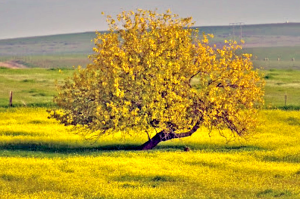
The Mustard Tree (Bush?), Kristi’s Morning Devotional.
So, given all that, today seems to be a calling to each of us to make an accounting, at this time, and to examine our Christian life and see if we are doing any scattering of the good seed at all. Can I point to times and places when what I said or did made a positive difference in someone’s life? Have I been Christ to the world in any way at all? Have I cultivated the seedlings of life, light and love to grow in my heart and spread them to those around me? And not by giving an impression of being a holy joe, but by loving example and generosity? It’s not easy, but it is necessary. And it is what is meant by being Christian at all times and in all places.

Sowing seeds on the Farm, Westend61.
PLEASE FORWARD THIS REFLECTION TO THOSE YOU THINK WOULD APPRECIATE IT.
THANK YOU.
Reflections on next Sunday’s Mass Readings will be posted on Wednesday.
Please send your reactions to: RogerJohn@aol.com
© SundayMassReadings.com
SUNDAY 9 JUNE 2024: THE TENTH SUNDAY IN ORDINARY TIME.

Adam and Eve, stained glass, provenance unknown.
Then [God] asked [Adam], “Who told you that you were naked? You have eaten, then, from the tree of which I had forbidden you to eat!” The man replied, “The woman whom you put here with me— she gave me fruit from the tree, and so I ate it.” Genesis 3:11-12.
Click here to read today’s Sunday Mass Readings.
Click on words highlighted in red for further information.
The opening chapters of the Book of Genesis have been subject to furious differences of opinion and even philosophy. Many fundamentalist Christians believe them to reveal the actual, physical, beginnings of the world, made in six days, with God resting on the seventh day, and so on. Many Christians do not accept that, and instead look to alternative explanations, including this author. In my opinion, these opening chapters of Genesis reveal not the physical start of the world, but to its philosophical beginnings, and are a profound source of wisdom and understanding of the human experience. Allow me to explain.
God created all of us, all the world, all the universe. How God did this is the domain of the scientists, the “Big Bang”, dark matter, evolution and all the other attempts to understand everything. On the other hand Genesis is a source of understanding the human condition and what can be done about it. Everything begins in perfect harmony, into which humanity is placed. It is a vision of heaven. As far as we can tell, humans are the only creatures who can reason and decide which of many ways we can take in life, many of us with at least a vague hope of arriving in heaven at the end of life. But there are many obstacles in between, not the least of which is humanity itself. Here’s where Genesis (a word which means beginning) can be of assistance. Adam and Eve were given heaven to live in, to enjoy, to have children and to be happy. But one single restriction was given – not to eat the fruit of the tree of the knowledge of good and evil. So at once you know what is going to happen! It is the opening of many stories. In “The Secret Garden” for example, our heroin, being shown about her new home, is forbidden by the housekeeper EVER to go through THAT DOOR. So you know at once what is going to happen! Well in Eden of course the forbidden fruit is eaten (not named, by the way. The poor apple which is a very healthy food, is traditionally considered to be the means of our downfall). And at once things go wrong.

Expulsion of Adam and Eve from Eden, John August Swanson 2016.
After the sin was committed, Adam heard God walking in the garden and hid. Why? Because he had broken the one instruction God had given, and hence alienated himself from God, and hid. Consider that for a moment, hiding from God, the source of life and hope. Push that to its extreme and you have despair, the conviction that one is utterly alone with no source of redemption anywhere, total alienation from God and everything else, the source of all hope, a state we call despair. Clearly not a part of paradise. “Why did you hide?” God asked. “Because I was naked” Adam answered (and lied). Now just think of that. It had not been a problem before; now it is. Why? It reveals a second element of the downfall: Adam is now ashamed of his body… Even alienated from it. Draw that element to its absolute extreme and the result is suicide, fatal hatred of self. Clearly not part of paradise. God made each one of us and was pleased, as Genesis says. In God’s eyes each one of us, without exception, is beautiful. Who are we to deny this? Adam does just that. Then Adam admits the woman gave him the fruit and he ate it. He blames her. He is now alienated from his partner, his neighbor, his companion. Draw that to its extreme conclusion, fatal hatred of neighbor, and you have murder. Clearly not a part of paradise. God gave us neighbors to support and help each other; that should be our image of neighbor. Eve then blames the snake for the temptation, thereby alienating nature itself from us, we who should be the guardians and caretakers of our world, something which has come to haunt us in the last 50 years. We are destroying paradise not saving it!
Looked at in this way, the first three chapters of Genesis are a profound source of wisdom and insight. Reversing all that has just been said, namely trusting and hoping in God, who made me and each of us as God’s children, relying on and helping our neighbors within a careful and respectful use of our world is, truly, paradise. Open tomorrow’s paper and see what the grim reality is. Now place all this against today’s gospel and see its call to obey God’s will no matter what, because the opposite is of the devil, which can be so easily seen all around us. Today’s readings tell us strongly and clearly what we should avoid, and what we should be doing. And Jesus came to us to point it all out, to tell us what should be done, and he is our best and strongest neighbor, treating us the same way he treated his own family as seen in today’s gospel, as obedient children of God. In this way he helps us through all the challenges listed above to a better future and our ultimate happy union with God forever.

Christ Taking Leave of his Mother, Altdorfer c. 1520, The National Gallery, London, UK.
PLEASE FORWARD THIS REFLECTION TO THOSE YOU THINK WOULD APPRECIATE IT.
THANK YOU.
Reflections on next Sunday’s Mass Readings will be posted on Wednesday.
Please send your reactions to: RogerJohn@aol.com
© SundayMassReadings.com
SUNDAY 2 JUNE 2024: THE SOLEMNITY OF THE MOST HOLY BODY AND BLOOD OF CHRIST, CORPUS CHRISTI.
 The Last Supper, Munir Alawi November 2018.
While they were eating, he took bread, said the blessing, broke it, gave it to them, and said, “Take it; this is my body.” Mark 14:22.
Click here to read today’s Sunday Mass Readings.
Click on words highlighted in red for further information.
There are good Christians throughout the world who accept the Holy Bible as the absolute and irrefutable Word of God. Many reject the findings of science that the world is millions upon millions of years old, because the world was made in six days, according to the Book of Genesis. In Tennessee in 1925, the Butler Act criminalized teaching evolution in high schools as incompatible with biblical teaching. It remained law for 40 years. Even today there is a school of thought which attempts to harmonize biblical with scientific discovery called Creationism. So, for example, many creationists still accept that God created Adam from the dust of the earth, and Eve from one of his ribs. God did that because God can do whatever he wills. This is generally called a fundamentalist approach to biblical teaching, and is not accepted as such by several mainstream churches, including the Roman Catholic Church. However, there tends to be one major exception to this rule, where Catholicism becomes fundamental, and the fundamentalists become relativist. And that concerns today’s feastday.
At the Last Supper, Jesus took bread, blessed it, broke it and gave it to his friends saying “This is my body”. Similarly with a cup of wine, he prayed, and passed it to his friends saying “This is my blood”. We Catholics accept these words as literally true – the consecrated bread and wine are, in fact, the body and blood of the Lord, as he said. And because he also said “Do this in memory of me” every time those words at spoken by a priest at Mass, they are as literally true as they were at the Last Supper: the Lord is actually presentunder the form of bread and wine. But, and here is the point, many Protestants, including most fundamentalists, do notaccept these words as literally true, but claim they are symbolic of the Lord’s presence, not the real presence. However, Jesus did not say at the Last Supper: “This is the symbol of my body”, or “This represents my body”, or “This is a likeness of me” but said simply and directly “This is my body”. Additionally, St. Paul, in his second letter to the Philippians, says “Therefore God exalted [Jesus] to the highest place and gave him the name that is above every name, that at the name of Jesus every knee should bow, in heaven and on earth and under the earth….” which accounts for Catholics kneeling before the consecrated bread and wine, as Jesus is really present there, something most Protestants would not do. And today’s great feast is in honor of that belief. Today many parishes will carry the consecrated bread, in a monstrance, through the streets around the parish church, as witness to the belief that the Lord is present in the midst of everyday life.
 The Dominicans at St. Mary Church in New Haven, Connecticut hold a Corpus Christi procession on June 18, 2017.
It is encouraging to find out that most Catholics do, in fact, accept and believe in the “Real Presence” of the Lord, as the consecrated bread and wine is called, ranging from 64% to 95%. This might be considered to be the most deeply felt truth of Catholicism, without which our faith would be eviscerated. To walk into a church which does not accept this as a reality, a Catholic feels a coldness, an emptiness which is not pleasant or welcome. That little red lamp at or near the altar tells us that Jesus is present really and actually in the consecrated bread within the tabernacle. After the Holy Thursday mass, which ends when the sacred species (as the consecrated bread and wine are called) are taken to another private reserved place until Holy Saturday. The tabernacle is empty and the door is left open. To Catholic eyes, that seems to be wrong, cold, uninviting. It makes that time really alien, and it only occurs at that time in the year. It signifies the death of the Lord, and his body laid in the tomb. It is the opposite of today’s joyous Corpus Christi celebration, with the Lord actually present even in the streets near the church. Consequently it is up to all of us to be, as it were, the presence of the Lord in the streets, in our life, on every other day in the year, whenever and wherever we are. Perhaps that is the message of the day. We see and acknowledge the Lord present among us, and it is up to each of us to maintain that presence as children of God all all the other days in the year.
A final thought. One young man called Carlo Acutis had a special devotion to the Eucharist and documented all the eucharistic miracles he could find. He created his own website reporting those miracles recognized by the church. The National Catholic Reporter also documented this site. He was also intrigued by marian apparitions and created a site for that purpose also. He was clearly a devoted Catholic and demonstrated this in his life and in his activities. He developed acute promyelocytic leukemia, a fatal blood disease. He died on 12th October 2006 at the age of 15. In May of this year, 2024, Pope Francis recognized the second miracle attributed to this young man’s intercession, and Blessed Carlo will become Saint Carlo sometime this year, the first millennial to be so designated. His overwhelming devotion to the Eucharist powered his short life and enabled him to face acute suffering and die in the grace of God. His body lies in the church of Santa Maria Maggiore, in Assisi where he wished to be buried. He is dressed in jeans, sneakers, and a sweater. For him, the Eucharist was the means whereby he left this world to enter the glory, the peace and the happiness of the next.

The Body of Blessed Carlo Acutis, Church of Santa Maria Maggiore, Assisi, Italy.
PLEASE FORWARD THIS REFLECTION TO THOSE YOU THINK WOULD APPRECIATE IT.
THANK YOU.
Reflections on next Sunday’s Mass Readings will be posted on Wednesday.
Please send your reactions to: RogerJohn@aol.com
© SundayMassReadings.com
SUNDAY 26 MAY 2024: THE SOLEMNITY OF THE MOST HOLY TRINITY.
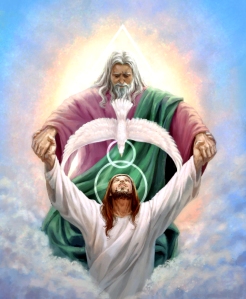
Holy Trinity, Feael, no date.
Click here to read today’s Sunday Mass Readings.
[Jesus said], “Go, therefore, and make disciples of all nations, baptizing them in the name of the Father, and of the Son, and of the Holy Spirit…” Matthew 28:19.
Click on words highlighted in red for further information.
In the year of Our Lord 325 in the ancient city of Nicaea, now the city of Iznic in Türkiye (the new name for Turkey), to the south-east of Istanbul, the Emperor Constantine, recently converted to Christianity, called a meeting of the Christian bishops of the whole church to settle certain questions which were tearing the new church apart. He wanted a peaceful Christianity where all believed the same thing, and worked and worshipped peacefully together (which would also allow him to rule more comfortably and strongly). Paganism was still a major force, and a divided Christianity might well collapse faced with any renewed pagan strength. One of, if not the, principal questions to be asked and answered was Who is God? Although that might seem to be an easy question, it was not. Take, for example, God’s statement in the 26th verse of the first chapter of Genesis: “And now we will make human beings; they will be like us and resemble us” So the question is, who are they if there is only one God? Then there was the question of the Son, Jesus. Was he created by the Father and so had a beginning, or was he “begotten” by the Father from his own being, therefore having no beginning. That dispute, actually a major fight, led to a heresy called Arianism, which claimed Jesus had a beginning rather than being eternal. That was the sort of dispute Nicaea was called to settle. The final document was called the Nicene Creed, the one recited at every Sunday Mass to this day. The question of the Holy Spirit was left to later councils, though considering the final words in today’s gospel reading, there is a clear equality with all Three Persons. That marked the beginning of the doctrine of the Holy Trinity. Last week’s readings were all about love. The nature of love is to be returned. Unrequited love, which is love not returned, is a very painful experience. So the Three Persons in One God are able to love, because it can be returned. With a One-Person God exclusively, that would be impossible: the thought of I love Me (One God) is something we Christians would have much trouble with. It is the nature of love to be returned from another person, certainly possible with one God of more than one Person, impossible otherwise. In fact, that love is so strong that it gave birth to all of us, children of God. Consequently, we are each asked to return that love to our Creator. There is a song which echoes that idea: “Love isn’t love ’till you give it away“ – but true love really has to be returned! There is one other element to be considered when thinking of the Holy Trinity (and those of you who have followed this webpage know what is about to be said). The word spirit in English comes from the Latin word spiritus. The -us ending in Latin means the word has a masculine gender. The Christian Scriptures were all originally written in the Greek that was spoken by everyone in the first century, called koine Greek. In that language, the word, translated as spiritus in Latin, is pneuma, πνεῦμα. We get words such as pneumatic (filled with air) from it. But in Greek that word is neuter, not masculine, not feminine, but neuter. So in English, we would refer to πνεῦμα as “it”. Not acceptable when referring to the Third Person of the Blessed Trinity! Πνεῦμα is a translation of the Hebrew word for spirit, רוּחַ, pronounced ruach (the ch pronounced as in Scottish “loch”). Now, note, in Hebrew the gender of this word is feminine, as is the Hebrew word for wisdom. The word also means breath or wind. So, for example, if Jesus heard us saying “he” for God’s Holy Spirit, he would be as astonished as us hearing “she” for the Holy Spirit! But doesn’t “she” sound better, fuller when considering the Holy Trinity than simply three “he’s”? And that’s the way it should really be. Consequently, the Holy Spirit of God can be considered a she! With that in mind, look with new eyes on the greatest Christian mystery of One God, Three Persons. Father and Spirit eternally uniting to beget the eternal Son. That makes much more sense, especially as each of us is invited into that eternal loving circle, as true love is never exclusive; it spreads out and invites all to enter in. Although God really cannot be tied down to our human definitions, it does help to link our human experience to the nature of God, and see that even with such limited eyesight, we are perhaps more able to enter the mystery of the Trinity. With that, it is so much easier to consider the complete unity of the Trinity, bound together in love, inviting each of us into that embrace. And the Spirit, revealed in the gospels both as “like a dove” at the baptism of Jesus, and “as of flames of fire” at Pentecost, gives us a total horizon of the nature of God’s Holy Spirit, strong, life giving and gentle, easily uniting the nature of femininity with the Father of creation and the Son of redemption. Glory be to the Father and to the Son and to the Holy Spirit inviting each of us to enter that embrace of love and light and remain in eternal happiness there forever.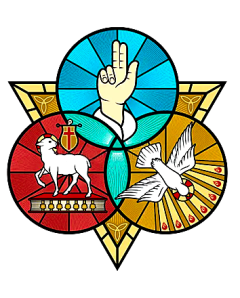
The Holy Trinity, Dreamstime.
PLEASE FORWARD THIS REFLECTION TO THOSE YOU THINK WOULD APPRECIATE IT.
THANK YOU.
Reflections on next Sunday’s Mass Readings will be posted on Wednesday.
Please send your reactions to: RogerJohn@aol.com
© SundayMassReadings.com


 Sunday Mass Readings
