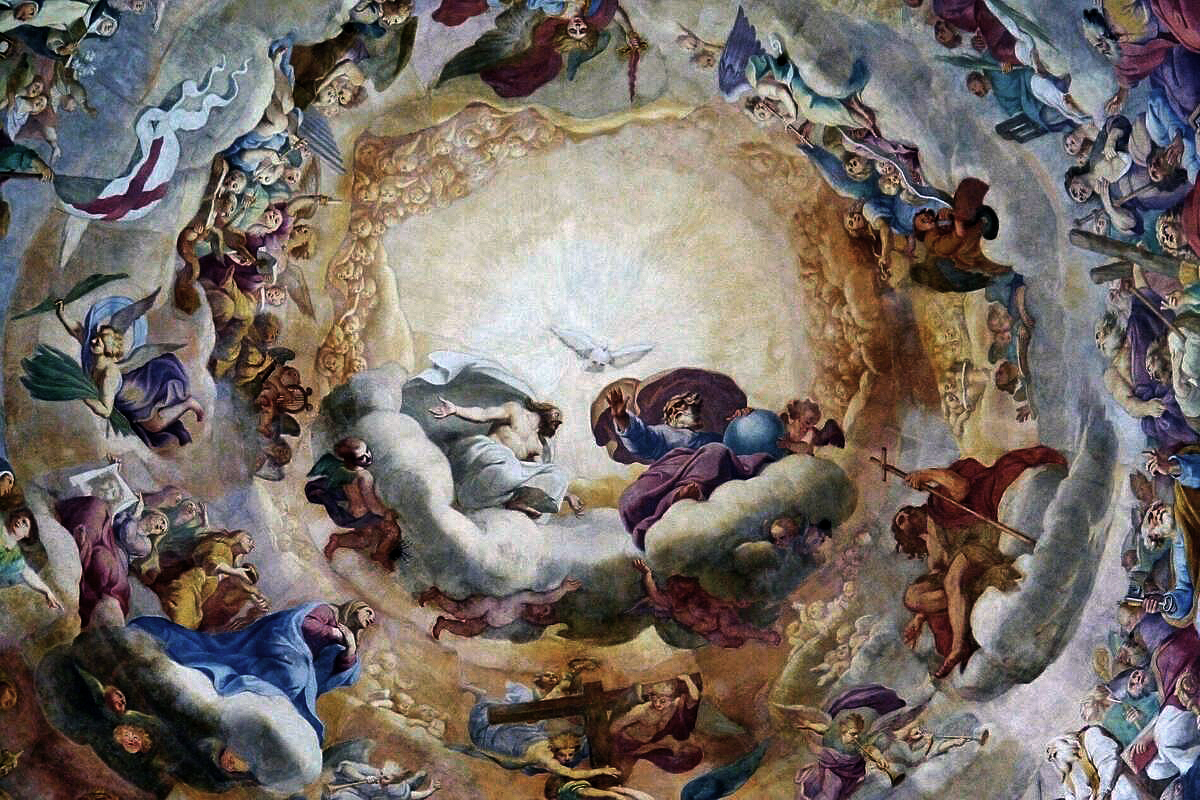
SUNDAY 15 JUNE 2025: THE SOLEMNITY OF THE MOST HOLY TRINITY.

The Holy Trinity, Pierre Mignard c.1663, Church of the Val-de-Grâce, Paris, France.

[The Holy Spirit] will glorify me, because he will take from what is mine and declare it to you. Everything that the Father has is mine; for this reason I told you that he will take from what is mine and declare it to you.”     John 16:14-15.

Click here to read today’s Sunday Mass Readings.

Click on words highlighted in red for further information.

At the very deepest level of the beating Christian heart is its most profound mystery, the Holy Trinity of God. Christianity is a monotheistic faith, meaning a belief in one God, yet at its heart there are three persons, Father, Son and Holy Spirit – yet one God. Artificial Intelligence assures us that “thousands” of books have been written about this profoundest Christian mystery, theological, devotional, historical and academic. So it is, in a word, inexplicable. It rests on faith alone. If Jesus said it, it’s true. And he did. And buried right at the center of this mystery is its power: love. Now note that carefully; love requires, demands even, at least one other. Unrequited love is agonizing. It certainly isn’t love as it is understood. But when it is returned, the drab world is filled with color, you feel as though you are walking on air, there is one other person who means everything to you. The other person completes your life. It is perfection. For many it is God, the unfathomable depth of love present for all eternity, always present and always constant. And for many it is the person in this life with whom you want to spend the rest of your life. This love is life-enhancing, making everything in it tolerable and meaningful. It is the power which created everything, sustains it and gives it hope. It is the only reasonable explanation of how everything came to be, as love opens us up to the world and everything in it. If something is not perfect, love urges us to transform it into something acceptable and good. And only togetherness can do that. Hence the Holy Trinity must be at the heart of all that is good and beautiful. Yes, one God, so united that the three persons had to share their love with others – with us. They provide the template of perfection against which we can measure everything. And if lacking, it is to the Trinity that we can call and receive guidance and help. True love freely gives, asking nothing in return. 

It was through the centuries that God slowly revealed this profoundest mystery of the Christian faith. The Father intervened in human history with the call of Abram/Abraham. Through the centuries we humans slowly understood that this God was open to relationship, beginning with the revelation of the God’s holy name, Yahweh, I Am Who Am to Moses (Exodus 3:14). The arrival of Jesus in our midst exemplified all the qualities revealed as divine through the pages of the Old Testament. Taking the ideal of relationship, for example, to a numinous level, Jesus at the Last Supper declared basic human food, bread, to be his body, and we were to take and eat it. This was relationship at its ultimate: we take the Lord into ourselves! Complete union! The Holy Spirit is the power which has enabled everyone since that time to participate in the Lord’s Supper, beginning with the miracle of Pentecost, celebrated last week, down to today. And at each Mass, God’s Holy Spirit is called to descend on the gifts of bread and wine so that they become the body and blood of the Lord himself. It is the ultimate sharing, the love of God coming to us, transforming the simple realities of bread and wine into the real presence of God. God gives his very self to us! 

Now at this point I ask you to look at the notes from last week, the feast of Pentecost, which refer to the gender of the words which refer to the Holy Spirit. All of them are feminine in the language of Jesus, Aramaic (as well as in Hebrew). Whenever the Holy Spirit of God is invoked in the Hebrew Testament, she is always referred to as she! Now I say this to make a point. We, each and every one of us, were conceived in the womb of our mother. Most of us grew up amid a welcoming and loving family which nurtured us and created the foundations on which we stand for life. I know this does not apply to everyone, but I think my point still holds. The Holy Trinity without the feminine principle present seems hollow to me. Our whole experience of life requires a feminine presence. We all of us exhibit male and female traits. Consequently the question arises, where did they all come from? If the Holy Spirit is constantly referred to as “he” there is an awning empty space somewhere. Look at today’s gospel and compare it to this:

But when she comes, the Spirit of truth,
she will guide you to all truth.
She will not speak on her own,
but she will speak what she hears,
and will declare to you the things that are coming.

She will glorify me,
because she will take from what is mine and declare it to you.

And when Jesus spoke these words, he used the Aramaic word for Spirit (also meaning breath and wind), רוּחַ pronounced “roo-akh” which is feminine in gender, so Jesus’ words would have sounded like the revised gospel above! And if you add that feminine presence or reality to the Holy Trinity, surely it must reflect our experience much more realistically. The Father and the Spirit forever creating the Son, the incandescent eternal presence of creative, sustaining love. And that is the reality we are celebrating today! And one final word: in Hebrew the word for truth, אֱמֶת, emet, is feminine, and is composed of the first, middle and last letter of the Hebrew alphabet; but in Aramaic, it is שְׁרָרָא, sherara, meaning tightly bound, and is masculine. But it also means umbilical cord… 

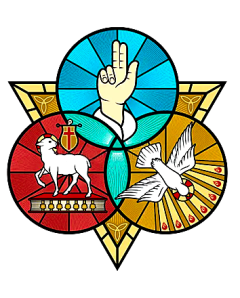
The Holy Trinity, Most Holy Trinity Catholic Church, Covington, Louisiana, USA.

© SundayMassReadings.com

SUNDAY 8 JUNE 2025: SOLEMNITY OF PENTECOST: THE DESCENT OF THE HOLY SPIRIT; THE BIRTHDAY OF THE CHURCH.

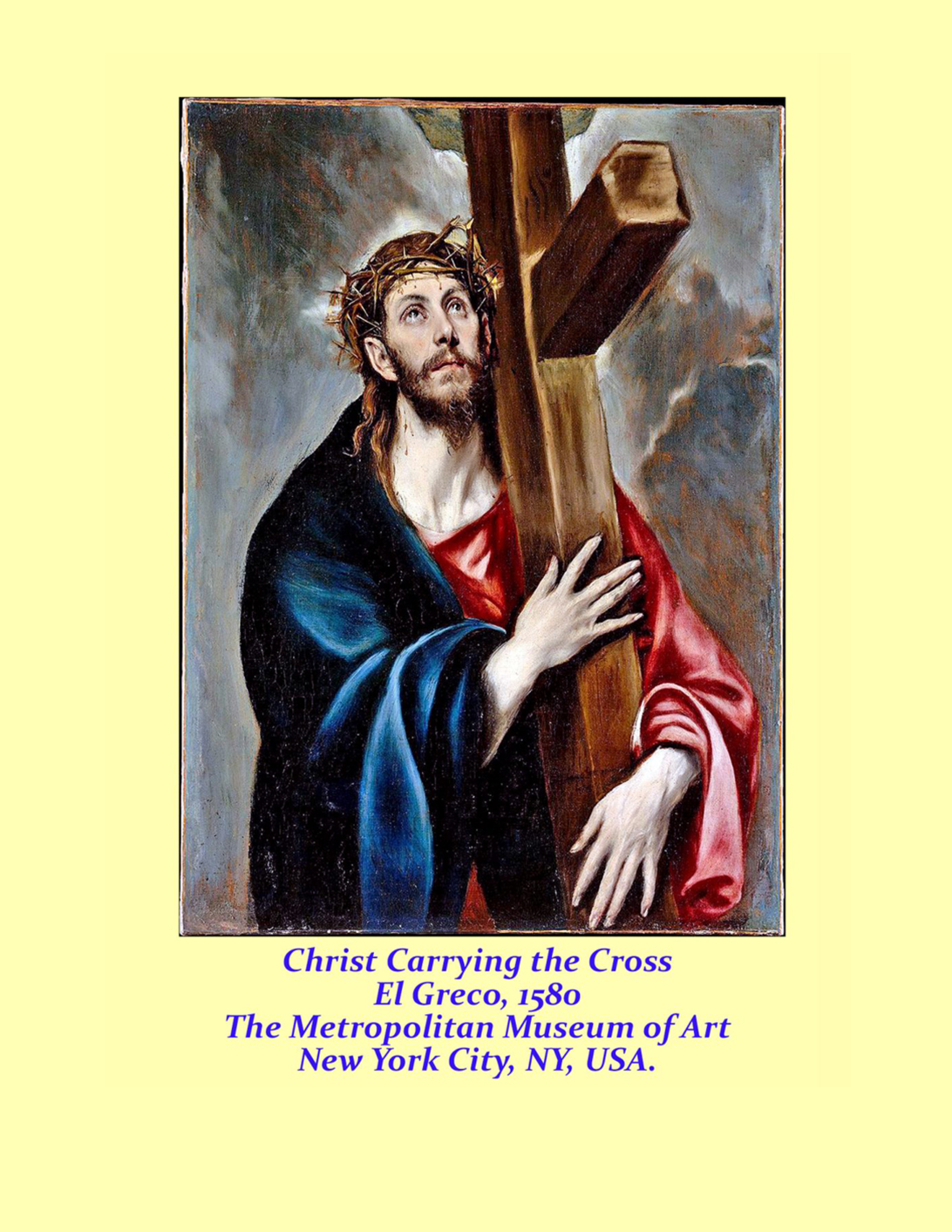
Pentecost, El Greco c. 1600, Museo del Prado, Madrid, Spain.

When the time for Pentecost was fulfilled, they were all in one place together. And suddenly there came from the sky a noise like a strong driving wind, and it filled the entire house in which they were. Then there appeared to them tongues as of fire, which parted and came to rest on each one of them.            Acts of the Apostles 2:1-3.

Click here to read today’s Sunday Mass Readings.

Click on words highlighted in red for further information.

First, you could make a case for this event to be the most important happening ever in the church’s history, save for the Resurrection itself. Why? Because without it there would be no church, no Christianity, no saving message of Christ to each of us today. Remember John’s gospel states twice that the entire small Christian community trembled behind locked doors “for fear of the Jews”. But this was the Jewish Feast of Pentecost, 50 days after Passover, the reason why Jerusalem was packed with Jewish pilgrims (Pentecost is the Greek word for 50th  πεντηκοστός – pentēkostós). Today it has a Hebrew name, Shevuot, to distinguish it from the now better-known Christian Pentecost. For the Jewish people, it was at that time one of the three pilgrimage feasts, when those who could, would travel to Jerusalem and worship in the Temple. (The others were Passover and Sukkot). Originally Shevuot was the Feast of the First Fruits of the Harvest, a sample of which you would bring and offer there. Later it became the Feast of the Law, because by tradition, the Hebrew people arrived at Mount Sinai 50 days after leaving slavery in Egypt, and where God gave Moses the 10 Commandments. But whatever it was, Jerusalem was packed with devout Jewish pilgrims intent on giving thanks to God at the holiest place on earth, the Temple (which was completely destroyed by the Romans in 70AD), but not before the first fruits of the Descent of the Spirit had shown themselves! 

But before that, the earliest Christians trembled in their upper room, fearful they too would suffer the same fate as the Lord, especially with the city packed with devout Jews. Then it happened, as reported in the Acts of the Apostles stated above. These cowering mice suddenly became fearless lions, rushing out into the streets proclaiming the Good News to anyone who would listen! Now, in the absence of the Lord, but with the promised strength of God’s Holy Spirit, the Christian message was, for the first time, proclaimed in the streets of the Holy City itself without any fear of the consequences. Hence it was indeed the truly miraculous Birthday of the Church! What else but a miracle could explain this sudden, permanent and inexplicable change in outlook? Those, by the way, are the hallmarks of a true miracle to this day! It was the inaugurating moment of the Age of the Holy Spirit of God, in which we all live at this moment. The red vestments at Mass today reflect the mystic fire of the Holy Spirit descending on the heads of those first true Christians, now fearless, and intent on spreading the Good News. And spread it has, to the estimated 2.4 billion believers today, the world’s largest religion, of whom 1.3 billion are Catholic. And note also, that the disciples miraculously spoke in many tongues to the pilgrims from throughout the Roman Empire. Theologians say that this cancelled out, at long last, the curse of confused tongues at the building of the Tower of Babel, built by humans to ensure that if God ever sent another flood, they would overcome it.

God’s Holy Spirit appeared on that wonderful day “as of fire”. You will recall that at the Baptism of Jesus, God’s Holy Spirit came upon him “like a dove”. I cannot resist repeating the following, which appears in almost all my messages concerning God’s Holy Spirit. The words dove, יוֹנָה yonah, wind, spirit, breath (in Hebrew the same word) רוּחַ ruach, and wisdom, חָכְמָה, chokmah are, each and every one, feminine in gender in Hebrew and Aramaic. Each one of those words, whenever they appear in Scripture, reflect God’s power. The “dove” anointed Jesus as the Messiah (the “Anointed One”), giving him the power of God. When God “breathed” into the handful of mud in Genesis 2:7, Adam was created. The feminine “wind” allowed the Hebrews to escape from the Egyptians at the Red Sea and gave courage to the timorous Christians in the Upper Room, and they received a double dose of spiritual power as they also had fire,  אֵשׂ esh, also feminine in gender, descending on them, changing them into fearless Christian missionaries. Unhappily for us, all our Christian writings are in Greek, and in Greek the word for Spirit is neuter: πνευμα, pneuma. Now technically that means we have to refer to the Holy Spirit as “it”, which is completely unacceptable. So when the Greek Scriptures were translated into Latin, where the word for Spirit is Spiritus, the -us ending makes it a masculine noun, and so the Holy Spirit has been referred to as “he” evermore. But in Hebrew and Aramaic, the language of Jesus himself, the correct pronoun is “she”. Look at this short passage from the Book of Proverbs: Wisdom shouts in the street, she lifts her voice in the square (Proverbs 1:20). Now this is not to say that wisdom was a woman once sitting in judgment at some place and time in the Old Testament. But it does apply a quality to this word and all the others just mentioned. And above all, you could make a case that God’s Holy Spirit has as much claim to “she” as does the Father and Jesus himself to “he”. Put it this way, Jesus would be just as surprised, shocked even, to hear of God’s Spirit referred to as “he” as we would be to hear the Holy Spirit addressed as “she”. Note that in most European languages words have meaningless genders: in French a table and a chair are feminine but the carpet and sofa are masculine; meaningless. But in English that does not apply. Almost everything is “it” if not referring to people where it is definitely he or she. So gender means something in English, hence this argument. And so, as an interesting exercise, how would you alter the Creed, said each Sunday at Mass, to reflect this argument:

I believe in the Holy Spirit, the Lord, the giver of life,
who proceeds from the Father and the Son,
who with the Father and the Son is adored and glorified,
who has spoken through the prophets.

So we celebrate the church’s birthday on this day which, I believe, is a Judeo-Christian feast which has more names than any other, at least six by my reckoning. It is the sine qua non of our faith. Amen. Alleluia!

© SundayMassReadings.com

SUNDAY 26 MAY 2024: THE SOLEMNITY OF THE MOST HOLY TRINITY.

Holy Trinity, Feael, no date.

Click here to read today’s Sunday Mass Readings.

[Jesus said], “Go, therefore, and make disciples of all nations, baptizing them in the name of the Father, and of the Son, and of the Holy Spirit…”    Matthew 28:19.

Click on words highlighted in red for further information.

In the year of Our Lord 325 in the ancient city of Nicaea, now the city of Iznic in Türkiye (the new name for Turkey), to the south-east of Istanbul, the Emperor Constantine, recently converted to Christianity, called a meeting of the Christian bishops of the whole church to settle certain questions which were tearing the new church apart. He wanted a peaceful Christianity where all believed the same thing, and worked and worshipped peacefully together (which would also allow him to rule more comfortably and strongly). Paganism was still a major force, and a divided Christianity might well collapse faced with any renewed pagan strength. One of, if not the, principal questions to be asked and answered was Who is God? Although that might seem to be an easy question, it was not. Take, for example, God’s statement in the 26th verse of the first chapter of Genesis: “And now we will make human beings; they will be like us and resemble us” So the question is, who are they if there is only one God? Then there was the question of the Son, Jesus. Was he created by the Father and so had a beginning, or was he “begotten” by the Father from his own being, therefore having no beginning. That dispute, actually a major fight, led to a heresy called Arianism, which claimed Jesus had a beginning rather than being eternal. That was the sort of dispute Nicaea was called to settle. The final document was called the Nicene Creed, the one recited at every Sunday Mass to this day. The question of the Holy Spirit was left to later councils, though considering the final words in today’s gospel reading, there is a clear equality with all Three Persons. That marked the beginning of the doctrine of the Holy Trinity. Last week’s readings were all about love. The nature of love is to be returned. Unrequited love, which is love not returned, is a very painful experience. So the Three Persons in One God are able to love, because it can be returned. With a One-Person God exclusively, that would be impossible: the thought of I love Me (One God) is something we Christians would have much trouble with. It is the nature of love to be returned from another person, certainly possible with one God of more than one Person, impossible otherwise. In fact, that love is so strong that it gave birth to all of us, children of God. Consequently, we are each asked to return that love to our Creator. There is a song which echoes that idea: Love isn’t love ’till you give it away – but true love really has to be returned! There is one other element to be considered when thinking of the Holy Trinity (and those of you who have followed this webpage know what is about to be said). The word spirit in English comes from the Latin word spiritus. The -us ending in Latin means the word has a masculine gender. The Christian Scriptures were all originally written in the Greek that was spoken by everyone in the first century, called koine Greek. In that language, the word, translated as spiritus in Latin, is pneuma, πνεῦμα. We get words such as pneumatic (filled with air) from it. But in Greek that word is neuter, not masculine, not feminine, but neuter. So in English, we would refer to πνεῦμα as “it”. Not acceptable when referring to the Third Person of the Blessed Trinity! Πνεῦμα is a translation of the Hebrew word for spirit, רוּחַ, pronounced ruach (the ch pronounced as in Scottish “loch”). Now, note, in Hebrew the gender of this word is feminine, as is the Hebrew word for wisdom. The word also means breath or wind. So, for example, if Jesus heard us saying “he” for God’s Holy Spirit, he would be as astonished as us hearing “she” for the Holy Spirit! But doesn’t “she” sound better, fuller when considering the Holy Trinity than simply three “he’s”? And that’s the way it should really be. Consequently, the Holy Spirit of God can be considered a she!  With that in mind, look with new eyes on the greatest Christian mystery of One God, Three Persons. Father and Spirit eternally uniting to beget the eternal Son. That makes much more sense, especially as each of us is invited into that eternal loving circle, as true love is never exclusive; it spreads out and invites all to enter in. Although God really cannot be tied down to our human definitions, it does help to link our human experience to the nature of God, and see that even with such limited eyesight, we are perhaps more able to enter the mystery of the Trinity. With that, it is so much easier to consider the complete unity of the Trinity, bound together in love, inviting each of us into that embrace. And the Spirit, revealed in the gospels both as “like a dove” at the baptism of Jesus, and “as of flames of fire” at Pentecost, gives us a total horizon of the nature of God’s Holy Spirit, strong, life giving and gentle, easily uniting the nature of femininity with the Father of creation and the Son of redemption. Glory be to the Father and to the Son and to the Holy Spirit inviting each of us to enter that embrace of love and light and remain in eternal happiness there forever.

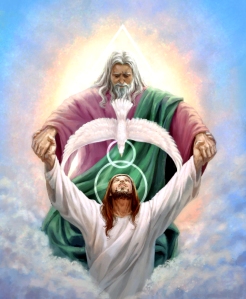
The Holy Trinity, Dreamstime.

PLEASE FORWARD THIS REFLECTION TO THOSE YOU THINK WOULD APPRECIATE IT.

THANK YOU.

Reflections on next Sunday’s Mass Readings will be posted on Wednesday.

Please send your reactions to: RogerJohn@aol.com

© SundayMassReadings.com

SUNDAY 19 MAY 2024: THE DESCENT OF THE HOLY SPIRIT, THE BIRTHDAY OF THE CHURCH, PENTECOST SUNDAY.

Pentecost the Descent the Holy Spirit, Jen Norton May 2021, Picturing Stories from Home.

Click here to read today’s Sunday Mass Readings for the Mass During the Day.

And suddenly there came from the sky a noise like a strong driving wind, and it filled the entire house in which they were. Then there appeared to them tongues as of fire, which parted and came to rest on each one of them.    Acts of the Apostles 2:2-3.

Click on words highlighted in red for further information.

On this day, approximately 1991 years ago, the entire Christian church was crammed into a small upper room somewhere in Jerusalem, scared to death that the fate which had befallen their leader would happen to them if they were discovered. John’s gospel states quite clearly that the door of the upper room was locked for fear of the Jews – and states it twice! Despite the appearance of the crucified one alive in their midst, they were still terrified. Not only that, but the city of Jerusalem was packed with visitors from all over the Roman Empire, Jews celebrating their feast of Pentecost. Look at the word: it contains “pente”, the Greek word for five. Pentecost was celebrated 50 days after the first day of Passover. So it is a much older feast than the Christian Pentecost, but in the years following it became better known as a Christian feast, with the Jewish name Shevuot (“Weeks”) becoming their name for the day, (also occasionally known as the Feast of the First Fruits of the Harvest from the time of year). It was by tradition that 50 days after the flight from enslavement in Egypt, the Jews arrived at Mount Sinai and were given the Law – the 10 Commandments – by God, hence it is also known as the Feast of the Law. And so this one Judeo-Christian feast day carries a total of at least six titles! Finally, Shevuot/Pentecost was one of the three “pilgrimage feasts” in the era of the Jerusalem Temple, when those Jews who could, would go on pilgrimage to the Temple in Jerusalem, hence explaining why today’s reading talks of the city being packed with people from all over the Roman world. (The other two pilgrimage feasts were Passover and Sukkot, the feast of booths or tents). So one can understand the reluctance of Jesus’ followers to do nothing except lie low and hope and pray for the best!

And then it happened!

In my opinion, after the miracle of the Resurrection itself, this was the greatest miracle recorded in the Christian scripture. Suddenly these cowering mice became lions of the Word, rushing out into the Shevuot crowd to proclaim the truth of Christ – the Messiah – to anyone who would listen! Without Pentecost, there would have been no Church (hence this event celebrates its “birthday”). What, besides the Hand of God, could possibly explain this transformation? These people were once understandably terrified of being crucified because of their association with Jesus. Now they could not wait to tell the “Good News” – the gospel – to the world. And not only that, but to proclaim it in all of the tongues of the Roman Empire, as listed in today’s reading (thus cancelling the punishment of the Tower of Babel, built with overweening pride, cursed with its multiple languages). Truly a spectacular beginning, made possible by the Descent of God’s Spirit on each of Christ’s followers that day. And note that the event sounded “like a strong wind” to the cowardly remnant. In Hebrew, the words “wind. “spirit” and “breath” are all the the same wordruach רוּחַ – and so it was God’s very breath “as of fire” come upon them. Jesus, in today’s gospel story, “breathed” on them and they received God’s Spirit. Nothing could now stop them from proclaiming the Good News! 

Now, do we enjoy that same Spirit? Yes, received at baptism and then, fully, at confirmation. Do we rush into the street proclaiming the Good News? Well….. no. So what are we supposed to do in that case? If we are full of God’s Holy Spirit, how does it show? How can those who are not actively Christian see and recognize the reality, the happiness, of being Christian? Easy – we act, speak, think in a totally Christian way, so clearly and convincingly that others want to know where it comes from. That’s how we show it! Being a child of God, which is what every Christian is, means being totally involved in the world (see last week’s reflection) in such a good way that we reflect God’s goodness and the happy contentment which comes with it. Done properly, it is irresistible! Let us ask God for that same Spirit to possess us in the same way those very first Christians demonstrated it to the world all those years ago.

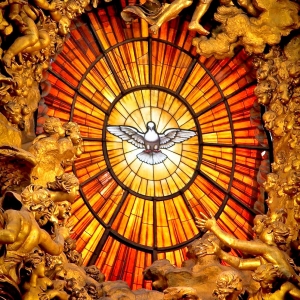
The Holy Spirit, unknown provenance.

PLEASE FORWARD THIS REFLECTION TO THOSE YOU THINK WOULD APPRECIATE IT.

THANK YOU.

Reflections on next Sunday’s Mass Readings will be posted on Wednesday.

Please send your reactions to: RogerJohn@aol.com

© SundayMassReadings.com

SUNDAY 28 JANUARY 2024: THE FOURTH SUNDAY IN ORDINARY TIME.

The Conversation: The science of gossip, March 30, 2017.

Click here to read today’s Sunday Mass Readings.

In their synagogue was a man with an unclean spirit; he cried out, “What have you to do with us, Jesus of Nazareth? Have you come to destroy us? I know who you are—the Holy One of God!”     Mark 1:23-24.

Click on words highlighted in red for more information.

Pope Francis certainly has a knack of saying things that go viral in seconds. In September 2013, for example, he let his opinion about gossip be known, even published in the papal newspaper Osservatore Romano. He pulled no punches; the opening line states, “Gossip is a weapon and it threatens the human community every day; it sows envy, jealousy and power struggles. It has even caused murder”. The picture above gives some small idea of what he is talking about. Some poor soul seems to be the butt of a rumor perhaps of a scandal going about, against which, of course, she is defenseless. But what is my point? In today’s gospel set in the synagogue in Capernaum, I think there is a clear potential of Jesus becoming what Pope Francis would deem the butt of malicious gossip in today’s gospel. The possessed man, mentioned in the quote above, is stating the truth. Indeed, Jesus IS the Holy One Of God, but… Releasing that news at the very beginning of Jesus’ mission would have been disastrous. Jesus immediately expelled the evil spirit, and with it the message which had the power to ruin his mission. Why? Well, the prevailing idea about the long-awaited Messiah in the Holy Land at that time was one of military might, he astride his mighty horse, able to expel by the sword the unclean, pagan, barbarian Roman occupiers for good, and restore the kingdom of David. That was hardly a description of the Lord! Once everyone came to the realization through gossip that he was not their idea of the Messiah, he would indeed have been the butt of whispers for evermore and his vocation ruined. Of course his ability to expel the evil spirit certainly showed he had extraordinary power, but in that solitary case, it tied in with his mission, the conquest of evil. Following his vocation in the way God wanted it would fulfill Moses’ prophesy in the first reading. Hence Jesus wished to obey God’s will for him, not through the crazed revelation of an evil devil who, though speaking the truth, intended to crush Jesus’ mission at the very beginning. So, in expelling that evil spirit Jesus was indeed beginning his mission in the right way, combating that which was not of God in the way that was of God. 

And so it must be for all of us. If we hear of a juicy piece of gossip concerning one of our neighbors or a co-worker in the office, what should we do? The temptation to pass it on is almost overwhelming, but in doing that, the contagion would spread. Even if the juicy “news” is true, what good would it do to spread it? Wouldn’t that make things worse for the person being targeted? What if we were in those shoes? And I would not be surprised if many of us have secret truths we would prefer to remain untouched, let alone the subject of gossip. Jesus knew that his version of the Messiah was completely at odds with the prevailing, and universally accepted, idea of the Messiah being the one who would rid the country of the ruling and hated Gentile Romans and reign as the new King David. It is easy to accept the first reading, the passage from Deuteronomy, in that light, and almost everyone did. No-one would see in the figure of the holy man from Nazareth the New David! So Jesus had to crush the evil spirit’s message immediately. Jesus wanted people to come to the truth in their own, unique, way, not in muffled whispers from one to another with laughter as the conclusion. That was the danger, and it was avoided.

So from this, Pope Francis’ condemnation of gossip makes a great deal of sense. Gossip had the potential strength to destroy even Jesus’ divine mission. It was saved right there in that synagogue in Capernaum, the ruins of which are still visible in Galilee to this day:


The Remains of the Synagogue at Capernaum in Galilee, Israel, September 2018.

It is thought Jesus walked on the older black stone floor beneath the later sculpted white stone.

PLEASE FORWARD THIS REFLECTION TO THOSE YOU THINK WOULD APPRECIATE IT.

THANK YOU.

Reflections on next Sunday’s Mass Readings will be posted on Wednesday.

Please send your reactions to: RogerJohn@aol.com

© SundayMassReadings.com