
SUNDAY 30 JUNE 2024: THE THIRTEENTH SUNDAY IN ORDINARY TIME.

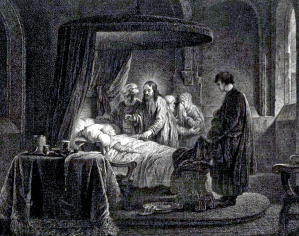
The Resurrection of the Daughter of Jairus, Gerbrand van den Eeckhout 1767, The British Museum, London, UK.

Click here to read today’s Sunday Mass Readings.

So [Jesus] went in and said to them, “Why this commotion and weeping? The child is not dead but asleep. And they ridiculed him.   Mark 5:39-40.

Click on words highlighted in red for further information.

Note the curious parallels in the longer gospel today. The woman with the hemorrhages had suffered with them for 12 years. The daughter of Jairus was 12 years old. Jesus calls the woman “daughter” and the little girl is clearly Jairus’ daughter, but this is the one and only time Jesus calls anyone “daughter”, the same in the three synoptic gospels. So the intriguing question is, what does it mean? Note that the woman, suffering from the unnatural flow of blood, would be considered unclean and unworthy of living in the community – excommunicated, in other words, not unlike lepers. Remember there was an ancient belief back then that such individuals were being divinely punished as they were considered sinful in some way. Touching the hem of Jesus’ garment would make it unclean – but she was prepared to risk it; being discovered, however, was a very unpleasant surprise, hence the “fear and trembling” she exhibited. The community would turn on her as a result; remember anyone or thing she had touched would have been rendered ritually unclean. But Jesus knew power had gone out of him – to cure her. So he turned to find out who was responsible. Of course, far from condemning her, his compassionate response was, “Daughter, your faith has saved you. Go in peace and be cured of your affliction”. So one action resulted in a new life for an outcast, and the other, a new life for an infant, both of them owing their new life to the Lord, now his daughters. 

Two other interesting points in today’s gospel. One, that Jesus knew the girl would be hungry, and told her parents to give her something to eat. People who are the happy recipients of a curing miracle, as recognized by the church, are frequently ravenously hungry (search for “hungry” or “hunger” in that long article from the National Library of Medicine on miracles). Not surprising as their bodies, now cured, have been starved of nourishment for a long time. The other point is the Aramaic quotation “talitha koum” (little girl, get up) as quoted in Mark’s gospel. Although the gospels of Matthew and Luke also talk of this miracle, only Mark quotes Jesus’ actual words in the language he spoke. It can also be translated “little lamb, get up” something you would expect of The Good Shepherd! As Mark is considered to be the earliest gospel to be written down, it is also closest to the actual event, and might well be quoting a witness to the event. 

Now, finally, consider the people involved in this gospel passage. Jairus was a synagogue official, hence a leader of society, and presumably wealthy. The outcast woman was from the lowest of the low, unclean and no doubt familiar with rejection in all its terrible forms. Yet Jesus treated them equally, with compassion and care. He loved both ends of this societal spectrum. No-one is excluded from Jesus’ outstretched arms. We are all welcome: no exclusions anywhere. If you are ever tempted to think of yourself as too bad, awful, sinful, rejected, or anything like that, it is your own judgement, not the Lord’s. Jesus never rejected anyone – including those who killed him. All are welcome, anytime, anywhere. It is in his loving embrace that we are cured, restored to the dignity of God’s children.

The Sacred Heart of Jesus, Responding to Love with Love.

PLEASE FORWARD THIS REFLECTION TO THOSE YOU THINK WOULD APPRECIATE IT.

THANK YOU.

Reflections on next Sunday’s Mass Readings will be posted on Wednesday.

Please send your reactions to: RogerJohn@aol.com

© SundayMassReadings.com
SUNDAY 11TH FEBRUARY 2023: THE SIXTH SUNDAY IN ORDINARY TIME.

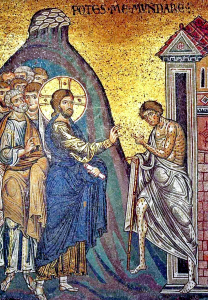
Potes me mundare (You can make me clean), 12th century mosaic, Cathedral of the Nativity of the Virgin Mary, Monreale, Italy.

Click here to read today’s Sunday Mass Readings.

A leper came to Jesus and kneeling down begged him and said,“If you wish, you can make me clean.”   Mark 1:40

Click on words highlighted in red for further information.

The very word leprosy still carries dread and fear if ever mentioned, despite the fact that today it can be cured, and people infected with it are no longer banished into isolation hospitals. The word itself comes from the Greek word λέπρᾱ (lepra) meaning scales or scaly. Today it is more properly called Hansen’s disease, named for the Norwegian doctor who investigated it in the 19th century. For centuries it was considered highly contagious, and sufferers were treated accordingly. Even in today’s first reading from Leviticus it states baldly that any sufferer “shall dwell apart, making his abode outside the camp, which is to say he shall be excommunicated; and even worse, sufferers must cry out “unclean” to prevent anyone approaching them. The disease can in fact be contracted person to person, but it is far from being highly contagious apparently. But in Jesus’ time people were terrified of it. Which makes Jesus’ action, touching the leper, very unusual. And the man being cured makes it unique – that was not possible for another 1000 years and even today it can take up to one year to get rid of it! It was no wonder then that Jesus’ action became sensational news and must have spread like wildfire, despite Jesus telling the man that he should tell no-one about his cure. But in those times of tight, small communities, it would have been impossible to keep something that momentous a secret. Leprosy had never been cured before!

Which brings us to today’s second reading which seems to have little to do with leprosy! Paul simply says give offense to no-one, and simply imitate Jesus in all things. Except that Jesus, in today’s gospel, showed the correct way to respond to those who were banished from the camp for no reason other than they had had the bad luck to contract a dread disease. For that they were excommunicated! Which got me to thinking about this dread disease so I started to read about it. It is not pleasant. Hansen’s disease affects the nerves, hence loss of feeling or sensation set in, which means one might not even be aware of something wrong. Then I thought, is there a parallel here between the body’s gradual and unconscious loss of feeling and a Hansen’s disease of the soul? It is possible, I suspect, to get used to some apparently insignificant but sinful habit such as (taking a leaf from last week’s reflection) gossip? Then you begin to think the worse of people as gossip tends to the dark side, doesn’t it, where interest perks up and reputations become, little by little, damaged? Soap operas are typical examples. If we do not check ourself, it can become an obsession, thinking the worse and worse of one’s target or targets. With Hansen’s, things like burns become unnoticed; non-healing ulcers on the feet can be ignored because they are not painful. A dyed-in-the-wool malicious gossip-monger becomes utterly unaware of the evil being inflicted, thinking no doubt that it’s the victims’ fault that their reputations are being trashed, lies about them flying all over the place, and the one spreading it all feeling utterly justified. He or she does not know the evil they are causing, ignoring the whispers from a cowering soul that what they are doing is wrong. Or, alternatively, stealing from the office. That might begin with a few reams of paper, then a stapler, then something bigger and more valuable, and so on, the thief convincing himself that the firm can afford it, yet ignoring that the firm will become financially weaker as this continues – a strong parallel with leprosy, slowly destroying the body and perhaps the body does not know it. For older readers, you could parallel this with venial sins multiplying to become, eventually, the deadly mortal sin which has the power to deaden the soul itself.

Victims of Hansen’s will indeed eventually become aware of the damage now evident – paralysis, shortening of fingers and toes, nose disfigurement and so on, and by now would be seeking help. Not so the evil gossip or thief, who in some ways is worse off because self-justification is paramount, believing that the victims “asked for it” or the “firm can afford it”.  Having read all this, now turn to today’s second reading for a picture of the exact reverse, “doing everything for the glory of God”, “trying to please everyone in every way” and so on. In fact, having written all the the above, then going to Paul’s recommendations to the Christians in Corinth was a shaft of pure sunshine and peace. The choice is so clear. The message today might well be to check and see if we are completely free any spiritual Hansen’s in our life, things which deep down we know should not be there, and not asking God to help us eradicate it. That is to say, anything which damages others, which demeans ourselves by not living as the children of God which we are. We are the ones supposed to be carrying the light of grace, reason and love, and we can only do that by making sure, inside, we are creatures of grace, reason and love. Always and at all times, good or bad.

Seeing the Light, kabbalistic concepts.

PLEASE FORWARD THIS REFLECTION TO THOSE YOU THINK WOULD APPRECIATE IT.

THANK YOU.

Reflections on next Sunday’s Mass Readings will be posted on Wednesday.

Please send your reactions to: RogerJohn@aol.com

© SundayMassReadings.com