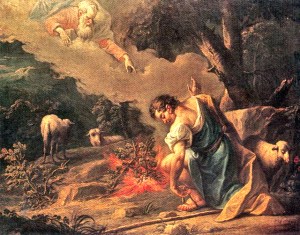
Moses and the Burning Bush, Jean Baptiste van Loo, no date, Chi-Mei Museum, Tainan City, Taiwan
Click here to read today’s Sunday Mass Readings.
When the LORD saw him coming over to look at [the burning bush] more closely, God called out to him from the bush, “Moses! Moses!” He answered, “Here I am.” God said, “Come no nearer! Remove the sandals from your feet, for the place where you stand is holy ground. Exodus 3: 5-4.
Click on words highlighted in red for further information.
Today’s first reading has to be among the most famous scenes from Scripture. Put it another way, who has NOT heard of the Burning Bush? Moses, caring for his flock of sheep, noticed that there was a bush on fire, presumably isolated from neighboring vegetation otherwise he might just have gathered the whole flock and moved away from apparent danger. But no, this was unusual, as there was no spreading of the flames, but even stranger, the fire was not consuming the bush; it just burned and burned. So, as anyone would, he got up and went over to take a closer look. And then he heard The Voice, as shown in the caption above. Clearly this was something very, very, special. He heard the voice telling him he stood on holy ground and that therefore he should remove his sandals as a sign of respect. This Moses did. But who or what, we might ask, was going on and whose voice was it? It turned out that Moses was probably thinking the same thing, because the voice from the bush anticipated it, and stated “I am the God of your fathers, the God of Abraham, the God of Isaac, the God of Jacob.” In other words, here was the God who had inspired the founding fathers of the faith into which Moses had been born many generations later. Understandably, Moses was reluctant, terrified even, to look up, for to see the face of God was to die. There is nothing in the text to say Moses looked up even for a second. Then God began to explain what this incredible scene was all about.
Now, recall that Moses, who had grown up in the household of the Egyptian king, the pharaoh, having been rescued from the River Nile following the order of the king that all Hebrew boys were to be destroyed (the Hebrews had become too numerous and hence were a threat to the Egyptians). An Egyptian princess had rescued him and had brought him up amid privilege and wealth, including, it can be assumed, a fine education. Hence he was special – Hebrew slaves were not educated. But he knew his roots, that he was Hebrew, not Egyptian. One day he was outside and an incident took place which meant he had to escape Egypt. Read all about it here. That explains why he was a humble shepherd when today’s incident took place. But God had other plans for him, and I believe this to be the underlying theme of today’s readings. But before we get on to that, consider the implications of what followed between God and Moses. Moses agreed to return to Egypt and obey God’s command that he insist the pharaoh release all Hebrew slaves and allow them to depart to the land promised them by God, a land “flowing with milk and honey”. But then Moses asked, “But when I go to the Israelites and say to them, ‘The God of your fathers has sent me to you’, if they ask me, ‘What is his name?’ what am I to tell them?” (Remember that all the Egyptian gods had names, Isis, Osiris, Ptah, etc.). Note that God had only given Moses his titles (“The God of Abraham” etc.), not the personal name of God, which was, until this moment, completely unknown. So God answered, “I am who am.” Then God added, “This is what you shall tell the Israelites: I AM sent me to you.” In Hebrew, Yahweh. This is the most sacred name in existence. To strict Jews it is never to be spoken. So ancient is this stricture that no-one is really sure how to pronounce the name properly. The consequence is that Moses now has an intimate bond with God: he knows the sacred name, and a sacred relationship was now established as never before between Moses and God, who, note, also called Moses by his name. Later, through Moses, that relationship was expanded to the entire Hebrew people, now the Chosen People of God.
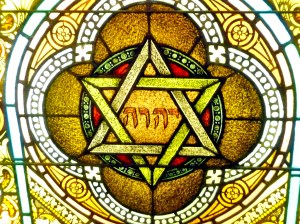
The Tetragrammaton, the Sacred Name of God, Museum of Stained Glass, Chicago, USA.
Moses had fled Egypt as there was, so to say, a price on his head for killing an Egyptian who was striking a Hebrew. Given today’s first reading, it is clear that God had forgiven Moses, presumably taking all things concerning the incident into account. Scripture also tells us that the pharaoh of that time had died, suggesting that Moses was less likely to be accused of a crime. But now God had given him a much more important mission, to lead God’s people out of Egypt to a new, promised, land. Clearly this mission was greater than tending sheep; yes he was to be a shepherd still, but of God’s chosen people! And here we can begin to see the links in today’s readings. God has given each one of us a mission, and the talents – skills – to enable us to fulfill such a mission. The second reading demonstrates that the rescued Hebrews, instead of being overwhelmed with gratitude that God had led them out of slavery, acted in ways which were not evident of thanksgiving. Yes, life is tough, even horrible at times, but there is always a God of love ready to assist us. Instead, as the second reading says, many Hebrews “desired evil things” and many of them “grumbled” about their conditions. In other words, they brought evil upon themselves.
This stands in contrast to today’s gospel however. Two incidents are mentioned, presumably current and well-known at the time, where people had died, which were not the result of dissatisfaction with God, but simply being in the wrong place at the wrong time. Poor construction caused one disaster, and a brutal Roman governor the other. All who suffered were not guilty of anything in those cases. But, concluding, Jesus does point out that indeed each one of us has been given a divine vocation where we are responsible for what happens. The fig tree that produces no figs is pretty clearly not fulfilling its destiny, but is given one last chance. That applies to everyone with no exception. We are all gifted by God, some more abundantly than others, and only God knows why. But each one of us is expected to use our God-given talents in ways God expects, to serve God, others and self. On that we can be sure we will be judged. This being Lent, we are all asked to consider our response to that challenge anew: are we, in fact, fulfilling our destiny? A grand word – but the right one for each one of us. And with God happy and willing to assist us in that, are we grabbing that opportunity and doing what we ought? Are we being God’s true, obedient and willing children?

The Fruitful Fig Tree, Jill Morgan, Homes and Gardens, January 2023.
PLEASE SHARE THIS REFLECTION WITH SOMEONE YOU KNOW WOULD APPRECIATE IT. THANK YOU.
Reflections on next Sunday’s Mass Readings will be posted on Wednesday.
Please send your reactions to: RogerJohn@aol.com
© SundayMassReadings.com
 Sunday Mass Readings