SUNDAY 7 DECEMBER 2025: THE SECOND SUNDAY OF ADVENT.

Spur Pruning Pinot Noir Vineyards Without Losing Crop Yield, American Vineyard, October 2019.

Click here to read today’s Sunday Mass Readings.

“John the Baptist appeared, preaching in the desert of Judea and saying, ‘Repent, for the kingdom of heaven is at hand!’        Matthew 3:1-2.

Click on words highlighted in red for further information.

In 2023 I was in the Sonoma Valley visiting a friend. It was in April, and as I looked out at the many vineyards in that part of the world, I saw a very similar sight to the one above. Those poor vines looked like they had been trimmed down – pruned – to almost nothing! I thought it would be miraculous for any of them to produce anything! That shows how much I know about vines: nothing! Had I returned to Sonoma later that year, before the grapes are harvested, this is what I would have found:

St. Francis Vineyards 2025, Sonoma Valley, California, USA.

Why this sudden interest in vineyard husbandry, or viticulture? Advent! What if we did all that pruning to our own life during this holy season, cutting our lives down to bare essentials to look like the pictures above? That would give us the chance to grow once more into the children that God wants all of us to be. The pictures above show the difference over perhaps three seasons of one year. We have four weeks. 

Alright – where to begin? Today’s first reading could be the start: “…a shoot shall sprout from the stump of Jesse, and from his roots a bud shall blossom. The spirit of the LORD shall rest upon him: a spirit of wisdom and of understanding, a spirit of counsel and of strength, a spirit of knowledge and of fear of the LORD, and his delight shall be the fear of the LORD.” It could almost have been written with viticulture in mind! The “stump of Jesse” ties in well with the pruned vines above: it suggests an absolute start. We could begin with a simple goal, to clear one’s mind, to concentrate for a moment on what is essential to our lives, and what isn’t. People are essential! How have I treated those nearest and dearest? Could it be better? And we are off and running. Let us all hope we can trim our lives down the absolute essentials, and grow from there.

It might help to remember that tomorrow, December 8, is the Solemnity of the Immaculate Conception and is a holyday of obligation, despite being a Monday. This feast is in recognition that Our Lady was conceived without stain of original sin, the only person so blest. Pope Pius IX declared this to be dogmatically true in 1854, meaning that all Catholics must accept this teaching as true. Hence Mary was prepared perfectly to receive God’s Holy Spirit and bear the Son of God. It is a teaching that goes back even to the 2nd century. Early writers compared Mary to Eve, one obedient to the will of God, the other disobedient. Remember that the angel greeted her as one “full of grace” which we say with every Hail Mary, meaning that Mary was full of the presence of God. The Eastern Church was the first to acknowledge this as a feast in the 7th century. Many years later Pope Pius formally declared this to be a true teaching of the church in 1854. Something intriguing happened just a few years later in 1858. In that year Our Lady appeared to Bernadette Soubirous in Lourdes in the French Pyrenees. This young girl had difficulties learning, was often sickly, and yet claimed a beautiful lady had appeared to her several times. Bernadette was asked time and again to find out the Lady’s name. Eventually the Lady said “I am the Immaculate Conception”, which Bernadette did not understand, but insisted that was the Lady’s answer. It went a very long way in convincing the church authorities that Bernadette was telling the  truth. There was no way this peasant girl would have been aware of the Pope’s declaration four years earlier or even understood it if she had! The resulting miracles which the church has recognized in Lourdes could be considered confirmation of all that. Although we all have not been perfect in the eyes of God, we can ask for guidance and strength in this Advent season to return to the beginning and like those pruned vines, start again. So – can we conceive of a life better, purer, more attuned to God’s will than our own, and in so doing become a stronger, better Child of God?

The Coronation of the Virgin, Velazquez 1635, Museo del Prado, Madrid, Spain.

PLEASE FORWARD THIS WEBPAGE TO SOMEONE YOU THINK WOULD LIKE IT.

THANK YOU.

©SundayMassReadings.com

SUNDAY 23 NOVEMBER 2025: The Solemnity of Our Lord Jesus Christ, King of the Universe.

Aeticon, The Thief on the Cross.

Then (the crucified thief) said, “Jesus, remember me when you come into your kingdom.” He replied to him, “Amen, I say to you, today you will be with me in Paradise.”   Luke 23:42-43.

Click here to read today’s Sunday Mass Readings.

Click on words highlighted in red for further information.

The name of today’s feast puts everything into perspective, don’t you think? When you are styled “King of the Universe” there isn’t much left to be king of! Yet quite a few ancient monarchs styled themselves exactly that, the first being Sargon of Akkad about 4200 years ago, and the last was Antiochus I Soter, about 270 years  before the birth of Christ:


                                          Sargon                                  Antiochus

But apart from scholars of the distant past, who would know? Those remarkable titles seem to have died with them. So we celebrate the true King of the Universe today and bow before his majesty knowing that this title depicts the actual truth.

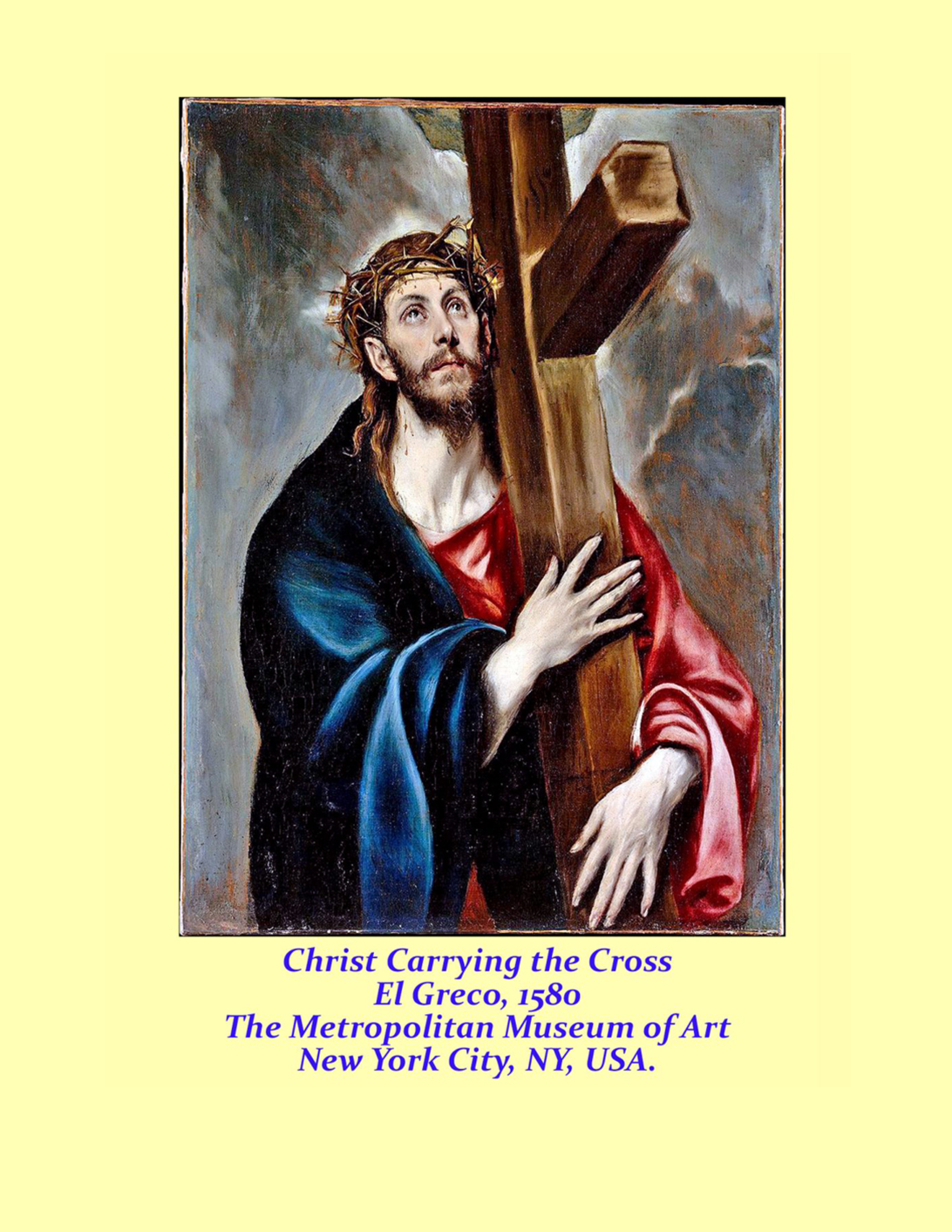
However, the King we celebrate is radically different from Sargon and Antiochus. They no doubt had their jewels and crowns and armies of servants catering to their whims. And there our King is radically different. When King Charles was crowned in 2023, the regalia was prominently displayed for all to see. The throne, the crowns (two of them), the magnificent robes, the congregation crying “God save King Charles” and so on. Now take a look at our King, suggested in the picture above. His crucifixion was his coronation. His robe was stolen by the soldiers. His greeting that day from the crowd, standing next to Roman governor, was “Crucify him!” And then afterwards they shouted “If you’re the Son of God, come down from that cross”. His crown was made of thorns, and his throne was the cross itself. This was not a King of pretension or apparent power; this was a King of stupendous suffering, who took all our sins on his bruised and bleeding shoulders that we might be free of sin and guilt and be made worthy of heaven. This was the ultimate sacrifice made solely for our salvation that we might be able to follow him through who-knows-what and still gain eternal happiness. So the goal is worth anything that fate, luck, circumstances, accidents, health etc., can throw at us. With our eyes fixed on the ultimate destination, we should be able to tolerate just about anything. Remember that Jesus went through what could be described as hell to ensure we received his message down to today. Also recall that he was utterly human, hence terrified of the fate which awaited him (he sweated blood in his terror, a rare condition called hematidrosis). He was also aware that he could repudiate everything he stood for by simply denying he had claimed he was the Christ, the Anointed One, and the Son of God, and gone back to Nazareth and act as though nothing had happened. But he didn’t. He considered his message to be critically important to us all, to be universally significant, eternally relevant and completely human, meaning anyone could adopt his teachings (and challenges), live happily and be accepted into the Kingdom of Heaven. He had made sense of the human condition and given an identity of what it means to be a human being in the world in ways pleasing to God our Creator. In a nutshell, he demonstrated that to be utterly human is to be completely acceptable to God our Creator. One step away from being human is a step in the wrong direction requiring correction. We are here to serve God, to serve each other, and develop our gifts in order to be able to do exactly that to the best of our ability. If we succeed in that, we can expect to be invited into paradise to live in joy and peace forever. It is in our power to do that. And so we should. Therefore when we are called from this life, we may justifiably expect to be invited to share in the happiness of Our Lord Jesus Christ, King of the Universe forever. 

Suffer Little Children to Come Unto Me, Juan Urruchi 1854, Museo de Arte de Querétaro, Querétaro, Mexico.

IF YOU KNOW SOMEONE WHO MIGHT BE APPRECIATIVE OF THIS WEBPAGE, PEASE FORWARD IT TO THEM. 

THANK YOU.

©SundayMassReadings.com

SUNDAY 16 NOVEMBER 2025: THE THIRTY-THIRD SUNDAY IN ORDINARY TIME.

The Last Judgement, Jean Cousin the Younger 1585, Musée du Louvre, Paris, France.

Click here to read today’s Sunday Mass Readings.

You will be hated by all because of my name, but not a hair on your head will be destroyed.    Luke 21:17-18

Click on words highlighted in red for further information.

Have you heard of Pyotr Kuznetsov? This gentleman is the leader of the True Russian Orthodox Church. There are no reliable membership figures for this church. It is not a part of the Russian Orthodox Church. Anyway, he predicted the end of the world would come in May, 2025. Because of that, 35 members of his church hid themselves in a cave 400 miles southeast of Moscow last November waiting for the day. He promised them that on that day, they would be the ones to decide who would get into heaven and who would end up in hell. When the event did not happen, many of his followers refused to come out of the cave, and threatened to blow themselves up if the authorities tried to get them out. There is also the danger that water from melting snow will result in the cave collapsing. Their leader, who had been held in a psychiatric hospital, was allowed to try and convince the remainers to come out. This was partially successful, but the majority remained inside. The authorities seem to have left it up to them to decide what to do. And none of this would not have happened if they had simply read – and believed – Jesus’ words in today’s gospel: “See that you not be deceived, for many will come in my name, saying, ‘I am he,’ and ‘The time has come.Do not follow them!” And note this, there seems to have been over 20 predictions of the end of the world since the year 2000. It seems there is something irresistible in predicting this Last Day despite Jesus’ prohibition on trying to do so. And note also that those “in the know” are always counted with the righteous, the saved, a judgement, you would think, is reserved for God alone…..

Today’s gospel does exactly that. It is typical at this time of the church’s year as it comes to an end that the readings begin to talk of the end time, but absolutely do not even suggest when that might be because nobody knows! But, that being the case, we are all still cautioned that we should at least be ready for that moment. And today’s gospel seems to be an inauguration of such thinking. Things will become harsh, wicked and intolerable, Jesus says, and many will be persecuted because of his name, but he promises “not a hair on your head will be destroyed”, a strange thing to say of those martyrs who will be tortured, maimed and executed in the most brutal ways possible. But having lived through such degrading and humiliating punishment, a pure and glorified, undamaged soul will be welcomed into heaven. And then there is this fact: over 14,000 named individuals have been declared martyrs for the Faith over the centuries up to today. One of the latest martyrs, St. Edith Stein, canonized in 1998, died in the Nazi death camp of Auschwitz in 1942. Even more recently canonized martyrs (October 2025) were St. Peter To Rot, the first saint from Papua-New Guinea who died at the hands of the occupying Japanese troops in 1945, and St. Ignatius Maloyan who died in the persecution of the Christian Armenian people during the First World War in the Ottoman Empire. And there is, of course, St. Carlo Acutis, who died age 15 of leukemia but lived a life, extremely short as it was, of dedication to God. And even though he did not die a martyr, he died in the faith and love of God even though his life was cut horribly short due to leukemia. Who knows who is dying today for the faith with so many wars and so much hatred in so many places? Our saints displayed so great patience, tolerance and even love for their persecutors that they can stand beside the Lord as faithful followers to the end. Most of us, of course, will never face such hatred, so we can only guess how we would react, but we can hope that it would be worthy of a disciple of Jesus. But we can pray for those who are faced with impossible situations wherever in the world. Christians have been confronted with hatred for centuries, and one wonders why, as we pray for everyone, wish everyone good health and happiness and trust they will be happy and perhaps open to seeing the good in us Christians and wondering on what it is based. 

And also remember that each one of us will have to face a more intimate judgement when we are called from this vale of tears. There might not be trumpets braying or cymbals crashing, but we will certainly know that the time of reckoning for us, individually and alone, has come. We will stand before God and made to answer for our actions throughout our life. And today, unlike then, we can do something about those times when we failed the Lord, failed ourselves and ended up in a mess. Now is the precious time when we can make amends, show our true Christian identity and act accordingly. As the year ends, perhaps now is the time to make resolutions and strengthen our identity as a child of God and our vocation as Christ to the world. 

The Last Judgement, Michelangelo 1541, Sistine Chapel, Vatican City State.

(Note, by tradition, the bottom right hand corner of most depictions of the Last Judgement shows those who have not been faithful being thrown into Hell)

DO YOU KNOW SOMEONE WHO MIGHT BE OPEN TO THIS MESSAGE? IF SO, PLEASE FORWARD IT TO THEM. 

THANK YOU.

©SundayMassReadings.com

SUNDAY 9 NOVEMBER 2025: THE FEAST OF THE DEDICATION OF THE LATERAN BASILICA IN ROME.

The Church of St. John Lateran, March 2025, Rome, Italy.

Click here to read today’s Sunday Mass Readings.

Do you not know that you are the temple of God, and that the Spirit of God dwells in you?  1 Corinthians 3:16.

Click on words highlighted in red for further information.

Well, first things first. The full, correct name of the church pictured above is “The Major Papal, Patriarchal and Roman Archbasilica, Metropolitan and Primatial Cathedral of the Most Holy Savior and Saints John the Baptist and the Evangelist in Lateran, Mother and Head of All Churches in Rome and in the World”. So, given that, perhaps there is less amazement at this church being the center of attention for today’s Sunday Mass! It is, in fact, the most important Catholic church in the world, even more so than St. Peter’s Basilica in the Vatican City State. If you look closely at the picture above, you can glimpse the papal chair, or cathedra, behind the altar at the very back. Every cathedral in the world gets its name from the cathedra, or seat of the local bishop, that word coming from the Greek word for a chair, 𝜅𝛼𝜃𝛿𝜌𝛼 (kathdra); so every cathedral in the world will have that special chair, the cathedra, reserved exclusively for the bishop of that place alone. Hence the Bishop of Rome has a cathedra, and you will find it in the Church of St. John Lateran in Rome:

The Cathedra of the Bishop of Rome, Wikipedia, Church of St. John Lateran, Rome, Italy.

And, as you know, the Bishop of Rome is the Pope. And one little note: “Lateran” is the name of the land on which the church was built, once belonging to the Laterani, a Roman family whose palace once stood there. That has also given its name to several treaties and councils. The Lateran Treaty, for example, was the founding document of the Vatican City State, creating the smallest independent country in the world in 1929. Additionally, there are certain Catholic churches in Italy which are “extraterritorial”, meaning they are exempt from Italian taxes and other restraints. St. John Lateran is one of those sites. And note that the church’s title of “Most Holy Savior” allows this day to be considered a feast of the Lord, hence taking precedence over the 32nd Sunday in Ordinary Time. 

So what is this all about? All very interesting (perhaps) but why is this considered so important that we will be thinking and remembering a church today, even if it is beautiful and uplifting? But if you are intrigued by a building which stands on the ground of the first legal Christian church in the western world on land donated by the Roman Emperor Constantine shortly after his victory in AD 312 at the Milvian Bridge, click here. Meanwhile, let us ponder on the symbolism and significance that St. John Lateran should have for us today. Note that the term “Archbasilica” is used only for this church, indicating its importance and uniqueness. It is also the “Mother” church as it was the first legal, openly recognized Christian church in the western world, consecrated by Pope Sylvester I in AD 324, and all Catholic churches were born of this first “mother”. 

The first idea which occurs about this church and the world is the link it represents between all Catholic churches in the world and the essential bond they all have in recognizing the pope as the head of the church in his capacity as Bishop of Rome. The pope claims to be the successor of St. Peter whom Christ himself called the “rock” on which he was to build his church (Matthew 16:18). So, in a sense, this church is the first western legal “rock” which spread throughout the world down to today, when on this day we acknowledge that it all began, once it was open to the world, with St. John Lateran. And note there are many moments in Scripture which equate human experience with the surroundings in which we live.  For example, Jesus is called the “corner stone”, the essential element in a building upon which everything rests, especially in an arch. Or we ourselves are described as the “living stones”. Or Christ and the apostles as the “foundation” of the church, and so on. And remember that we hardly ever see foundations; they are usually buried from sight, but woe betide the building that does not have a solid foundation, as seen in Matthew 7:24-27. And the history of the church of St. John Lateran certainly has had its major ups and downs, including fires in 1309 and 1361, an earthquake in 897 which nearly destroyed it, the neglect it suffered during the  period of the Avignon exile 1309-1377, and in the the notorious Sack of Rome in 1527 by the troops of the Catholic Emperor Charles V (not to mention the earlier two sackings by Vandals in the 5th century). And in July 1993 it even suffered a Mafia bombing which damaged part of the church. Yes, this old church has shared in good times and bad, just as we have, both through the centuries and the parallels in our own lives. Yet it has survived and still carries out its obligations as our church’s foundational building, the mother church of the Catholic world. And so do we, through good times and bad, confident that the Lord stands beside us, as he has done with his Church, symbolized above all by the first church of the Catholic world, St. John Lateran.

Click here to see Pope Leo XIV, Bishop of Rome, take possession of his diocese in May 2025. 

Installation of Pope Leo XIV, Bishop of Rome, May 25, 2025.

IF YOU THINK SOMEONE YOU KNOW WOULD RESPOND WELL TO THIS REFLECTION, PLEASE FORWARD THIS TO THEM. 

THANK YOU.

©SundayMassReadings.com

SUNDAY 2 NOVEMBER 2025: THE COMMEMORATION OF ALL THE FAITHFUL DEPARTED: ALL SOULS DAY.

“What is All Souls Day and…..” Colleen Pressprich October 2022, Brother Francis Store, McKinney, TX. USA.

Click here to read today’s Sunday Mass Readings.

(Jesus said) “…..this is the will of my Father, that everyone who sees the Son and believes in him may have eternal life, and I shall raise him on the last day.”  John 6:40.

Click on words highlighted in red for further information.

This Sunday is reminiscent of the feast of Saints Peter and Paul this year when the feast took precedence over the Sunday in Ordinary Time. Today we have another such upset of the regular progress of Sundays through the Church year. In the old days it was unthinkable that a day such as All Souls would take precedence over the regular Sunday, but the Second Vatican Council in the 1960s thought otherwise, and here we have the consequence. So today our thoughts and prayers turn to our beloved dead, to pray for them and to ask they be admitted into eternal happiness and peace. And perhaps a prayer could be offered for those who have no-one to pray for them. And today’s readings are designed to encourage us to intercede for our predecessors to ask for God’s mercy and love to envelope them and take them to heaven. It is our Christian duty so to do! 

Now in the first reading from the Hebrew Book of Wisdom, there is a clear hope expressed for the dead: “The souls of the just are in the hand of God, and no torment shall touch them.” This is a huge progression from an earlier, more traditional view, where all the dead went to Sheol, a place of gloom, with both good and bad people, all of them, no matter how they had lived their lives. It represents an advance towards our Christian point of view, and as such the Book of Wisdom, written very close to the Christian era, has a more “modern” view of the dead. Much more can be said of this book of the Old Testament, but not here. You will recall in the Apostles Creed, we recite that Jesus “descended into hell”, into Sheol, to release all the righteous but imprisoned there. The Catholic idea of purgatory is similar, though there we are imprisoned by our own sins, until cleansed. 

The Harrowing of Hell, Fra Angelico c.1442, Convent of San Marco, Florence, Italy.

Indeed, our Orthodox Christian brothers and sisters emphasize this idea of Christ liberating the righteous from Sheol rather than concentrating on the silent tomb during Holy Saturday. That is a much more active, positive idea, suggesting Our Lord was busy fulfilling his mission to the very end, liberating not only the living, but also the dead. Love, of course, was at the root of all this, as ever. To the Lord, the dead were as much to be served as the living, and the picture above is a representation of this. Note the flattened devil under the broken-down door through which the Lord is stepping! Nothing can stop the advance of divine love and its power! 

So how can we help our own beloved dead? This of course is the day of days to be conscious of that. Today we remember those who have been responsible for bringing us to God in one way or another. My own mother, born into the Anglican/Episcopalian Communion, promised to bring my sister and I up in the Roman Church, and she did. She was faithful to the promise she made, and ultimately joined us, becoming Catholic late in life. My father, traumatized by fighting in the Second World War, never really recovered from it, but I only understood all that later in life, after he had died. Now, instead of thanking him (which of course I should have done when he was alive) I can now at least pray for him, knowing God is much more understanding than any of us. So today, in a way, gives us a chance to acknowledge not only those who have gone before us, but also to acknowledge the influence they have had over us, challenges and all, and both be thankful and forgiving for all that. The thought that they might well have been doing the best that they could (even if it is not our best) might be a source of comfort to us as we pray for them. And for those unfortunate enough to have had parents or friends who have been damaged by them, then we could ask God’s love to descend on them and balance out the evil done to them. Christ forgave everyone, even his torturers. It is the hallmark of our faith, the ultimate expression of belief, of love. Forgiving is, as it were, the essential attribute of our faith. 

So today, when we remember those who have gone before us, whether marked with the sign of faith or not, are today the focus of our Christian attention. We are asked to be generous in forgiveness, generous in prayer and above all generous in love. After all, the God of love made us, and so we must have love as a basic constituent in our spiritual DNA makeup! As Christians we are required to recognize that fact, cultivate that reality and let it overflow into our lives, our thoughts, our actions and our very identity. And recognizing that, to remember those who have left us and who may need our help even now, and make sure they receive it. And remember, we are never alone; the Lord stands beside us in all that we do. It is up to us to hope and trust in that truth, and be generous in thought, word and deeds.

Perhaps a few words could be said about the two days preceding All Souls Day. Let’s face it, Halloween seems to have taken much of the glamor (if you can use that word) out of All Saints Day, on Saturday. Even the word “Halloween” means little to many people, when in fact it means the evening before All Saints: “(All) Hallows Even(ing)”, hallows being an old English word for saints, or that which is holy. We even say it every Sunday at Mass: “Hallowed be thy name” or, may your name be ever holy, addressing God the Father. And many Catholic countries have a public holiday on All Saints Day. And then there seems to be a vague linking of ghosties and long leggedy beasties at this time with an ancient pagan Celtic tradition. In all a strange combination of the holy and profane. In the UK it also seems to have overtaken a very old tradition, remembered on November 5th, of the Catholic Guy Fawkes trying to blow up King and Parliament, thus setting back by at least 100 years Catholic emancipation in Britain. You can read all about that here. “Remember, remember, the fifth of November: gunpowder, treason and plot….” But the main focus of these days must be the holy men and women who fought for truth, generosity and love, both the canonized and those we ourselves remember today who made our lives better and happier. Blessed are they… 

God of Love, Christianity.com

IF YOU KNOW SOMEONE WHO WOULD APPRECIATE THESE THOUGHTS, PLEASE FORWARD THIS TO THEM. 

THANK YOU.

©SundayMassReadings.com

SUNDAY 5 OCTOBER 2025: THE TWENTY-SEVENTH SUNDAY IN ORDINARY TIME.

A Mulberry Tree in the Cloister Garden of Hereford Cathedral, UK, and a Mustard Seed, Praise.Com

[Jesus said] “If you have faith the size of a mustard seed, you would say to this mulberry tree, ‘Be uprooted and planted in the sea,’ and it would obey you.”      Luke 17:6.

Click here to read today’s Sunday Mass Readings.

Click on words highlighted in red for further information.

With a typical city-dweller’s ignorance, I had no idea what a mulberry tree looks like, or even how big it is! But I sort of knew that a mustard seed must be fairly small – and there they both are, above. It is quite a sizable tree, that’s for sure. Apparently the mulberry berry is delicious when ripe (and the tarpaulin under the tree is to prevent the fruit from staining the footpath). As ever, Jesus knew exactly what he was talking about, but I wonder if this is another example of hyperbole, which we saw on the 23rd Sunday in Ordinary Time a few weeks ago. But I am fairly sure that not one of us has faith strong enough to move that tree into the Atlantic Ocean (or the Irish Sea, which is nearer Hereford!). Are we being criticized for lack of faith here by the Lord himself? And why? Should we be insulted or…..? But frankly, what would be the point of one’s faith being capable of that? We have faith enough to be reading this webpage don’t we? And we have goodwill enough to trust that the Lord will guide us in what we do and say in normal times and places. And each week we receive the strength from our encounter with the Lord at Mass to be his obedient servant through the week. And that is the point of being God’s good servant, not even requiring a ‘thank you’ for what we are expected to be doing. It is, in a sense, simply our job to be servants of the Lord. Payment is in the satisfaction of what we do, knowing it to be right and good. It is certainly nice to be recognized for doing the right thing, but it should not be necessary. There should be an inner peace knowing we are doing the Lord’s will.

Habakkuk is reported as saying something we almost certainly have said in our own day: Why do you let me see ruin; why must I look at misery? Destruction and violence are before me; there is strife, and clamorous discord. That could easily be taken from tonight’s TV newscast from somewhere in the world or, indeed, our own backyard. God seems to assure him that this too will pass and peace will descend: “…if it delays, wait for it, it will surely come, it will not be late”. God is talking of justice. In support of that promised peace, Paul says to Timothy, “For God did not give us a spirit of cowardice but rather of power and love and self-control”. And this all because “We are unprofitable servants; we have done what we were obliged to do” from today’s gospel. And remember the Lord himself is the perfect example of this total obedience to God’s will, to its sometimes bitter end.

So today’s readings really give us an unbiased picture of the true servant of the Lord. Yes, things are terrible in the world. Yes we should be upstanding in the face of everything bad. Yes we know how to behave in the face of all that because we are God’s servants. But we also know how it is all going to end if we keep the faith, even strong enough to move mulberry trees into the sea, because our faith is strong enough even to move mountains! As St. Paul says to us today: “For God did not give us a spirit of cowardice but rather of power and love and self-control”. Those are very strong characteristics, and used correctly they will nourish our faith in God and provide the required direction, always seeking the ultimate source of that power, the universal love of God for each one of us, as strong and as enduring as that mulberry tree above, fruitful, strong and life-giving.

Ron Kelleher, What Unique Trait Should Christians Share with Redwood Trees? June 2016.

SHOULD YOU KNOW SOMEONE WHO WOULD APPRECIATE THESE THOUGHTS, PLEASE LET THEM KNOW BY SENDING THEM 

THANK YOU.

©SundayMassReadings.com

SUNDAY 28 SEPTEMBER 2025: THE TWENTY-SIXTH SUNDAY IN ORDINARY TIME.

The Rich Man and Lazarus, Codex Aureus of Echternach, Germanisches Nationalmuseum, Nuremburg, Germany.

[Jesus said to the Pharisees] “There was a rich man who dressed in purple garments and fine linen and dined sumptuously each day. And lying at his door was a poor man named Lazarus, covered with sores, who would gladly have eaten his fill of the scraps that fell from the rich man’s table….”           Luke 16:19-21a

Click here to read today’s Sunday Mass Readings.

Click on words highlighted in red for further information.

Over the centuries the rich man in this very famous parable has been given a name: Dives (Dy-vees), and so it has been referred to as the parable of Dives and Lazarus. That way there is no confusing this Lazarus with the Jesus’ friend Lazarus, whom he raised from the dead. Also, the point Jesus makes here is crystal clear (unlike last Sunday’s). It is very hard to imagine such a man as this rich one passing Lazarus each time he left and entered his house without doing anything for him. Inconceivable in fact. But one supposes there are, indeed, people like that even in today’s world. Certainly there are examples of that in the nations of the world. And to judge from the first reading today, from the prophet Amos, who lived about 760BC in a small village just south of Jerusalem, such a situation was all too common even then. Jesus himself said we will have the poor always with us (Matthew 26:11). And we do, 2000 years later! 

Beggar in Sokoto, Nigeria.

Today’s second reading talks in the same way: “to keep the commandment without stain or reproach”. And Jesus’ supreme command was to love one another and all that that implies, even having to sacrifice for another’s good. In the parable, poor Lazarus died and is taken off by angels to “the bosom of Abraham”. This expression is tantamount to eternal happiness. It finds its highest expression only in this parable and implies a deep, blessed, and privileged connection with Abraham, the father of all Hebrew people, representing a place of comfort and honor for the righteous dead. It stands in stark contrast to the suffering of the rich man now in hell, begging for relief which is not forthcoming. He eventually suggests a way for his brothers to avoid his punishment, even suggesting that Lazarus return from the dead to warn the selfish what awaits them. Then comes the deadly line: “Then Abraham said, ‘If they will not listen to Moses and the prophets, neither will they be persuaded if someone should rise from the dead.”

The command is utterly clear and without obscurity: We are here to help and support each other, now and at all times. It is God’s command, it is God’s wish, and we are to accept it, and allow it to become an integral part of our very existence. There must never be a moment when we think otherwise. Likewise we should hope and pray for an equal response from others, should we be in distress, should it ever come to be. And at that point, we can refer once more to last week’s teaching……

Here is a beautiful hymn which I believe reflects the love this parable calls us to:

“I Heard the Voice of Jesus say…..” Celtic Source Volume 2; Words: Horatius Bonar; Traditional English folk tune, arr. Ralph Vaughan Williams: “Kingsfold”. 


White Throne Ministries, The Truth About Death. 

Please forward this reflection to someone of your acquaintance who would welcome it.  

THANK YOU.

©SundayMassReadings.com

SUNDAY 21 SEPTEMBER 2025: THE TWENTY-FIFTH SUNDAY IN ORDINARY TIME.

Effects of Being a Spendthrift, Fancy Alpha Faith Blog.

[Jesus said] “No servant can serve two masters. He will either hate one and love the other, or be devoted to one and despise the other. You cannot serve both God and mammon.”  Luke 16:1-13.

Click here to read today’s Sunday Mass Readings.

Click on words highlighted in red for further information. 

Today’s gospel is a conundrum. Jesus is apparently recommending fraud and theft! (Read it and see if you agree). It seems he was talking to his disciples, and possibly the pharisees. The parable he presented describes a steward in the pay of a rich man who is not satisfied with the steward’s performance, and has has given him the sack, effective in a few days. In that time the steward had to figure out what he is going to do. He knows that he is not strong enough for manual labor and he is too ashamed to beg. So he decides on a distinctly questionable course. He calls in those indebted to his master to see him, and reduces the debt  of each one by a significant amount. That way, he figures, they will remember him in his poverty and assist him as needs be. Of course, his employer has no clue that this is going on, but, Jesus says, when he does find out he commends the man for his audacity and quick thinking! So what is going on here? Well Jesus offers us little by way of explanation, so here is my take on the situation 

When we enter this world all we know is peace or hunger and discomfort, all pretty selfish, but that is all we are aware of. Then we begin to see that the world is not entirely us; there are others. Those others seem to care a great deal about us (which is just as well), and so the interaction between the world and each of us has begun. Slowly and sometimes painfully the world begins to make demands on us: potty training, asking for peace and quiet, encouraging us to take first steps, and so on. We find we are part of a tapestry; there are other patterns around us, and sometimes we can contribute and, more times, we can learn from them. And so the world opens to us, and we are invited to join in. It is in this way that we discover what things we are good at, and what is challenging. We discover our gifts, the talents God has entrusted to us. Then, through education, we begin to develop them and so help those others who have helped us in many and varied ways. And at that moment we have, as it were, become the steward in today’s parable.

He was given the sack; similarly we face a termination also, at some time, perhaps distant, perhaps not, namely that moment when we get called from this world, and we must all try to handle that in the best way. Most of us would prefer not to think about it at all! But there it is nonetheless. How do we face it? I think this is where the parable comes in. Those gifts we have discovered within us were placed there by a loving God. We are indebted! (The debts of the steward’s master in today’s parable). They were not placed there to be buried (witness the parable of the talents). They are there to be used, and used in such a way that they benefit others (note today’s parable). Even though our talents belong to God, God is more than delighted that they are being used to help others! We have been entrusted by God with them, and it is up to us to use them as we see fit – but it is crystal clear from Jesus’ teachings how we should use them – clearly for the benefit of others! 

So I think today’s parable in a strange, even unique, way is telling us how God wants us to run our lives, being fully aware that our talents really belong to God, and are entrusted to us as a means of fulfilling our destiny in a positive, rewarding and satisfying way – to help others, or, in terms of today’s parable, to reduce the loads or burdens of those around us in any way we can! And in this way we should hope for and expect those all-welcoming words when at last we stand before God: “Well done, good and faithful servant!”  

Well Done, Telling My Story.

DO YOU THINK SOMEONE YOU KNOW WOULD APPRECIATE THESE THOUGHTS? PLEASE SEND THEM TO THAT PERSON! 

THANK YOU.

©SundayMassReadings.com

SUNDAY 7 SEPTEMBER 2025: THE TWENTY-THIRD SUNDAY IN ORDINARY TIME.

Your Child Says “I Hate You”, Parents July 30, 2024. 

[Jesus said], “If anyone comes to me without hating his father and mother, wife and children, brothers and sisters, and even his own life, he cannot be my disciple”.      Luke 14:26.

Click here to read today’s Sunday Mass Readings.

Click on words highlighted in red for further information.

I would not mind making a tiny bet on which word you found to be the most challenging in today’s readings; there it is up there in quotes. Specifically, the world “hate”. I looked up the Greek in the original passage in Luke, 14:26, most carefully. It is definitely the word μισώ, misō, “hate” (and it’s the same word in modern Greek). And we have words in English which link to it: Misanthrope, hatred of mankind; misogyny, hatred of women. It means hate alright, even 2000 years ago when the Lord uttered it. And traditionally the opposite of hate is… love (or, possibly, indifference). So we have a real challenge here. Is Jesus really telling us to hate everyone we love? Well, clearly not. I think the Lord is, in a sense, pulling our communal leg. Do you recall these moments from the gospel:

First take the plank out of your own eye, and then you will see clearly to remove the speck from your brother’s eye; Matthew 7:3-5.

It is easier for a camel to go through the eye of a needle than for a rich person to enter the kingdom of God;  Matthew 19:24.

If your hand causes you to stumble, cut it off;     Mark 9:43

And we do it all the time in common everyday language:

If I’ve told you once, I’ve told you a million times: Don’t do that!  (A million times???).

I’m so hungry I could eat a horse….

This shirt cost me an arm and a leg….

All that is done simply to hammer home a point, called hyperbole, in other words, exaggerated statements or claims not meant to be taken literally. We get the word hype from the same root. And Jesus must have been doing exactly that in today’s gospel – and the other gospel passages mentioned above. It is critical, he is saying, that you hear what I say, implement what I say and remain always true to what I say. Why? Because there is eternal life in my words (and this time it is not hyperbole). But his language is extremely strong; indeed it is difficult to state it in any stronger way! There must be nothing standing in the way between each of us and him, the one who invites us to eternal life and happiness. 

The rest of today’s gospel is also a little difficult to understand. First there is a man who sets out to build a tower, and figures out ahead of time to see if he has sufficient resources to complete it. If he does not, but still goes ahead but is unable to complete it, he will be subject to ridicule and mockery. Or if a king, going out to battle an enemy, will be foolish not to carefully calculate if he has any realistic chance of defeating his enemy. If not, deal with the problem more realistically. We, for our part, are looking at life and wondering if we will end up happily – or not. And Jesus answers that question for us: if we accept and live by what he offers, we will be happy. If not, then we will allow our worries and cares, our worldly problems, to overwhelm us, dominate us and drag us down. Paul, in the second reading, was indeed dealing with the end of his life and the worries and challenges that situation presented. He dealt with them in the most charitable way possible, helping others by sending Onesimus to them, someone he treasures as his own son, yet deciding others have greater needs than he. It is just such worries, challenges and obstacles that the Book of Wisdom deals with in the first reading. We earthly creatures, weighed down by our earthly concerns, should always turn to the Lord God, whose Holy Spirit is sent to us, and then because of that, our pathway is straightened, our goal clear and God’s wisdom is available for the asking, along with the power to make it happen. And so all three readings coalesce and our choices and direction become clear and possible. That anything is possible with God! But Jesus, as always, does not hide that good news in cotton wool: “Whoever does not carry his own cross and come after me cannot be my disciple”. So it is not a fairy tale he is giving us, quite the contrary. There will be challenges galore he seems to be saying, temptations to betray his teachings. Even your own family, he seems to suggest, might try to divert you from the true way. And remembering the early church and its persecution by the state and the terrible punishments which threatened the lives of those early Christians, he was not hiding the cost of being his follower. It is almost as if he knew what would eventually happen to those who accepted him and followed his example. Today, though, it is mostly indifference, disinterest, distraction – call it what you will – which separate his message from the lives of many people. So it is up to each one of us to display his message loud and clear in our lives, our actions, our words and our attitudes. And, in doing that fully, we might well risk ridicule and mockery. But with our Savior standing beside us, we are not alone, and will withstand the mighty gales of indifference and the earthquakes of ignorance! 

Help Club for Moms, Teaching Children that Nothing is Impossible with God.

SHOULD YOU KNOW SOMEONE WHO WOULD APPRECIATE THESE THOUGHTS, PLEASE FORWARD THIS WEBSITE FOR THEIR CONSIDERATION. 

THANK YOU.

©SundayMassReadings.com