SUNDAY 29 SEPTEMBER 2024: THE TWENTY-SIXTH SUNDAY IN ORDINARY TIME.

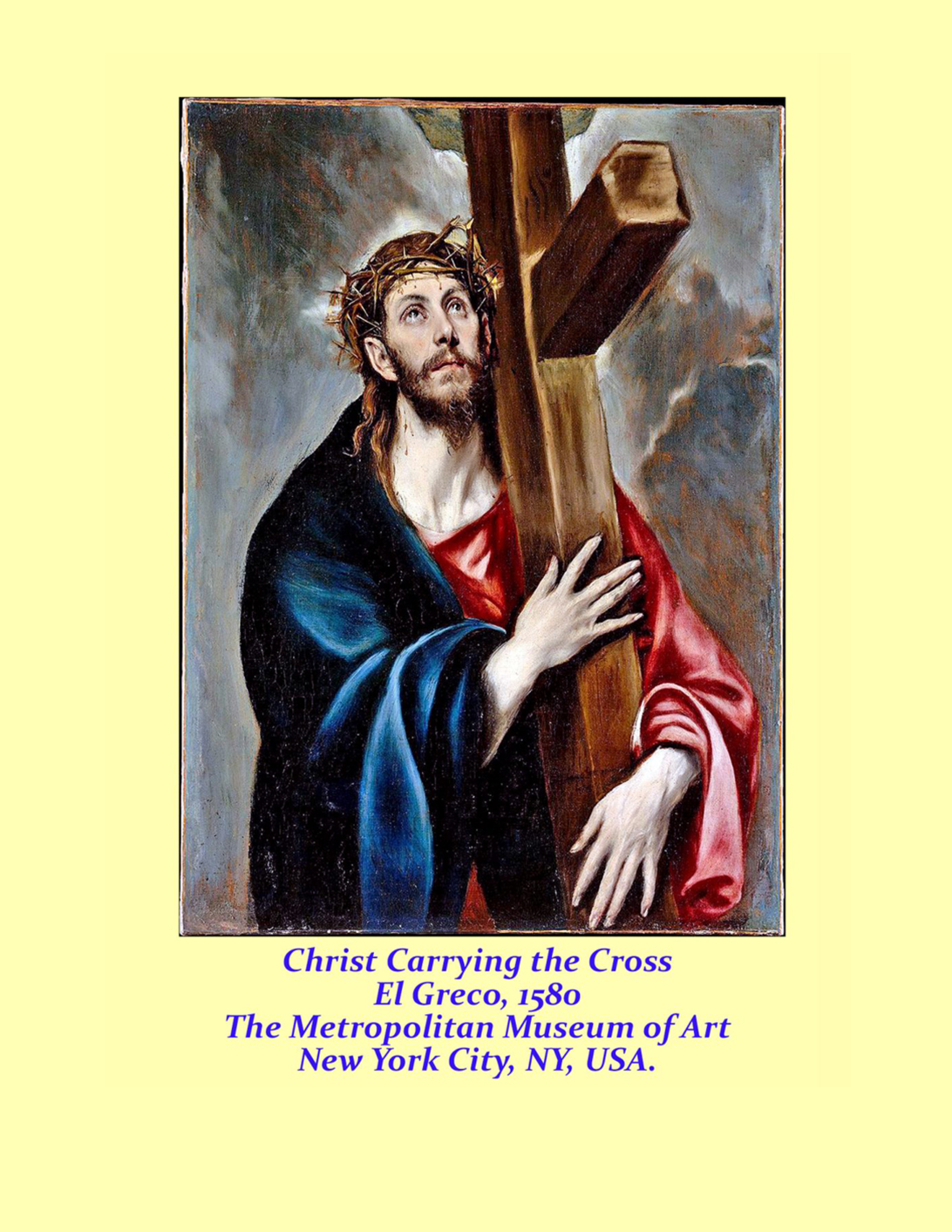
Christ Blessing (The Saviour of the World), El Greco c.1597, National Galleries of Scotland, Edinburgh, UK.

There is no one who performs a mighty deed in my name who can at the same time speak ill of me. For whoever is not against us is for us.    Mark 9:39-40.

Click here to read today’s Sunday Mass Readings.

Click on words highlighted in red for further information.

I grew up in London many years ago. At that time it was pockmarked with bomb sites galore, there was very little money to spend on anything except essentials, and it is a wonder how my mother, and the millions like her, managed to bring children up at all. But my childhood was additionally difficult in that I was Catholic in a predominantly Protestant country. I felt this especially on Ash Wednesday. I had that black mark on my forehead (and no-one else did at that time) and had been told it was NOT to be removed (mortal sins flew around in those days like leaves in autumn) and so I had to endure grown-ups looking at me as if in pity because I had a mother who didn’t care, who let her son out with a filthy face. It was agony. But at least I had the consolation knowing that they were all going to hell because they weren’t Catholic! Except my Protestant mother, of course. It was one of the givens back in those days. I’m sure it wasn’t strict church teaching, but there was (as far as I could tell at the age of 10) a widespread acceptance of that belief. There were certainly echoes of it even in pontifical letters. Pope Pius XI, for example, responding in 1928 to the ecumenical movement which was then gaining ground, had this to say in his encyclical Mortalium Animos:

Let, therefore, the separated children draw nigh to the Apostolic See, set up in the City which Peter and Paul, the Princes of the Apostles, consecrated by their blood; to that See, We repeat, which is the root and womb whence the Church of God springs, not with the intention and the hope that the Church of the living God, the pillar and ground of the truth will cast aside the integrity of the faith and tolerate their errors, but, on the contrary, that they themselves submit to its teaching and government.

There was little room for movement there, and needless to say, not one non-Catholic group responded to the Pope’s invitation. I wonder what Pope Pius would say about this gathering in the shadow of the cathedral at Assisi in 2016, sponsored by Pope Francis, with, among many others of Abrahamic and non-Abrahamic faiths, Bartholomew, the Orthodox Ecumenical Patriarch, Aphrem II, Syro-Orthodox Patriarch and Justin Welby, the Protestant Archbishop of Canterbury, praying for world peace:

So we seem to have come quite far in recognizing that God can be worshipped in many different ways, not just “our” way, even if there are doctrinal differences with others. Today’s second reading from the letter of St. James seems to condemn those who lord it over lesser mortals, perhaps in some way condemning those who stand in power or judgment over others who have done no wrong yet suffer at their hands. Indeed Jesus seems to be especially harsh on those who force others to act, for example, against their consciences. Remove from yourself, he seems to say, those elements which, though precious to you, cause suffering in others. He even seems to say that hell awaits such perpetrators (Gehenna being an image of hell, the name taken possibly from the Hinnom Valley outside Jerusalem, where the city garbage was once incinerated and child sacrifice once conducted). So maybe intolerance can be reckoned as utterly condemned by the Lord, hence along with it, racism, discrimination, sexism, homophobia, xenophobia, ageism, and all the other unhappy examples of my way or the highway. Note that the Lord himself practiced what he preached, helping the Roman centurion (who would have encountered hatred from the Hebrews over whom he ruled), who appealed for help for his servant (Matthew 8:5-13), talking to the Samaritan woman, considered a heretic, (John 4-26) and even to a pagan woman whose daughter was, in her words, possessed (Matthew 15:21-28) and of course promising the repentant thief crucified with him that he would be with him in Paradise, relayed in three gospels (Matthew 27:38, Luke 23:32-43 and Mark 15:27). So, sinners, the despised, with women, to the Lord these were people crying for help, and he recognized their suffering, in one way or another. It mattered not what they were, it was WHO they were! And there is our example of simple kindness, acceptance and warmth which we are all encouraged to reflect. Let us all pray that we are indeed capable of such acceptance.

Peter and the others refusing to enter the house of Levi the tax collector when Jesus had dinner with him and his friends. Levi was an excommunicated Jew who collaborated with the pagan Romans. A Jew who entered his house would become ritually unclean. Yet Jesus entered his house and dined with him. Levi became Matthew and followed Jesus thereafter. Zeffirelli (brilliantly) has Jesus tell the story of the Prodigal Son here, with Levi the prodigal, and Peter the outraged older brother. Jesus of Nazareth 1977, Directed by Franco Zeffirelli.

IF YOU LIKED THIS REFLECTION, PLEASE LET OTHERS KNOW

Reflections on next Sunday’s Mass Readings will be posted on Wednesday.

Please send your reactions to: RogerJohn@aol.com

© SundayMassReadings.com

SUNDAY 2 JUNE 2024: THE SOLEMNITY OF THE MOST HOLY BODY AND BLOOD OF CHRIST, CORPUS CHRISTI.

The Last Supper, Munir Alawi November 2018.

While they were eating, he took bread, said the blessing, broke it, gave it to them, and said, “Take it; this is my body.”       Mark 14:22.

Click here to read today’s Sunday Mass Readings.

Click on words highlighted in red for further information.

There are good Christians throughout the world who accept the Holy Bible as the absolute and irrefutable Word of God. Many reject the findings of science that the world is millions upon millions of years old, because the world was made in six days, according to the Book of Genesis. In Tennessee in 1925, the Butler Act criminalized teaching evolution in high schools as incompatible with biblical teaching. It remained law for 40 years. Even today there is a school of thought which attempts to harmonize biblical with scientific discovery called Creationism. So, for example, many creationists still accept that God created Adam from the dust of the earth, and Eve from one of his ribs. God did that because God can do whatever he wills. This is generally called a fundamentalist approach to biblical teaching, and is not accepted as such by several mainstream churches, including the Roman Catholic Church. However, there tends to be one major exception to this rule, where Catholicism becomes fundamental, and the fundamentalists become relativist. And that concerns today’s feastday. 

At the Last Supper, Jesus took bread, blessed it, broke it and gave it to his friends saying “This is my body”. Similarly with a cup of wine, he prayed, and passed it to his friends saying “This is my blood”. We Catholics accept these words as literally true – the consecrated bread and wine are, in fact, the body and blood of the Lord, as he said. And because he also said “Do this in memory of me” every time those words at spoken by a priest at Mass, they are as literally true as they were at the Last Supper: the Lord is actually present under the form of bread and wine. But, and here is the point, many Protestants, including most fundamentalists, do not accept these words as literally true, but claim they are symbolic of the Lord’s presence, not the real presence. However, Jesus did not say at the Last Supper: “This is the symbol of my body”, or “This represents my body”, or “This is a likeness of me” but said simply and directly “This is my body”. Additionally, St. Paul, in his second letter to the Philippians, says Therefore God exalted [Jesus] to the highest place and gave him the name that is above every name, that at the name of Jesus every knee should bow, in heaven and on earth and under the earth….” which accounts for Catholics kneeling before the consecrated bread and wine, as Jesus is really present there, something most Protestants would not do. And today’s great feast is in honor of that belief. Today many parishes will carry the consecrated bread, in a monstrance, through the streets around the parish church, as witness to the belief that the Lord is present in the midst of everyday life. 

The Dominicans at St. Mary Church in New Haven, Connecticut hold a Corpus Christi procession on June 18, 2017.

It is encouraging to find out that most Catholics do, in fact, accept and believe in the “Real Presence” of the Lord, as the consecrated bread and wine is called, ranging from 64% to 95%. This might be considered to be the most deeply felt truth of Catholicism, without which our faith would be eviscerated. To walk into a church which does not accept this as a reality, a Catholic feels a coldness, an emptiness which is not pleasant or welcome. That little red lamp at or near the altar tells us that Jesus is present really and actually in the consecrated bread within the tabernacle. After the Holy Thursday mass, which ends when the sacred species (as the consecrated bread and wine are called) are taken to another private reserved place until Holy Saturday. The tabernacle is empty and the door is left open. To Catholic eyes, that seems to be wrong, cold, uninviting. It makes that time really alien, and it only occurs at that time in the year. It signifies the death of the Lord, and his body laid in the tomb. It is the opposite of today’s joyous Corpus Christi celebration, with the Lord actually present even in the streets near the church. Consequently it is up to all of us to be, as it were, the presence of the Lord in the streets, in our life, on every other day in the year, whenever and wherever we are. Perhaps that is the message of the day. We see and acknowledge the Lord present among us, and it is up to each of us to maintain that presence as children of God all all the other days in the year. 

A final thought. One young man called Carlo Acutis had a special devotion to the Eucharist and documented all the eucharistic miracles he could find. He created his own website reporting those miracles recognized by the church. The National Catholic Reporter also documented this site. He was also intrigued by marian apparitions and created a site for that purpose also. He was clearly a devoted Catholic and demonstrated this in his life and in his activities. He developed acute promyelocytic leukemia, a fatal blood disease. He died on 12th October 2006 at the age of 15. In May of this year, 2024, Pope Francis recognized the second miracle attributed to this young man’s intercession, and Blessed Carlo will become Saint Carlo sometime this year, the first millennial to be so designated. His overwhelming devotion to the Eucharist powered his short life and enabled him to face acute suffering and die in the grace of God. His body lies in the church of Santa Maria Maggiore, in Assisi where he wished to be buried. He is dressed in jeans, sneakers, and a sweater. For him, the Eucharist was the means whereby he left this world to enter the glory, the peace and the happiness of the next. 

The Body of Blessed Carlo Acutis, Church of Santa Maria Maggiore, Assisi, Italy.

PLEASE FORWARD THIS REFLECTION TO THOSE YOU THINK WOULD APPRECIATE IT.

THANK YOU.

Reflections on next Sunday’s Mass Readings will be posted on Wednesday.

Please send your reactions to: RogerJohn@aol.com

© SundayMassReadings.com