SUNDAY 30 NOVEMBER 2025: THE FIRST SUNDAY OF ADVENT.

Pilgrim Traveler, Matthew 24, “Stay Awake!”

(Jesus said to his disciples) Therefore, stay awake! For you do not know on which day your Lord will come.     Matthew 24:42.

Click here to read today’s Sunday Mass Readings.

Click on words highlighted in red for further information.

The presence of the Advent wreath up at the altar today and the lighting of one candle of the four tells us immediately that Christmas is around the corner, and that we have four weeks or so to prepare for it. The tradition of the Advent wreath started with our Lutheran brothers and sisters in northern Germany in the first half of the 19th century. Pastor Johann Hinrich Wichern had the inspiration when working with poor children in Hamberg. He must have become so fed up by the children constantly asking “Is it Christmas yet?” (the 19th century version of “Are we there yet?”) that he created this:
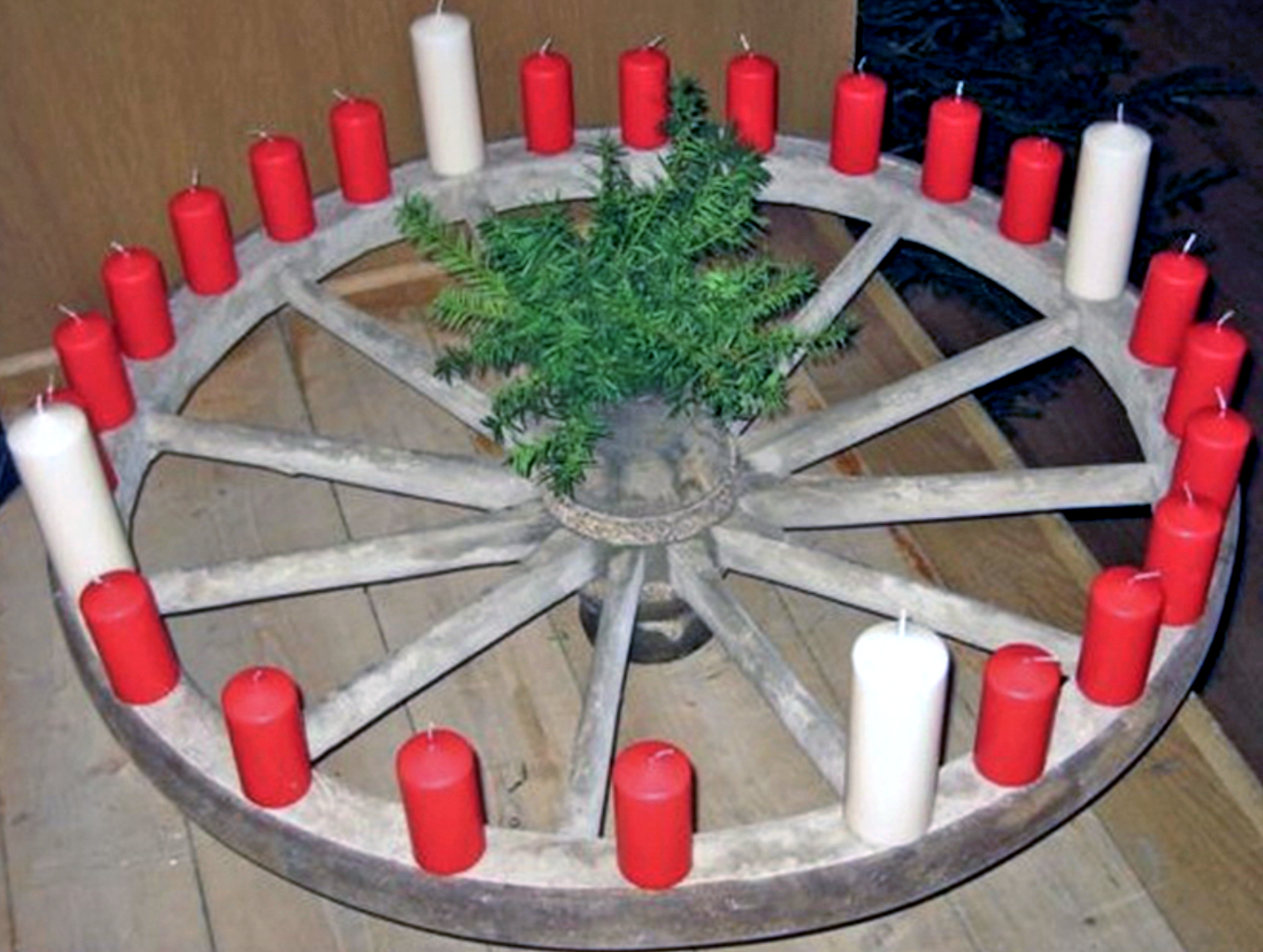
Recollections, Advent and Johann Hinrich Wichern, November 2017.

Not quite what we see today. The original wreath, with a base in an old cartwheel, shows all the days of Advent leading up to Christmas, with white candles indicating the Sundays. Quite elaborate compared to the present-day version! It’s a sort of 3D version of the Advent calendar!

This Sunday begins a new church year and with it our hopes and prayers for a year of peace and justice, of happiness and rejoicing, of goodwill among all people. Isn’t that what Christmas is supposed to be? Isn’t that what the angels themselves sang to the shepherds in the fields abiding? But as ever, we mustn’t get too carried away, with today’s gospel telling us to stay awake in a season when excess and collapse are more likely to be found than quiet reflection and attention. But we do have this season of Advent when we can do exactly that! Now is the time when we can reflect on the wonder of this season, when the almighty majesty of the Eternal Godhead took frail flesh and was born not into fame and glory but into a stable sheltering ox and ass! What a wonder, what an example; what a lesson. That we commemorate such a humble event 2000 years later is itself a wonder. It was, I believe, the culmination of God’s plan for us the human race and with whom, Genesis tells, God was “very pleased”. How so?

The greatest gift we have is free will. Unlike the beasts of the field, locked into the basics of getting through the day, we have choices. For whatever reason, we might forgo having a meal for some reason greater than responding to hunger. We might go and climb Mount Everest simply because “it is there”. We can create artwork to strengthen the beauty around us. Animals seem to have no idea or ability to do such. Only we can. But (as always) this greatest gift began to be used for the wrong purpose. We can cause grief, hatred, evil simply because we can. That was why, I believe, God entered human life. Ancient Canaan, the land promised to Abraham by God, practiced child sacrifice at that time. Even worse, the Canaanites thought they were doing the right thing. If they needed something tremendous, such as relief from famine, or the threat of invasion, such big requests of the gods (Moloch in particular), demanded a big price (which reflects normal human experience). But in this case it was child sacrifice. And I believe it was this that caused our God to intervene in human history. Abram/Abraham heard a tiny voice, believed it to be holy and obeyed it (Genesis 12). In that way, God found a believer, sent him into the heartland of this abomination, and so began the history of God’s people, beginning with the elimination of that terrible practice  (which took a long time). For about 2000 years God slowly revealed the divine nature: God was found to be  loyal, powerful, forgiving, a listener, merciful, a lover of freedom and open to relationship. With that finally established, God’s Son arrived and displayed those identical qualities in his lifework. Being fully human, Jesus showed us how to be fully human, acting and behaving in the way God has always wanted us to behave. And everything Jesus did in his ministry we can too, given the gifts which God has provided for all of us, without exception. And Christmas marked the arrival of this man who showed us the true meaning of being human utterly and completely. We can all be like him, he using his gifts, we using ours. 

And so how about an Advent resolution? To be as truly and completely human as Jesus was. So we can never excuse ourselves with the plaintive “I was only human” to explain a fault. No – had I been truly human I would never have done/said/thought the thing I should not have. It is to betray our humanity if we excuse ourselves in that way. To be completely human is to get as close to the Lord as we can, the One who made us human, and to ask guidance or forgiveness when we have failed, that is, become less than human. In this way we will be in great shape when the Great Day arrives, when Pastor Wichern gave a sigh of relief, and we sing Adeste Fidelis!

St. Mary’s Catholic Church, Navan, County Meath, Republic of Ireland.

THERE IS AN IMPORTANT MESSAGE HERE WHICH MIGHT BE GOOD NEWS TO SOMEONE YOU KNOW.

IF SO, PLEASE FORWARD IT TO THEM. 

THANK YOU.

©SundayMassReadings.com

AUGUST 19, 2018: TWENTIETH SUNDAY IN ORDINARY TIME

SUPPER

In Memoriam, The Last Supper, Andrew White, Jesuit Church of the Immaculate Conception, Farm Street, Mayfair, London, England.

http://www.usccb.org/bible/readings/081918.cfm

I am the living bread that came down from heaven whoever eats this bread will live forever; and the bread that I will give is my flesh for the life of the world.  John 6:51.

The readings for the last few Sundays seem to concentrate on what could be called Jesus’ central message, that he is with us until the end of time, and that he invites us to be an intimate part of his eternal life here on earth in anticipation of being with him forever in the next. It is, after all, the most important message he came to deliver to us. He lives in and with us today by means of the Holy Spirit of God, just as all those years ago, guiding us, refreshing us and empowering us to be true followers. But on the face of it, it is a shocking image, as seen in the quotation from today’s gospel.

In the early days of the Christian church, when the “sacred mysteries” remained well and truly sacred and mysterious (it is thought the early Christians never talked openly about the Eucharist, and so rumors began to spread), the Roman authorities charged Christians with being cannibals! In addition, rumors also got out that they were brothers and sisters who loved each other, and were therefore incestuous; these people believed in only one God, which to the Romans with their pantheon of gods and goddesses, was tantamount to being atheists, another accusation. As Christians refused to worship those gods, who protected the Roman Empire, they were also traitors by endangering the very life of the empire. The link below talks of these and other accusations against early Christians.

https://www.academia.edu/2519819/Incest_Infanticide_and_Cannibalism_Anti-Christian_Imputations_in_the_Roman_Empire

Quite a lineup of deadly crimes, resulting in 300 years of persecution. But the cannibalism was among the worst of the charges. All the other “crimes” could be considered secondary to that one. The Romans simply did not understand what this Christian belief in the consumption of the body and blood of the Lord was all about, and I think we can all understand that confusion. Even reading the gospel today represents a challenge to us, 2000 years later. It sounds extraordinary and requires an effort to understand and accept it.

The ancient Hebrews through the course of 2000 years or so, began to understand who their God was, and what qualities or characteristics this God had. For example, the gods of the ancients above all other things, had to be powerful. People needed protection and help from events over which they had no control at all, such as disease, famine, natural disasters, invasion. So they looked to their gods for help. Therefore when Yahweh God descended to earth, to an old man, Abram, in Haran in Mesopotamia, power had to be among the first divine qualities revealed. Sure enough, it was. Abram’s old and barren wife, Sarai, gave birth to a son, Isaac. That was a power even we today could not match. She was about 80 years old! Instead of defeating an enemy or stopping a plague, God gave new life to an old barren couple. And so salvation history began.

Among the divine qualities revealed through the ages was loyalty or trustworthiness. God promised Abram and Sarai, now renamed Abraham and Sarah by God, land and descendants, which eventually came to be. Hence Jesus had to demonstrate the exact same quality in his mission so that he could be truly considered God’s Son. The last verse of Matthew’s gospel is his promise to be with us to the end of time. And today’s gospel reveals how he meant to achieve it. The bread and the wine, consecrated by the Holy Spirit, becomes his flesh and blood for the life of the world which we take into ourselves. So he is with us in the most intimate way to the end of time. He was, and is, loyal to his word. The consequences can be glimpsed in today’s second reading. Paul talks about the rewards of a decent life, one rich with God’s presence. 

And note the first reading. Proverbs talks about God’s Holy Spirit, an intimation of the full revelation of the Holy Spirit eventually given to us by the Lord. In Hebrew, God’s Spirit is feminine (unlike the unfortunate gender given the Holy Spirit in our translation of the gospels from the Greek original, where the word spirit is neutral). The first reading seems to suggest the Spirit of God is preparing a party, preparing us for a really good time: Come, eat of my food, and drink of the wine I have mixed! This seems to be a wonderful elaboration of Jesus’ invitation to his banquet. But so often Christians seem to be a gloomy lot. Pope Francis has even suggested that ministers of communion should smile when fulfilling their office; after all, they are handing out the means by which we will achieve eternal life and happiness! A wonderful piece of advice I think.

And that sums up the message of this 20th Sunday in Ordinary Time. Jesus invites us into his life, his world, a world of unending joy, laughter, happiness, fulfillment, in an utterly unique and transforming way. So it is up to us to be sensible enough to accept this free gift, live up to its completely human expectations, and join the club!

banquet

http://www.progressiveinvolvement.com/progressive_involvement/2014/10/lectionary-blogging-pentecost-18-matthew-22-1-14.html

© SundayMassReadings.com

Roger2

Please leave a comment to let me know if this new website style is an improvement or not. Thanks.