Pilgrim Traveler, Matthew 24, “Stay Awake!”
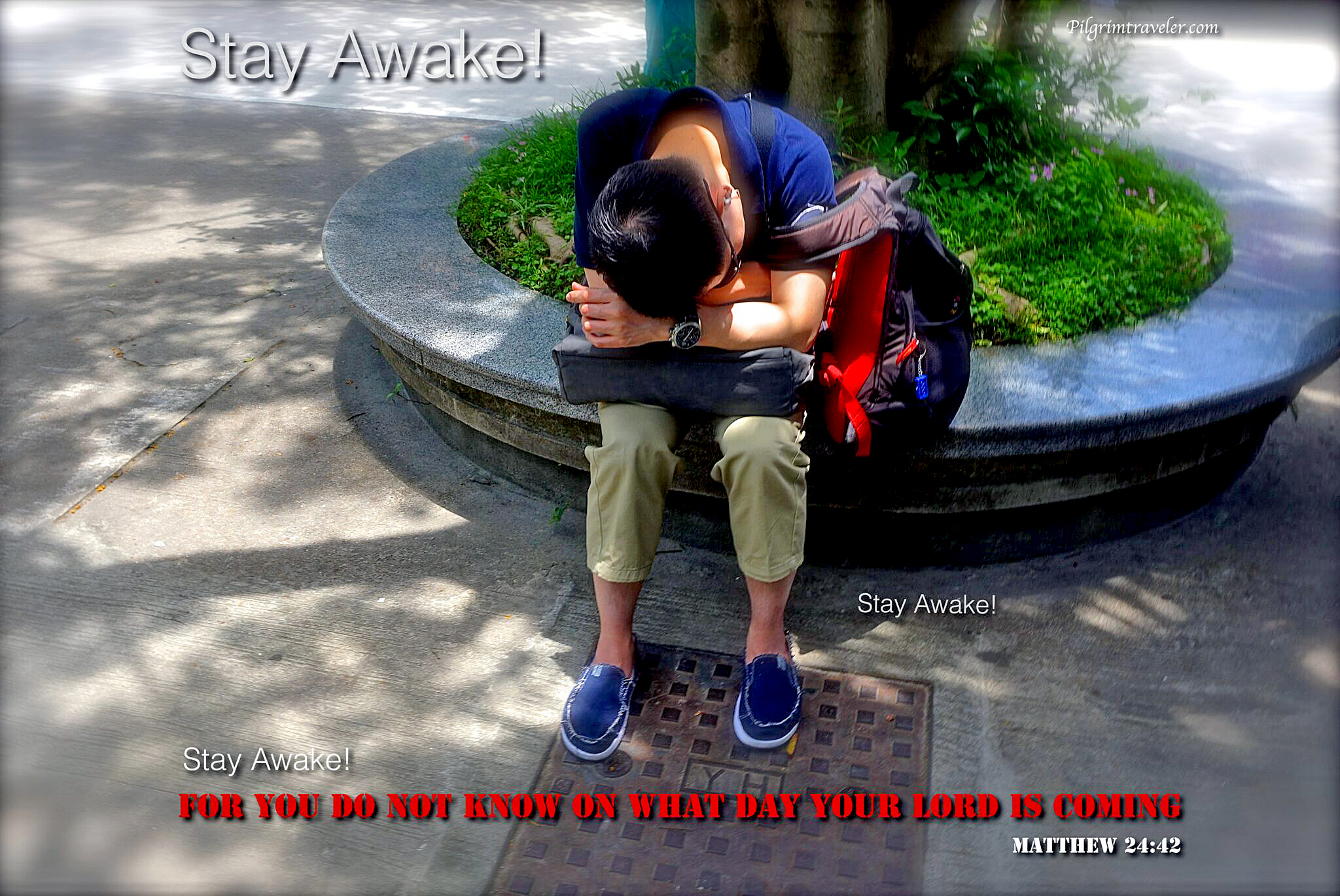
(Jesus said to his disciples) Therefore, stay awake! For you do not know on which day your Lord will come. Matthew 24:42.
Click here to read today’s Sunday Mass Readings.
Click on words highlighted in red for further information.
The presence of the Advent wreath up at the altar today and the lighting of one candle of the four tells us immediately that Christmas is around the corner, and that we have four weeks or so to prepare for it. The tradition of the Advent wreath started with our Lutheran brothers and sisters in northern Germany in the first half of the 19th century. Pastor Johann Hinrich Wichern had the inspiration when working with poor children in Hamberg. He must have become so fed up by the children constantly asking “Is it Christmas yet?” (the 19th century version of “Are we there yet?”) that he created this:
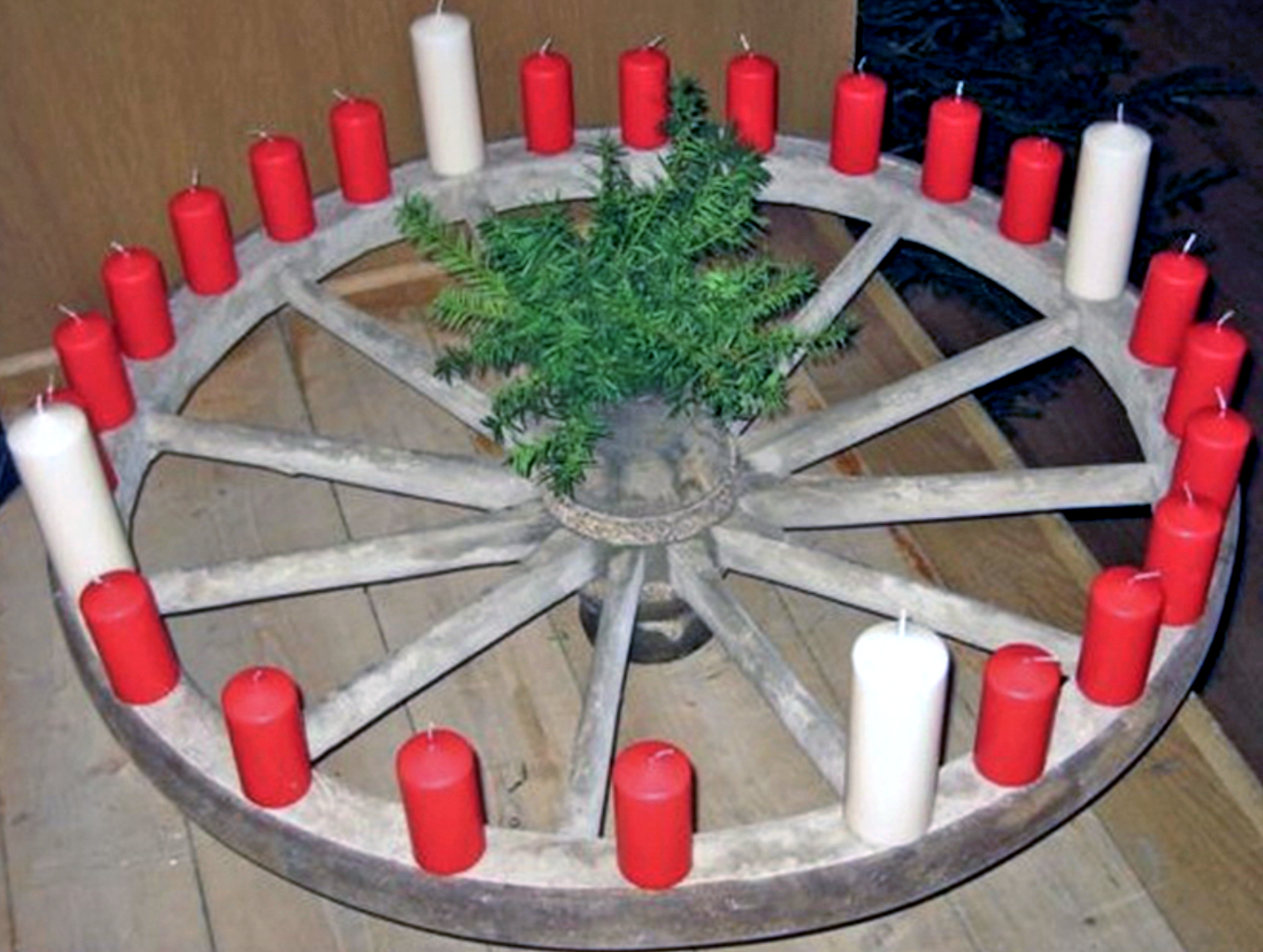
Recollections, Advent and Johann Hinrich Wichern, November 2017.
Not quite what we see today. The original wreath, with a base in an old cartwheel, shows all the days of Advent leading up to Christmas, with white candles indicating the Sundays. Quite elaborate compared to the present-day version! It’s a sort of 3D version of the Advent calendar!
This Sunday begins a new church year and with it our hopes and prayers for a year of peace and justice, of happiness and rejoicing, of goodwill among all people. Isn’t that what Christmas is supposed to be? Isn’t that what the angels themselves sang to the shepherds in the fields abiding? But as ever, we mustn’t get too carried away, with today’s gospel telling us to stay awake in a season when excess and collapse are more likely to be found than quiet reflection and attention. But we do have this season of Advent when we can do exactly that! Now is the time when we can reflect on the wonder of this season, when the almighty majesty of the Eternal Godhead took frail flesh and was born not into fame and glory but into a stable sheltering ox and ass! What a wonder, what an example; what a lesson. That we commemorate such a humble event 2000 years later is itself a wonder. It was, I believe, the culmination of God’s plan for us the human race and with whom, Genesis tells, God was “very pleased”. How so?
The greatest gift we have is free will. Unlike the beasts of the field, locked into the basics of getting through the day, we have choices. For whatever reason, we might forgo having a meal for some reason greater than responding to hunger. We might go and climb Mount Everest simply because “it is there”. We can create artwork to strengthen the beauty around us. Animals seem to have no idea or ability to do such. Only we can. But (as always) this greatest gift began to be used for the wrong purpose. We can cause grief, hatred, evil simply because we can. That was why, I believe, God entered human life. Ancient Canaan, the land promised to Abraham by God, practiced child sacrifice at that time. Even worse, the Canaanites thought they were doing the right thing. If they needed something tremendous, such as relief from famine, or the threat of invasion, such big requests of the gods (Moloch in particular), demanded a big price (which reflects normal human experience). But in this case it was child sacrifice. And I believe it was this that caused our God to intervene in human history. Abram/Abraham heard a tiny voice, believed it to be holy and obeyed it (Genesis 12). In that way, God found a believer, sent him into the heartland of this abomination, and so began the history of God’s people, beginning with the elimination of that terrible practice (which took a long time). For about 2000 years God slowly revealed the divine nature: God was found to be loyal, powerful, forgiving, a listener, merciful, a lover of freedom and open to relationship. With that finally established, God’s Son arrived and displayed those identical qualities in his lifework. Being fully human, Jesus showed us how to be fully human, acting and behaving in the way God has always wanted us to behave. And everything Jesus did in his ministry we can too, given the gifts which God has provided for all of us, without exception. And Christmas marked the arrival of this man who showed us the true meaning of being human utterly and completely. We can all be like him, he using his gifts, we using ours.
And so how about an Advent resolution? To be as truly and completely human as Jesus was. So we can never excuse ourselves with the plaintive “I was only human” to explain a fault. No – had I been truly human I would never have done/said/thought the thing I should not have. It is to betray our humanity if we excuse ourselves in that way. To be completely human is to get as close to the Lord as we can, the One who made us human, and to ask guidance or forgiveness when we have failed, that is, become less than human. In this way we will be in great shape when the Great Day arrives, when Pastor Wichern gave a sigh of relief, and we sing Adeste Fidelis!

St. Mary’s Catholic Church, Navan, County Meath, Republic of Ireland.
THERE IS AN IMPORTANT MESSAGE HERE WHICH MIGHT BE GOOD NEWS TO SOMEONE YOU KNOW.
IF SO, PLEASE FORWARD IT TO THEM.
THANK YOU.
Reflections on next Sunday’s Mass Readings will be posted on Wednesday.
Please send your reactions to: RogerJohn@aol.com
©SundayMassReadings.com


 Sunday Mass Readings
