SUNDAY 15 JUNE 2025: THE SOLEMNITY OF THE MOST HOLY TRINITY.

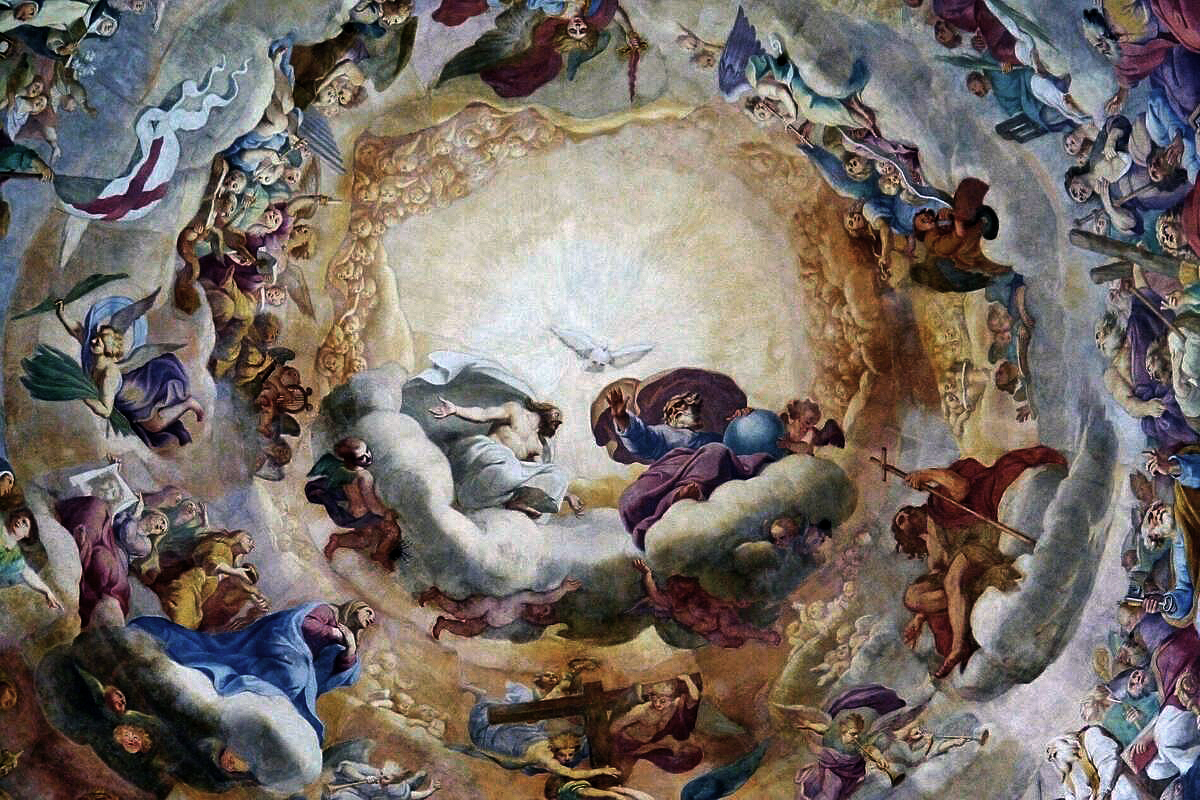
The Holy Trinity, Pierre Mignard c.1663, Church of the Val-de-Grâce, Paris, France.

[The Holy Spirit] will glorify me, because he will take from what is mine and declare it to you. Everything that the Father has is mine; for this reason I told you that he will take from what is mine and declare it to you.”     John 16:14-15.

Click here to read today’s Sunday Mass Readings.

Click on words highlighted in red for further information.

At the very deepest level of the beating Christian heart is its most profound mystery, the Holy Trinity of God. Christianity is a monotheistic faith, meaning a belief in one God, yet at its heart there are three persons, Father, Son and Holy Spirit – yet one God. Artificial Intelligence assures us that “thousands” of books have been written about this profoundest Christian mystery, theological, devotional, historical and academic. So it is, in a word, inexplicable. It rests on faith alone. If Jesus said it, it’s true. And he did. And buried right at the center of this mystery is its power: love. Now note that carefully; love requires, demands even, at least one other. Unrequited love is agonizing. It certainly isn’t love as it is understood. But when it is returned, the drab world is filled with color, you feel as though you are walking on air, there is one other person who means everything to you. The other person completes your life. It is perfection. For many it is God, the unfathomable depth of love present for all eternity, always present and always constant. And for many it is the person in this life with whom you want to spend the rest of your life. This love is life-enhancing, making everything in it tolerable and meaningful. It is the power which created everything, sustains it and gives it hope. It is the only reasonable explanation of how everything came to be, as love opens us up to the world and everything in it. If something is not perfect, love urges us to transform it into something acceptable and good. And only togetherness can do that. Hence the Holy Trinity must be at the heart of all that is good and beautiful. Yes, one God, so united that the three persons had to share their love with others – with us. They provide the template of perfection against which we can measure everything. And if lacking, it is to the Trinity that we can call and receive guidance and help. True love freely gives, asking nothing in return. 

It was through the centuries that God slowly revealed this profoundest mystery of the Christian faith. The Father intervened in human history with the call of Abram/Abraham. Through the centuries we humans slowly understood that this God was open to relationship, beginning with the revelation of the God’s holy name, Yahweh, I Am Who Am to Moses (Exodus 3:14). The arrival of Jesus in our midst exemplified all the qualities revealed as divine through the pages of the Old Testament. Taking the ideal of relationship, for example, to a numinous level, Jesus at the Last Supper declared basic human food, bread, to be his body, and we were to take and eat it. This was relationship at its ultimate: we take the Lord into ourselves! Complete union! The Holy Spirit is the power which has enabled everyone since that time to participate in the Lord’s Supper, beginning with the miracle of Pentecost, celebrated last week, down to today. And at each Mass, God’s Holy Spirit is called to descend on the gifts of bread and wine so that they become the body and blood of the Lord himself. It is the ultimate sharing, the love of God coming to us, transforming the simple realities of bread and wine into the real presence of God. God gives his very self to us! 

Now at this point I ask you to look at the notes from last week, the feast of Pentecost, which refer to the gender of the words which refer to the Holy Spirit. All of them are feminine in the language of Jesus, Aramaic (as well as in Hebrew). Whenever the Holy Spirit of God is invoked in the Hebrew Testament, she is always referred to as she! Now I say this to make a point. We, each and every one of us, were conceived in the womb of our mother. Most of us grew up amid a welcoming and loving family which nurtured us and created the foundations on which we stand for life. I know this does not apply to everyone, but I think my point still holds. The Holy Trinity without the feminine principle present seems hollow to me. Our whole experience of life requires a feminine presence. We all of us exhibit male and female traits. Consequently the question arises, where did they all come from? If the Holy Spirit is constantly referred to as “he” there is an awning empty space somewhere. Look at today’s gospel and compare it to this:

But when she comes, the Spirit of truth,
she will guide you to all truth.
She will not speak on her own,
but she will speak what she hears,
and will declare to you the things that are coming.

She will glorify me,
because she will take from what is mine and declare it to you.

And when Jesus spoke these words, he used the Aramaic word for Spirit (also meaning breath and wind), רוּחַ pronounced “roo-akh” which is feminine in gender, so Jesus’ words would have sounded like the revised gospel above! And if you add that feminine presence or reality to the Holy Trinity, surely it must reflect our experience much more realistically. The Father and the Spirit forever creating the Son, the incandescent eternal presence of creative, sustaining love. And that is the reality we are celebrating today! And one final word: in Hebrew the word for truth, אֱמֶת, emet, is feminine, and is composed of the first, middle and last letter of the Hebrew alphabet; but in Aramaic, it is שְׁרָרָא, sherara, meaning tightly bound, and is masculine. But it also means umbilical cord… 

The Holy Trinity, Most Holy Trinity Catholic Church, Covington, Louisiana, USA.

© SundayMassReadings.com

SUNDAY 8 JUNE 2025: SOLEMNITY OF PENTECOST: THE DESCENT OF THE HOLY SPIRIT; THE BIRTHDAY OF THE CHURCH.

Pentecost, El Greco c. 1600, Museo del Prado, Madrid, Spain.

When the time for Pentecost was fulfilled, they were all in one place together. And suddenly there came from the sky a noise like a strong driving wind, and it filled the entire house in which they were. Then there appeared to them tongues as of fire, which parted and came to rest on each one of them.            Acts of the Apostles 2:1-3.

Click here to read today’s Sunday Mass Readings.

Click on words highlighted in red for further information.

First, you could make a case for this event to be the most important happening ever in the church’s history, save for the Resurrection itself. Why? Because without it there would be no church, no Christianity, no saving message of Christ to each of us today. Remember John’s gospel states twice that the entire small Christian community trembled behind locked doors “for fear of the Jews”. But this was the Jewish Feast of Pentecost, 50 days after Passover, the reason why Jerusalem was packed with Jewish pilgrims (Pentecost is the Greek word for 50th  πεντηκοστός – pentēkostós). Today it has a Hebrew name, Shevuot, to distinguish it from the now better-known Christian Pentecost. For the Jewish people, it was at that time one of the three pilgrimage feasts, when those who could, would travel to Jerusalem and worship in the Temple. (The others were Passover and Sukkot). Originally Shevuot was the Feast of the First Fruits of the Harvest, a sample of which you would bring and offer there. Later it became the Feast of the Law, because by tradition, the Hebrew people arrived at Mount Sinai 50 days after leaving slavery in Egypt, and where God gave Moses the 10 Commandments. But whatever it was, Jerusalem was packed with devout Jewish pilgrims intent on giving thanks to God at the holiest place on earth, the Temple (which was completely destroyed by the Romans in 70AD), but not before the first fruits of the Descent of the Spirit had shown themselves! 

But before that, the earliest Christians trembled in their upper room, fearful they too would suffer the same fate as the Lord, especially with the city packed with devout Jews. Then it happened, as reported in the Acts of the Apostles stated above. These cowering mice suddenly became fearless lions, rushing out into the streets proclaiming the Good News to anyone who would listen! Now, in the absence of the Lord, but with the promised strength of God’s Holy Spirit, the Christian message was, for the first time, proclaimed in the streets of the Holy City itself without any fear of the consequences. Hence it was indeed the truly miraculous Birthday of the Church! What else but a miracle could explain this sudden, permanent and inexplicable change in outlook? Those, by the way, are the hallmarks of a true miracle to this day! It was the inaugurating moment of the Age of the Holy Spirit of God, in which we all live at this moment. The red vestments at Mass today reflect the mystic fire of the Holy Spirit descending on the heads of those first true Christians, now fearless, and intent on spreading the Good News. And spread it has, to the estimated 2.4 billion believers today, the world’s largest religion, of whom 1.3 billion are Catholic. And note also, that the disciples miraculously spoke in many tongues to the pilgrims from throughout the Roman Empire. Theologians say that this cancelled out, at long last, the curse of confused tongues at the building of the Tower of Babel, built by humans to ensure that if God ever sent another flood, they would overcome it.

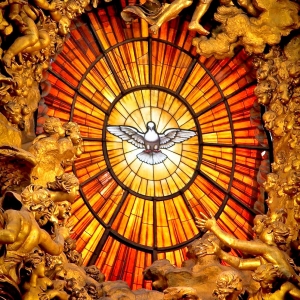
God’s Holy Spirit appeared on that wonderful day “as of fire”. You will recall that at the Baptism of Jesus, God’s Holy Spirit came upon him “like a dove”. I cannot resist repeating the following, which appears in almost all my messages concerning God’s Holy Spirit. The words dove, יוֹנָה yonah, wind, spirit, breath (in Hebrew the same word) רוּחַ ruach, and wisdom, חָכְמָה, chokmah are, each and every one, feminine in gender in Hebrew and Aramaic. Each one of those words, whenever they appear in Scripture, reflect God’s power. The “dove” anointed Jesus as the Messiah (the “Anointed One”), giving him the power of God. When God “breathed” into the handful of mud in Genesis 2:7, Adam was created. The feminine “wind” allowed the Hebrews to escape from the Egyptians at the Red Sea and gave courage to the timorous Christians in the Upper Room, and they received a double dose of spiritual power as they also had fire,  אֵשׂ esh, also feminine in gender, descending on them, changing them into fearless Christian missionaries. Unhappily for us, all our Christian writings are in Greek, and in Greek the word for Spirit is neuter: πνευμα, pneuma. Now technically that means we have to refer to the Holy Spirit as “it”, which is completely unacceptable. So when the Greek Scriptures were translated into Latin, where the word for Spirit is Spiritus, the -us ending makes it a masculine noun, and so the Holy Spirit has been referred to as “he” evermore. But in Hebrew and Aramaic, the language of Jesus himself, the correct pronoun is “she”. Look at this short passage from the Book of Proverbs: Wisdom shouts in the street, she lifts her voice in the square (Proverbs 1:20). Now this is not to say that wisdom was a woman once sitting in judgment at some place and time in the Old Testament. But it does apply a quality to this word and all the others just mentioned. And above all, you could make a case that God’s Holy Spirit has as much claim to “she” as does the Father and Jesus himself to “he”. Put it this way, Jesus would be just as surprised, shocked even, to hear of God’s Spirit referred to as “he” as we would be to hear the Holy Spirit addressed as “she”. Note that in most European languages words have meaningless genders: in French a table and a chair are feminine but the carpet and sofa are masculine; meaningless. But in English that does not apply. Almost everything is “it” if not referring to people where it is definitely he or she. So gender means something in English, hence this argument. And so, as an interesting exercise, how would you alter the Creed, said each Sunday at Mass, to reflect this argument:

I believe in the Holy Spirit, the Lord, the giver of life,
who proceeds from the Father and the Son,
who with the Father and the Son is adored and glorified,
who has spoken through the prophets.

So we celebrate the church’s birthday on this day which, I believe, is a Judeo-Christian feast which has more names than any other, at least six by my reckoning. It is the sine qua non of our faith. Amen. Alleluia!

© SundayMassReadings.com

29 MAY 2025: in dioceses of boston, hartford, new york, omaha & philadelphia – SOLEMNITY of the ascension ***** 1 JUNE 2015: THE SEVENTH SUNDAY OF EASTER. (ELSEWHERE, THE SOLEMNITY OF THE ASCENSION)

THE SEVENTH SUNDAY OF EASTER

The Martyrdom of St. Stephen, Annibale Carracci 1604, Musée du Louvre, Paris, France.

Stephen said, “Behold, I see the heavens opened and the Son of Man standing at the right hand of God.” But they cried out in a loud voice, covered their ears, and rushed upon him together. They threw him out of the city, and began to stone him.      Acts of the Apostles, 7:55-57.

Click here to read today’s Sunday Mass Readings. 

Click on words highlighted in red for further information.

St. Stephen is revered as the first person to die for love of God, Jesus the Son of God and the Holy Spirit of God. His words exalting Jesus the Christ as the Messiah were so offensive to those who heard them that they stoned him to death, even though that was forbidden in the Roman Empire unless ordered under Roman authority. It was the first taste of the persecution God’s People would undergo for the next 300 years from many different quarters. And note, Stephen was one of the first ordained deacons of the church. The word deacon means servant in Greek; he had been ordained to serve the people of God, and he demonstrated that by dying a martyr’s death, the first of many martyrs to enter God’s kingdom thus; he was God’s servant first. You may recall that his feast day is December 26. The contrast is presumably intended, the birth of an innocent baby on the 25th and the brutal death of a man refusing to betray all that the baby represented remembered on the very next day. And the power which gives life to the birth of Jesus, the strength which Stephen demonstrated in bearing witness to Jesus, and the second reading inviting “the one who thirsts come forward, and the one who wants it receive the gift of life-giving water” are all examples of the love God has for us, expressed in many ways. It is the power which gives us more strength than we know. And sometimes it is good to demonstrate that love in unexpected ways, the expression of which is left to each of us. God has given multiple examples; pick and choose!

***************************************************************

Solemnity of the Ascension of the Lord

The Ascension of the Lord, S. G. Rudl 1900, St. Wenceslas Church, Prague, Czech Republic.

Then [Jesus] led them out as far as Bethany, raised his hands, and blessed them. As he blessed them he parted from them and was taken up to heaven.     Luke 24:50-51.

Click here to access the readings for the Solemnity of the Lord’s Ascension.

Click on words highlighted in red for further information.

Notes from the first reading:

  1. Jesus’ disciples asked “Lord, are you at this time going to restore the kingdom to Israel?” In other words, they still expected the Messiah to be a conquering soldier! And Jesus said definitively, “It is not for you to know the times or seasons that the Father has established by his own authority…” Remember those words the next time someone announces that the world will end on a certain future date. It is NOT for us to know!
  2. Jesus quite clearly enjoined them not to depart from Jerusalem, but to wait for “the promise of the Father about which you have heard me speak”. The two men on the road to Emmaus were clearly disobeying that instruction, until, of course, the Lord caught up with them and, as a result, they voluntarily returned to Jerusalem.

                       ****************************************************************

The Lord’s ascension into heaven effectively ended his bodily presence here on earth somewhat spectacularly. Death had no further power over him, and he was destined to be seated at the right hand of the Father. Consequently he had to depart this world. It was also to fulfill his promise to send the Holy Spirit to us and hence begin the era of the Holy Spirit which has lasted to the present day: “…it is better for you that I go away, because if I do not go, the Helper will not come to you. But if I do go away, then I will send him to you” Jesus said (John 16:7). In other words, it was necessary for the Lord to ascend to his Father in order to send the Holy Spirit to us, and inaugurate the time of the Spirit, in which we now all live. Remember that over the centuries before Jesus, God the Father slowly revealed the nature, the qualities, of God through the pages of the Old Testament. Then Jesus had to demonstrate totally and completely the identical qualities in his own life in order to be recognized as God’s Son. Finally, the Holy Spirit, sent by God, has been with us ever since, being the power through which we all strive to be good followers of Christ in the world, in fact to be Christ to the world as best we can. From the Ascension on, the saints have been the guiding men and women who have modeled themselves on Christ and shown us what it truly means to be Christ to the world. And we try our best to do exactly that. In fact, we have to exhibit the identical qualities of God in our lives.

For example, one of the first qualities revealed by God was power. Abraham was an old man, perhaps near 100, and his wife was perhaps a few years younger, yet God announced she would have a child. Sarah laughed at hearing this, and then argued with God! (Genesis 18: 10-15). She gave birth to Isaac. Anything is possible with God. Jesus had divine power, the supreme example of which was the raising of Lazarus from the dead. And each one of us has power too. Even a 6-year old has power! How? I ask altar servers sometimes, “Do you have the power to make your mother’s life today a total misery?” and then, “Do you have the power to make today one of the best days of your mother’s life?” The answer is clearly “Yes” to both questions. We all have power, but do we use it as Jesus would? Take a look at the lives of the saints; they used their God-given power to do great things, just as a 6-year old has. We know deep down what our powers can do in the way we conduct our lives. Another divine quality revealed through the Old Testament is that God is relational, unlike just about all the pagan gods of the time. Moses asked God for the divine name at the famous scene with the burning bush. God revealed the divine name, Yahweh, I AM WHO AM, at that moment creating a relationship between God and Moses, and through Moses to the entire Hebrew people. Jesus took this quality to the level of the infinite, when at the Last Supper he took some bread and said to his disciples “Take, eat, this is my body”. Each time we consume the consecrated host, we literally incorporate the Lord into our own body; the relationship is total. And so we, in our lives, must be open to others, welcoming to others, friendly to others, help others, just as the Lord did. It is a divine quality. God revealed other qualities through the pages of the Old Testament: God listens, God forgives, God loves freedom, God is loyal, God is merciful. Jesus displayed each one of these in his ministry, clearly and strongly. And so must we. 

For a few days there was, in a sense after the Ascension, a sort of absence of God before the arrival of the Holy Spirit on Pentecost Sunday, 50 days after Easter/Passover (hence pente, the Greek for 5). A provocative friend of mine often suggested that it was at that “vacant” time that the empty seat at the table, once occupied by Judas Iscariot, was filled by a man rather a woman! Now there’s a thought to be pondered! One wonders. But Jesus had completed his vocation, to be Christ to the world, which is also our vocation, based on the gifts, the talents, that God has given us. Each one of us is a child of God through baptism. All was set after the Ascension, then, for the arrival of God’s Holy Spirit, to give each of us the strength, the power, to be truly children of God.

The Ascension of the Lord, unknown provenance.

© SundayMassReadings.com

SUNDAY 25 MAY 2025: THE SIXTH SUNDAY OF EASTER.

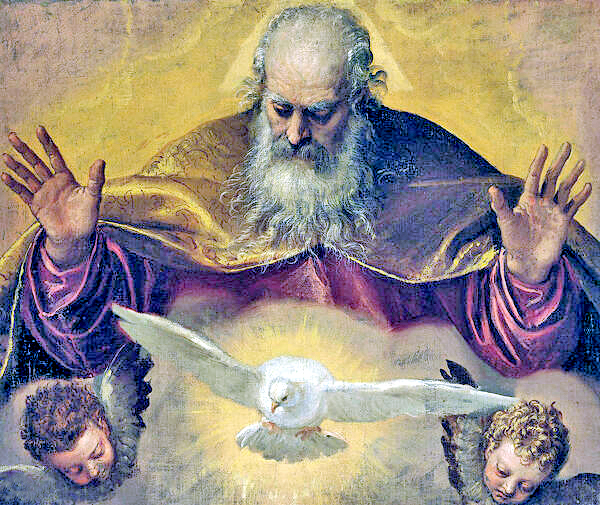
The Eternal Father, Veronese (undated), Hospital Tavera, Toledo, Spain.

[Jesus said] “I have told you this while I am with you. The Advocate, the Holy Spirit, whom the Father will send in my name, will teach you everything and remind you of all that I told you. Peace I leave with you; my peace I give to you.”       John 14:26-27.

Click here to read today’s Sunday Mass Readings.

Click on words highlighted in red for further information.

It cannot be by coincidence that the first major crisis in the brand new Christian community, described in today’s first reading, has been linked with today’s gospel. Word was spreading among the earliest Christian communities that pagan men who had expressed interest in following the Lord had to be circumcised to become Christian. Now all Jewish boys, following God’s orders as stated in Genesis 17:11-12, had been made to follow that command for hundreds of years. So it was not too surprising that such a thought had occurred to the new Christians (who had not yet had that name applied to them; before then we were “Followers of The Way”) especially the ones who had converted from Judaism, probably the majority. Today’s first reading describes that first controversy in the fledgling church. Not surprisingly, it threatened to tear the infant community to pieces unless it was addressed. So, what theologians now call the Council of Jerusalem, namely the “apostles and elders”, met together and decided that it was not necessary for men to submit to that Jewish tradition in order to follow “The Way”. And so it was proclaimed. As such it has never been a condition for boys to be circumcised in order to become Christian. And so it was the first time that Jesus’ prophetic words in today’s gospel were put to the test.

And it is even more interesting if you apply that ultimate requirement of the 16th century Reformation for changes in Church teaching, the “sola scriptura” test. This states simply that if you cannot prove your case from Scripture, then it fails. Both the Catholic and the Orthodox churches reject this teaching. Indeed, this Council of Jerusalem event today supports this rejection. The early Christians were forced to decide what needed to be done for a man to become Christian. For generations the Hebrew people had circumcised all boys, following the clear command recorded in Genesis. Now the Christians had changed that rule. But Scripture clearly proclaimed that this was an absolute requirement if you took the Christian community to be Jewish; after all, it proclaimed Jesus to be the long-awaited Jewish Messiah! However, the apostles and elders said it was not, and so, no circumcision. Looking at today’s gospel, Jesus had clearly stated that his followers would be guided by God’s Holy Spirit if and when this became necessary. Today’s first reading demonstrates the reality of Jesus’ promise, and the apostles and elders stated without hesitation that “It is the decision of the Holy Spirit and of us” not to require circumcision for men wanting to become Christian. Such a conviction has been present in the church ever since that time. In fact, the 1871 First Vatican Council proclaimed the logical extension of this belief that when the pope speaks “ex cathedra” his proclamation is infallible, meaning it must be accepted by Catholics as true  and without fault. Apart from that papal infallibility statement, only two further teachings have been declared to be infallible. One was at that Council, with the proclamation that the Virgin Mary was conceived without sin, the Immaculate Conception. The only other time was in 1950 when Pope Pius XII declared the Assumption of the Blessed Virgin Mary body and soul into heaven to be a doctrine of faith, to be accepted as true by all Catholics. Both those teachings had been present in the church from very early times. And so, even though they are not in Scripture, they are articles of faith to be accepted by all Catholics. No other teaching has been declared ex cathedra since 1950.

The First Vatican Council 1870, image located in the Library of Congress.

The Proclamation of the Doctrine of the Assumption of the Blessed Virgin Mary by Pope Pius XII, 1950.

Today’s readings are therefore really an object lesson in the ability of the church to handle questions of faith whenever they arise. Although teachings ex cathedra are extremely rare, the church does have the ability to discern between levels of acceptable belief. For example, the church accepts that St. Bernadette was especially privileged to receive visions and messages from the Blessed Virgin Mary, but it does not require any of us to accept such as essential to our faith: we can accept or reject Bernadette’s experience as we wish; the church simply states it is “worthy of belief”. But, in contrast, the church does, for example, expect us to accept the Real Presence of Christ at Mass in exactly the same way Jesus expected such from his followers at the Last Supper. “This is my body” he said, and he meant it, ordering us for ever to “do this in memory of me”. And what will be our reward, if you like, for accepting God’s word and living God’s Way? Take a look at the second reading today describing our ultimate destination, our home: “The city had no need of sun or moon to shine on it, for the glory of God gave it light, and its lamp was the Lamb”. Amen.

The Sacrifice of the Mass, unknown attribution. 

© SundayMassReadings.com


SUNDAY 18 MAY 2025: THE FIFTH SUNDAY OF EASTER.

The New Jerusalem, The Apocalypse Tapestry c.1373, Château d’Angers, Angers, France.

Click here to read today’s Sunday Mass Readings.

Then I, John, saw a new heaven and a new earth. The former heaven and the former earth had passed away, and the sea was no more. I also saw the holy city, a new Jerusalem, coming down out of heaven from God, prepared as a bride adorned for her husband.            Revelation 21:1-2.

Click on words highlighted in red for further information.

Today’s gospel may well be one of the most challenging to understand, accept and live by: “Now is the Son of Man glorified, and God is glorified in him. If God is glorified in him, God will also glorify him in himself, and God will glorify him at once.” So we must rely on scripture scholars to help us. Jesus is talking of his “glorification”, which is to say his death and resurrection. It is noteworthy that Judas had just left the table in order to betray his Lord before Jesus said this. Those who remained lived out their whole lives spreading the words of life and love, all to be martyred (with the exception of John). Jesus’ utter determination to stand by his teachings and his identity as Son of God meant that he would glorify himself by upholding this teaching to the bitter end, death on the cross. His resurrection glorified God his Father as this action conquered even death. It is a unity of action which glorified God totally. And then there is the source of all this strength, even conquering death: “I give you a new commandment: love one another”. There is the heart of all Jesus’ belief, strength and power. Death cannot conquer love. It has met its match. There is the glory of which Jesus speaks. There is the overarching strength of Jesus’ conviction, love conquers all. The other two readings are the practical result. Paul and Barnabas encounter fearsome odds trying to convince others of the truth of Jesus’ teaching and example. Yes there is rejection and ridicule, but the goal is worth all the suffering. The result with be a new, glorious and shining example of the perfect city of love and life, the New Jerusalem. All the suffering, frustration and pain will be gone. 

Given all that, I think the quotation in the paragraph above is an attempt to describe, even analyze, love. The complete bond between Jesus, God’s Son, and God the Father is complete, eternal, total and binding. To see the one, as Jesus himself said, is to see the other. There are likenesses in human life. Two people who are utterly devoted to each other are completely open to those around them in the sense they welcome them into their homes, into their lives as if they are one person. They enjoy the company of others, just as the others completely enjoy being with them. There is something life-giving being with them. You feel strengthened having been with them. There is joy anticipating being with them. They reflect the love of God. It was to defend that love that Jesus died. To have denied it before the high priest, for example, would have meant denying the love he had for God, his Father. That was not possible. That meant he had to die. And that same love brought him back from death! That is how strong it was! It makes today’s second reading understandable. That new Jerusalem is the dwelling of God’s love into which each one of us is invited, to live with the source of love forever! And it explains the determination of Paul and Barnabas to continue in the face of hostility, rejection and denial; to give up would be to deny the love they feel towards God and the Lord. 

And so to us today. How does each one of us reflect God’s love for us in our lives, our relationships and our outlook to others? Jesus was open to everyone, save perhaps to the money traders in the Temple, where he saw contempt for the One he loved – and he was prepared to do something about it. How far is each one of us prepared to go to uphold our most cherished convictions in the face of criticisms or challenges to our faith? Is the love of God central to our love of others – or the other –  in our life? If God is being hurt in the course of a normal day at work, at home or wherever, how do we react in defense of the one we love? Silence is clearly not an option… And there is the rub. Jesus was prepared to die in defense of such. How far is each one of us prepared to stand up for our deepest belief? 

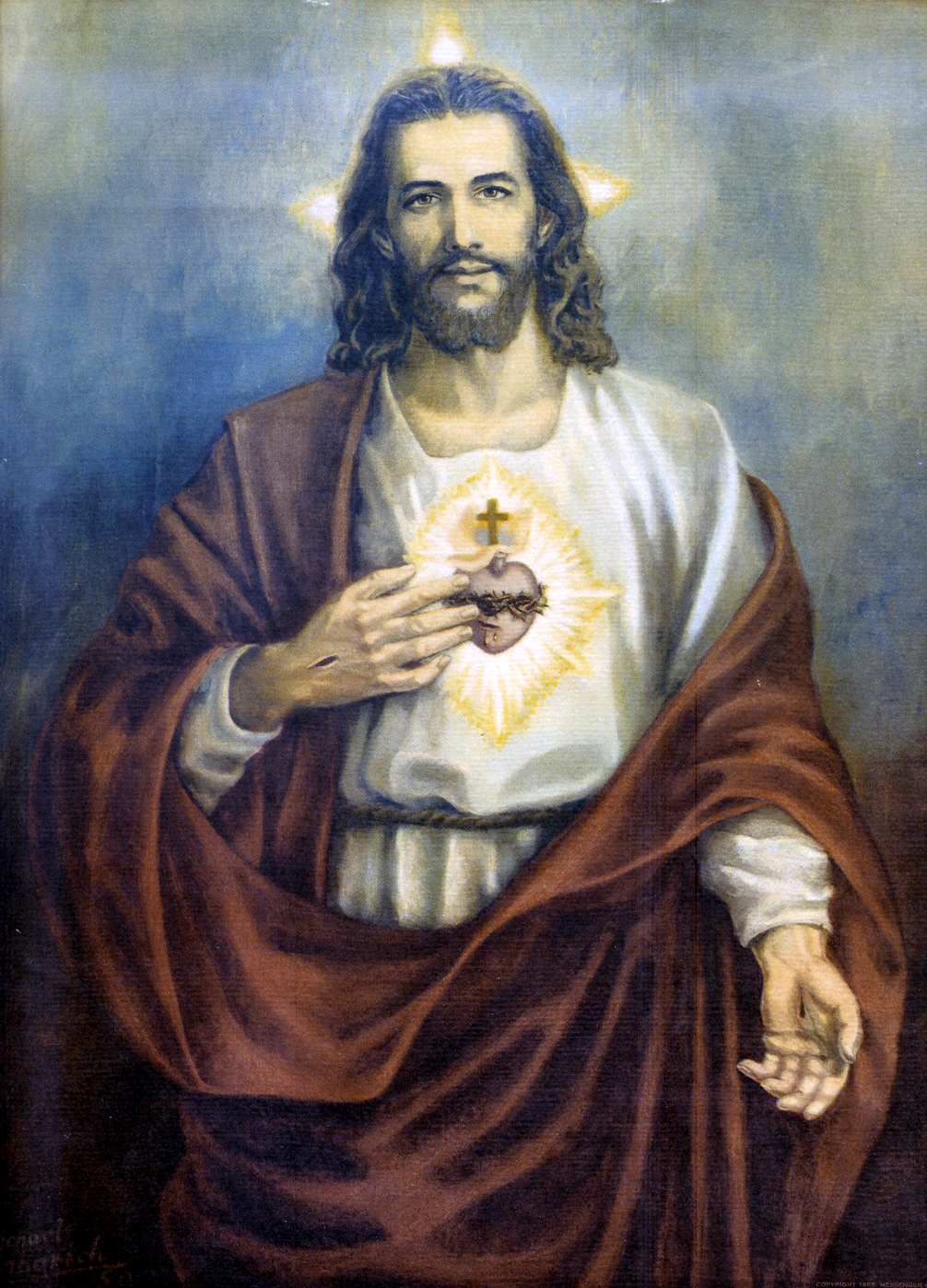
The Sacred Heart of Jesus 1955, Rocathour.

© SundayMassReadings.com

SUNDAY 11 MAY 2025: THE FOURTH SUNDAY OF EASTER: GOOD SHEPHERD SUNDAY.

The Good Shepherd mosaic, 5th century, Mausoleum of Galla Placidia 2015, Ravenna, Italy.

Jesus said: “My sheep hear my voice; I know them, and they follow me. I give them eternal life, and they shall never perish.”         John 10:27-28.

Click here to read today’s Sunday Mass Readings.

Click on words highlighted in red for further information.

The image above, created in the 5th century, making it over 1500 years old, shows a beardless Christ amid a pastoral scene of peace and abundance. Christianity was made legal in 313AD with the promulgation of the Edict of Milan. Between the time of Jesus and 313, the Christians had been hounded, persecuted, torn to pieces by the teeth of lions, and occasionally left in peace, so that, once the Edict was proclaimed, there was little idea of what a Jewish Jesus would have looked like. Hence he is seen here as a beardless young man, the Roman fashion of the time, amid a peaceful, luxuriant landscape completely removed from the Holy Land which is more desert than abundantly green! Also, Jesus as the Good Shepherd was by far the most popular image of the Lord for the next 100 or so years. Almost all the first representations of Jesus that we know of him are as the Good Shepherd. A crucified Lord was not the image those recently legalized Romans wanted to proclaim. A bearded Jesus began to appear later, possibly connected to the appearance of the image on the Shroud of Turin in the Byzantine Empire in the 6th century. But the point of all this is to cast light on the image created by the Lord in today’s gospel: Jesus said: “My sheep hear my voice; I know them, and they follow me.” In other words, Jesus is the Good Shepherd. Now for years I have been writing about how dumb sheep are, unable to learn to avoid mishaps, blindly following the leader, timid and easily frightened, and so on. Well, I was wrong. Although not as bright as dogs or pigs, they are, apparently, the equal of cows and other domesticated animals. So when Jesus called us his flock of sheep, there was no scantily disguised insult there. We are bright, other oriented, mutually helpful, even empathetic and exhibiting all the other qualities that the first hearers of today’s gospel would be familiar with, but we, today, are not. So it comes as a relief to know that we are intelligent creatures, treasured by our Shepherd who protects and loves us are cares about us to the extent of giving his very life for us.

And then there is the Lamb of God. It was John the Baptist who identified Jesus as such (John 1:29). There is a touch of pure innocence and life in a multitude of lambs together. Then there is the theological significance of the lamb slaughtered to ensure the protection from the angel of death, the 10th plague of Egypt, its blood therefore signifying life, not death. The blood on the Hebrew doorposts meant death would not enter their households. And the early Christians quickly came to the understanding of the full meaning of John the Baptist’s recognition of Jesus as the totally innocent lamb who would take away the sins, the corruption and death of the world. Its innocence would conquer everything! “Behold the Lamb of God, behold him who takes away the sins of the world….” That innocent Lamb’s blood washes our sinful souls white. And this from today’s second reading: For the Lamb who is in the center of the throne will shepherd them and lead them to springs of life-giving water, and God will wipe away every tear from their eyes.” Plenty for us to consider this Sunday, much to understand and apply to ourselves, and much to be thankful for.

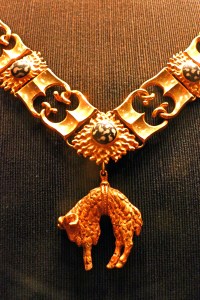
The symbolism of sheep and lambs is very old in Scripture. Apart from dogs, apparently domesticated 20,000 years ago, sheep are thought to have been among the next animals to be domesticated, perhaps about 10,000 years ago, probably in Mesopotamia. They were noted for their lack of aggression, they were of a size which was easily manageable, they had fast sexual maturity, a noticeable preference for good social behavior and a high reproduction rate, all of these being desirable qualities for domestication. Of course, their fleece and as a source of food made these animals highly desirable on many levels. Hence they became a symbol of wealth for their owners. Remember the legend of the Golden Fleece from ancient Greece, a symbol of wealth and strength, and the source of one of the most ancient honors in Europe:

The Order of the Golden Fleece, founded 1430, Schatzkammer, Hofburg Palace, Vienna, Austria.

But those who cared for them, the shepherds, were considered to be among the lowest in society. Remember that the prophet Samuel, sent by God to Bethlehem to seek a king to succeed Saul from Jesse’s sons, did not find him among the seven young men presented to him. Samuel, probably rather sheepishly, as it were, asked Jesse if he had any more sons. Yes, David, the youngest, who therefore had been sent to take care of the sheep, the traditional job of the youngest. And God chose him. So shepherds in the Bible were both lowly and yet kingly! And then there is Jesus, both lamb and shepherd: “For the Lamb who is in the center of the throne will shepherd them and lead them to springs of life-giving water…” from today’s second reading from the Book of Revelation. Here is the summation of the image, sacrificial Lamb and Shepherd protector and guide, both images found in the Lord Jesus. He is the perfect shepherd, willing even to give his life for the redemption of his flock’s souls, such is his love for us. No greater love can be conceived. 

Ghent Altarpiece: The Adoration of the Mystic Lamb, Hubert and Jan van Eyck 1432, St. Bavo’s Cathedral, Ghent, Belgium.


LET US GREET OUR NEW POPE, Pontifex Maximus, Servant of the Servants of God:

Robert Francis Prevost:

POPE LEO XIV

We are in the first days of the new pope, and we eagerly await the signs of what the new pontificate will be like. We probably will not have to wait long! Leo XIII, who seems to be the inspiration of our new pope, was a courageous man. He championed the cause of the worker, demanding just wages for honest work. He approved of trade, labor, unions, something unheard of from a Catholic leader. And he was the first pope to be filmed. And looking at these two men, they could well be identical twins! Let us pray for the new pope and ask God to strengthen and guide him as he takes on this most challenging rôle.

© SundayMassReadings.com

SUNDAY 4 MAY 2025: THE THIRD SUNDAY of EASTER.

Jesus appears to his Disciples at Lake Tiberias, James Tissot c. 1890, Brooklyn Museum, New York City, NY, USA. 

Click here to read today’s Sunday Mass Readings.

When it was already dawn, Jesus was standing on the shore; but the disciples did not realize that it was Jesus. Jesus said to them, “Children, have you caught anything to eat?” They answered him, “No.” So he said to them, “Cast the net over the right side of the boat and you will find something.” So they cast it, and were not able to pull it in because of the number of fish.          John 21:5-6.

Click on words highlighted in red for further information.

Today’s gospel scene is reminiscent of the call of Peter which was the gospel a few weeks ago. At that time, I invited you to put yourself in Peter’s shoes and react appropriately to the holy man, Jesus, who happened to be in that place at that time. Peter had caught nothing, laboring all night long with nothing to show for it. The holy man suggested, no doubt gently, that he should pull out again and cast his net down one more time. Now, if you put yourself in Peter’s shoes, wet, cold, exhausted and craving for rest, what would YOU have said to the holy man who was clearly no fisherman? However there must have been something special about this holy man, because the fisherman did go out again, caught a huge number of fish, and then fell at Jesus’ feet and told him to leave him as he was “a sinful man” (Luke 5-8). Jesus, of course, had no such intention; this was the man to whom he would entrust everything. He was the first leader of Jesus’ church. Now look at this scene in today’s gospel. Once again they have caught nothing, but without question or retort, they cast their net out once more as the Lord instructed them, on the right side of the boat as Jesus specifically told them, and the same miraculous catch resulted. Jesus is to be believed, be followed and obeyed. He was, is and will ever be the road to heaven. 

Now one thing attracted my attention in this scene. Jesus seemed to be very direct when he told the fishermen to cast their net on the right side of their boat. My thought was “what difference does it make? And that’s when at the age of 80 I learned something new. With ancient shipping, as most people are right-handed, steering the boat was, by convention, through a steering oar attached to the right-hand side of the boat, at the rear, or stern. So “steering board” became starboard, the ship’s right-hand side. With the steering mechanism  there, it was clearly easier to dock the vessel on the other side, especially when entering a port, utilizing the left-hand, or port side. When casting their net out to sea therefore, it would be much less likely to be caught up with the steering mechanism if it were cast out on the port side.

The Bark of St. Peter, after a drawing attributed to Giotto, no date, The Royal Academy, London, UK.

So Jesus seemed to have been breaking convention in his instruction to them telling them to cast their net out the starboard side! One might ask why? One commentator suggests that it is very unconventional  to reconcile, to be loving, patient, kind, gentle, understanding and self-controlled. Certainly Hollywood would find that so, being much more used to the opposite! But of course the Lord wouldn’t; it would be normal to him. Another claims “The act of casting the net on the right side of the boat also holds symbolic significance. In biblical and cultural symbolism, the right side is often associated with favor, blessing, and honor”. Yet another says “Jesus is not just giving fishing advice to the disciples in this verse; he is using it as a metaphor for faith and trust in his divine power. Jesus shows them that when they follow his guidance and trust in his words, they will experience abundance beyond their wildest expectations by instructing them to cast their nets on the right side of the boat after they had been fishing all night without success. The disciples witness a miraculous catch of fish by heeding his words, demonstrating Jesus’ authority over nature and emphasizing the importance of faith and obedience in the Christian walk”. With such a difference of interpretation, each one of us has to make up our own minds!

The longer gospel today has an intimate conversation between Jesus and Peter. Jesus asked  Peter three times if he loves him – three times! Anyone familiar with the Passion narrative would instantly connect this triple question with Peter’s three denials in the high priest’s garden that he even knew Jesus! After the Lord asked the question for the third time, Peter responded “Lord, you know everything; you know that I love you” perhaps with a little exasperation! It was as if Jesus was making sure that Peter had, indeed, reformed and was now ready for anything. Indeed he was, to the point of martyrdom years later. Now remember here that we are all free agents. The gift of total freedom that each of us enjoys extends everywhere. Jesus, the God-Man, cannot compel us to love him. We are utterly free to respond to the gift of love, the invitation to the company of Jesus, the strength resulting from that and the quiet, confident happiness which springs from it. We are completely free to reject all of it, to the delight of the Devil! Or we can accept it, and the challenges which flow from it, but which makes us all better people. And there is a glimpse of the final result in today’s second reading from the Book of Revelation, the most challenging and strangest in the Christian canon. All present cry out with an ecstatic cry, “Worthy is the Lamb that was slain to receive power and riches, wisdom and strength, honor and glory and blessing.”  Happiness is always from the other, love isn’t love ’till you give it away, as the song says. The Apocalypse reveals that the other is the Lamb of God, the sinless pure offering made on our behalf and for our salvation, the utter embodiment of life and love for us, always giving and always caring, jumping for the sheer joy of life. 

Revelation Scriptures, The Glorious Majesty of God’s Throne in Revelation 4.

IF YOU KNOW SOMEONE WHO WOULD FIND THIS HELPFUL, PLEASE FORWARD IT TO THEM. THANK YOU.

Reflections on next Sunday’s Mass Readings will be posted on Wednesday.

Please send your reactions to: RogerJohn@aol.com 

© SundayMassReadings.com

SUNDAY 27 APRIL: Second Sunday of Easter; Sunday of Divine Mercy

HIS HOLINESS POPE FRANCIS

Bishop of Rome 2013-2025

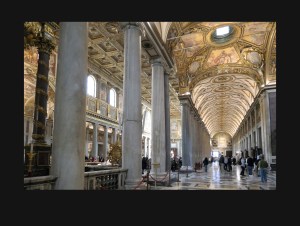
Basilica of Santa Maria Maggiore in Rome.

Our beloved Pope Francis will be laid to rest near the confessionals on the right hand side in the picture above, as per his wishes: The tomb should be in the ground; simple, without particular ornamentation, bearing only the inscription: Franciscus”.

~~~~~~~~~~~~~~~~~~~~~~~~~~~~~~~~~~~~~~~~~~~~~~~~~~~~~~~~~~~~~~~

APRIL 27 2025: THE SECOND SUNDAY OF EASTER: SUNDAY OF DIVINE MERCY

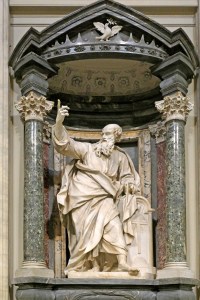
St. Thomas, Pierre Le Gros the Younger 1705-11, Papal, Patriarchal and Roman Archbasilica Cathedral of the Most Holy Saviour and Saints John the Baptist and the Evangelist in Lateran, Mother and Head of All Churches in Rome and in the World, Rome, Italy, commonly known as St. John Lateran.

Click here to read today’s Sunday Mass Readings.

[Jesus] said to Thomas, “Put your finger here and see my hands, and bring your hand and put it into my side, and do not be unbelieving, but believe.” Thomas answered and said to him, “My Lord and my God!” Jesus said to him, “Have you come to believe because you have seen me? Blessed are those who have not seen and have believed.”    John 20:27-28.

Click on words highlighted in red for further information. 

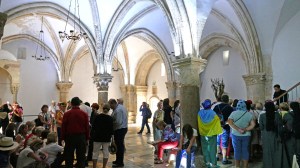
Thomas, after that passage appeared in John’s gospel, today’s gospel, has forever been given the name Doubting Thomas, and his finger has been his sign and symbol ever since (look at the statue above). And we might well be tempted to have done the same thing, hearing the outlandish claim that someone had returned from the grave! Thomas was pretty defiant about it, “Unless I see the mark of the nails in his hands and put my finger into the nail marks and put my hand into his side, I will not believe.” Then, confronted by the irrefutable evidence that he was wrong, Thomas sank to his knees with the words, “My Lord and my God”, the one and only time in all Christian Scripture that Jesus was so addressed. And we are not told if he did place his finger into the wounds. So, in a sense, we are all Thomases until we accept and believe the truth of this gospel and can utter those words “My Lord and my God” from the heart. And there are other revelations in today’s gospel. We are told two times that the doors of the place where the disciples found themselves were locked. So, the entire Christian church was sealed in one room somewhere in Jerusalem, by tradition, the Upper Room, the Cenacle:

The Upper Room, traditionally called The Cenacle, 2018, Jerusalem, Israel. 

Why? One presumes they were terrified that the fate which had fallen on Jesus would fall on them as his followers. And who would not blame them for being scared of that hideous Roman punishment? It was deliberately brutal as a disincentive to challenge any Roman law or question any Roman authority (or, in this case, to appease a hostile crowd). They were all in hiding. So when the Lord appeared in their midst and said “Peace be with you” you can be pretty sure that peace was just about the last attribute they enjoyed. Terror would be more like it. It also seems from this passage in John’s gospel that there was a kind of Pentecost event which took place, the receiving of the Holy Spirit of God. But as they remained behind locked doors, perhaps that was still to happen fully. At the real event, commemorated on Pentecost Sunday, they all rushed out into the street proclaiming the Lord as Messiah and Savior with no fear at all of the consequences! Perhaps this was a prequel gift from God waiting to be unwrapped. Today’s first reading in fact does describe that later post-Pentecost boldness the disciples eventually displayed.

And this Divine Mercy Sunday is one of the rare occasions when the main readings are all from the New Testament; only today’s psalm is from Jewish scripture, and that praises the divine quality of mercy: Let the house of Israel say, “His mercy endures forever”. My preferred definition of mercy is, “Compassion on someone who does not deserve it”. Recall the woman caught in adultery two Sundays ago. She did not ask for forgiveness, but Jesus did forgive her. This gentle act of forgiveness shows mercy, compassion on someone who did not deserve it. And remember the criminal crucified next to Jesus, who said that he deserved his punishment, but Jesus had done no wrong, and asked him to remember him. Jesus, in an act of pure mercy, said that he would be with him in paradise. So mercy reflects the divine; it is of God, and hence we are required to be merciful servants of God. Not easy!

And then there is the second reading today, again traditionally from John’s hand. This talks of his divine inspiration to write the Book of Revelation, certainly one of the strangest of all Christian writings, describing the end time and the extraordinary events to come. And he saw the Risen Lord also, the Alpha and Omega (the first and last letters of the Greek Alphabet, A and Ω, meaning the Lord of Everything). It was he who instructed John to write down what he saw. In Angers, in France, there is a unique collection of tapestries which display what he saw:

Tapestry of the Apocalypse, 1375, Château d’Angers, Angers, France.

So, how do we conclude this extraordinary week, tying in the death of a beloved Pope and this Sunday of Divine Mercy? Pope Francis was, if anything, a Pope of Mercy. He delighted in accepting people of all religions or none, he washed the feet of criminals, he listened to people who were in pain, victims of horrendous sexual abuse by Catholic priests. He insisted that the official church listen to the voices of the non-ordained. He appealed time and again for peace between nations, between opposing viewpoints, between individuals. He became the voice of peace and acceptance in the world. We could hardly do any better than to adopt his attitudes and response to others, to women, to gay people, to non-Christians, to those you disagree with, putting aside hostility in favor of friendship and the love that Jesus had for everyone, including his torturers. We could do no better than that.


PLEASE FORWARD THIS A SOMEONE YOU KNOW  WHO MIGHT FIND IT HELPFUL, REASSURING AND FULL OF HOPE. THANK YOU. 

Reflections on next Sunday’s Mass Readings will be posted on Wednesday.

Please send your reactions to: RogerJohn@aol.com 

© SundayMassReadings.com

APRIL 17, 18 19: THE SACRED TRIDUUM: MAUNDY THURSDAY, GOOD FRIDAY, THE GREAT EASTER VIGIL AND EASTER SUNDAY.

*****************************************************************************************************

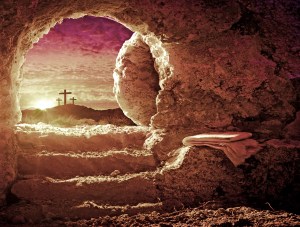
The Empty Tomb, Amazon BtsAn

On the first day of the week, Mary of Magdala came to the tomb early in the morning, while it was still dark, and saw the stone removed from the tomb.      John 20:1.

Click here for the readings of Holy Thursday, for Good Friday, the Easter Vigil and Easter Sunday. Today’s Reflection will be based mostly on the Easter Sunday readings.

Click on words highlighted in red for further information.

This week we remember and celebrate the most important event in the history of the world. This was the event where death itself was conquered, the conquest of the ultimate enemy of us humans, all animal life, all that we know, and, indeed, the entire universe. The Sacred Triduum (three days) records all the events leading up to this momentous event, with the repercussions and the consequences. Today’s gospel comes from John’s gospel, but remember that Mark’s gospel, in the opinion of most scholars, ends with the empty tomb and nothing more! Mark asks us to draw our own conclusions from that situation and ponder the words of the angel encountered by Mary Magdalene and other women with her:

“Do not be alarmed. You seek Jesus of Nazareth, who was crucified. He has risen; he is not here. See the place where they laid him. But go, tell his disciples and Peter that he is going before you to Galilee. There you will see him, just as he told you.” And they went out and fled from the tomb, for trembling and astonishment had seized them, and they said nothing” (Mark 16:6-8).

The Resurrection, Sebastiano Ricci 1715, Dulwich Picture Gallery, London, UK.

Those simple words: “He is risen” says it all. So how did those three days come to that point? Jesus knew he was playing into the hands of those who hated him. The most recent event, which certainly sealed his fate, was the raising of Lazarus from death (John 11:38-44). That took place in Bethany, very close to Jerusalem. It was certain that word of that event reached Jerusalem at lightning speed, and was almost certainly the cause of the rapturous welcome Jesus received when entering the city shortly after (commemorated last Sunday). Only the Messiah of God could ever have done such a thing! So Jesus knew that once it became known that he was not the kind of Messiah everyone expected, there would be a huge negative reaction. Look at this clip from the Zeffirelli film of Jesus of Nazareth, made in 1977, with an imaginary meeting of Jesus with Barabbas in the Temple area at that time. Once word got around that Jesus was not the type of Messiah the people had longed for over the centuries, his fate was sealed.

That certitude set the tone of the Last Supper, remembered on Maundy Thursday. On that occasion, Jesus recalled the events of the Passover, which the Last Supper commemorated, where God not only made possible the enslaved Hebrews to escape Egypt forever, but also gave the 10 Commandments to Moses, and, more importantly, created a covenant with the people that made them the Chosen People of God. It is all described in Exodus 24: Following God’s orders, a stone altar was built, representing God, surrounded by 12 stones representing the 12 tribes of Israel. Animals were sacrificed as fellowship offerings. Half the blood of the animals was sprinkled over the altar, and the other half over the people. Remember that the blood of sacrificed animals represented life, not death. This was the symbolic representation of the life of the people linked with the life of God. It was this event Jesus paralleled in the Last Supper, but took it to an unimaginably higher level. He stated that the wine of the Supper was his blood, the new covenant, which his disciples were told to take and drink. Jesus linked his life with those of his friends in the most intimate possible way: they took his life blood into themselves. This is why, in Luke’s account of the Last Supper, “Jesus gave them the cup after the supper, saying, “This cup is God’s new covenant sealed with my blood, which is poured out for you”. Not only that. The Passover meal, which celebrated the release of the Jews from slavery in Egypt for the promise of a land flowing with milk and honey, meant they had to prepare for a hasty exit, so unleavened bread, quickly made without yeast (which takes time to rise), was the hallmark. That would be their sustenance for the journey. Jesus took that unleavened bread at the Last Supper and declared it to be his body, which would sustain us for our life journey (the reason why communion bread is unleavened). Then his order, or mandatum in Latin, hence “Maundy”, was to “Do this in memory of me”, which is considered to be the establishment of the ordained ministry, to celebrate this event in his memory forever. Hence he would be with us forever, until the end of time.

The Last Supper, The Predella 1435-1440, St. Elizabeth’s Chapel, Basilica Co-Cathedral of St Mary, Gdansk, Poland.

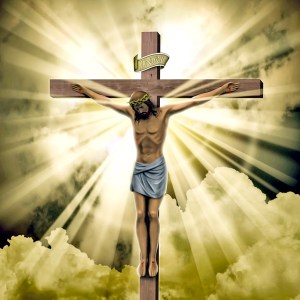
Good Friday recalls the dread events of Jesus’ death, sealed by his answer to the high priest’s question, “Are you the Messiah, the Son of God?”. Mark reports Jesus’ answer “I Am” to that question, very close to the most sacred name of God, Yahweh, I AM WHO AM. He was condemned for blasphemy. The high priest was not empowered to condemn him to death, but the Roman governor was. With the embittered people crying for his death as they thought themselves betrayed by this so-called Messiah, Pilate gave in and Jesus was killed in the most deliberately brutal way. He took the pain and suffering for all our sins on his shoulders willingly, paying for what we have done and asking nothing in return, save belief in him. 

The Cross of Jesus, Pixars.us.

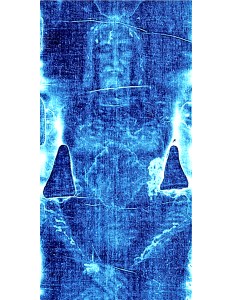
Jesus’ dead body was taken down from the cross and laid in a stranger’s tomb and left, awaiting anointing once the Passover Day was ended. No person witnessed the resurrection, but there might be the most extraordinary possible witness to that event. The artifact, the most studied in the world, the Shroud of Turin, is, perhaps, the most fascinating witness to this unique, world-changing event. It displays all the marks of a crucified man. It dates from the time of Christ, has the nail wounds which differ from almost all the pictures of Christ crucified, but which experts say would have to be those on a crucified body. There are many other elements of this piece of linen which point to that all-important event. The scare some years ago that it was a fake have been swamped by evidence that it was deeply flawed in the way it was obtained. Ultimately there is no way to prove it is the burial cloth of Jesus, but just look at what has been discovered from this one piece of material. And gaze at the serene face imprinted on it…

And then the event itself, Jesus’ conquest of death. The Shroud may be the moment that happened, a photograph, if you like, of that most significant moment, but ultimately it is a question of faith: Do YOU believe that Jesus conquered death itself? Our Greek Christian brothers and sisters greet each other today with the statement “Χριστός Ανέστη” (Christos Anestē – “Christ is Risen”) and the response is Aληθώς Aνέστη” (Alithōs Anestē – “Truly He is Risen”) which is much more appropriate to the day than “Happy Easter”, where Easter is, in fact, a pagan word coming from the Old English word Auston or dawn, towards the sunrise, the east. Most European words for Easter parallel the Jewish word for the feast of Passover when all this happened (Spanish Pasqua, Italian Pasqua, Swedish Påsk, Greek Πάσχα (Páscha), and so on). However we English speakers can console ourselves with the thought that the dawn of a new, eternal life of happiness with God dawned with Jesus conquering death on this day.

Χριστός Ανέστη!

Adoration of the Holy Trinity, Albrecht Dürer 1508, destroyed in the Second World War, Vienna, Austria.

The crucified figure on the Shroud of Turin.

PLEASE FORWARD THIS AN AN ACQUAINTANCE WHO MIGHT FIND IT HELPFUL, REASSURING AND FULL OF HOPE. THANK YOU AND HAPPY EASTER!

Reflections on next Sunday’s Mass Readings will be posted on Wednesday.

Please send your reactions to: RogerJohn@aol.com 

© SundayMassReadings.com