SUNDAY 19 OCTOBER 2025: THE TWENTY-ninth SUNDAY IN ORDINARY TIME.

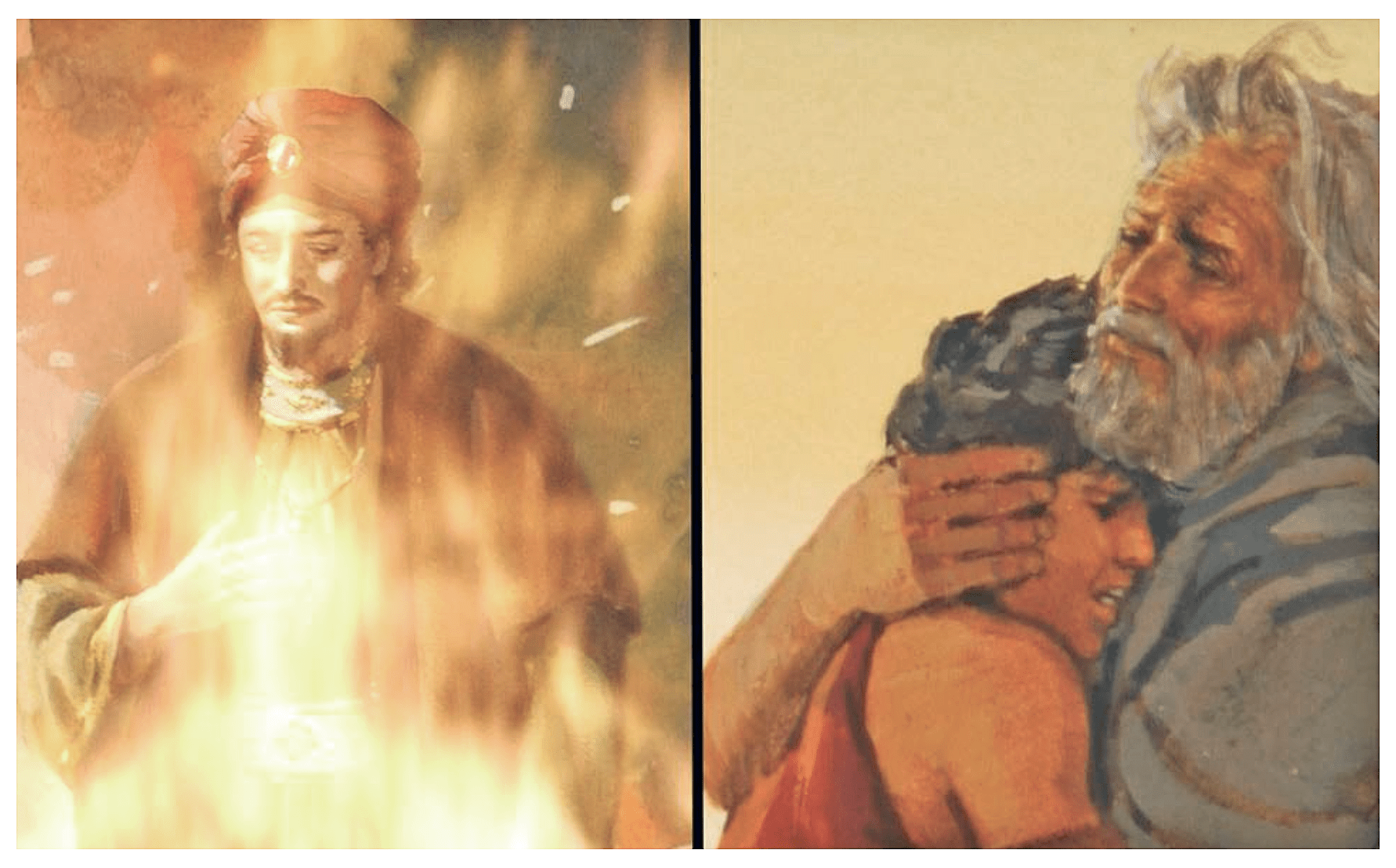
The Unjust Judge, John Everett Millais 1863, Harvard Art Museums, Cambridge, MA, USA.

(The judge said) ‘While it is true that I neither fear God nor respect any human being, because this widow keeps bothering me I shall deliver a just decision for her lest she finally come and strike me.'”        Luke 18:4-5.

Click here to read today’s Sunday Mass Readings.

Click on words highlighted in red for further information.

The first thing that struck me (if I can say that) is the judge’s fear “lest she finally come and and strike me”. First, this is a widow he’s scared of, not usually associated with threatening behavior sufficient to strike fear in a judge! Then I looked up the original Greek passage in Luke’s gospel. The key word is ὑπωπιάζῃ, hupōpiazē, meaning to wear out, weaken; to beat up, treat roughly. One commentator even suggests “getting a black eye”! I suppose even a widow might be driven to such a desperate course of action in the face of intransigent, utterly ignored behavior from the bench. Jesus does not reveal what the cause of this despairing  behavior was, but it was clearly impinging on this woman’s world to an extreme level, demanding action. It was obvious the judge could not give a damn, until he saw that his behavior was beginning to drive this woman to possibly dangerous extremes: he had to act! Of course, Jesus was comparing this judge’s behavior to what one can expect from God, the eternally just, listening judge who hears our every word. We cannot consider giving God a black eye, but it should not be necessary; the Lord hears our every cry. Isn’t that sufficient?

Jesus was clearly making the point that God, the all-just and all-hearing, will be immediately aware of our needs and our concerns even before we utter them. Unlike the uncaring and unresponsive judge of the parable, God knows our cares almost before we do! The thing is, of course, how does our just God respond to our needs, because it is so often not the way we would wish and hope for. Now in a court of law, the setting for today’s gospel, remedies are rather restricted. Fines, imprisonment, confiscation of money or goods, court orders, even the death penalty in some parts of the world (which is categorically condemned by the Church),  that’s about it. But God has an infinite way of responding to our requests for help, ranging from guiding each of us to handle our needs ourselves, to the church-recognized miraculous (which is extremely rare – but does happen). And there is always that helpful maxim, “A problem shared is a problem halved”. And there are numerous church charities designed to help those in desperate need, even though many would be very reluctant to approach them, being too proud or timid. But they are all there to help! Even a simple “To Do” list can be very effective in dealing with crises. But quietly sitting down with the Lord might be the best, and letting it all hang out and, in silence, considering all the  possibilities worthy of a Christian, remembering the words Thy will be done on earth as it is in heaven…” 

Another lesson lies, it would seem, in the first reading. Here the Promised Land was facing dire threat of invasion. Moses directed Joshua to go out with his army to confront the enemy. He, Moses, would be standing at the top of a nearby hill with his arms raised up. When in that posture, Joshua would have the best of the battle. If, however, Moses began to waver and droop his arms, the enemy would be gaining. It was at that point that Moses’ companions Aaron, his brother, and Hur, supported Moses’ arms which then remained upright and steady, and the enemy was defeated. Today’s psalm says it all: “Our help is from the Lord, who made heaven and earth”. There is no shame in accepting help. If even Moses needed assistance, who are we to deny it we need it from time to time? And the final word might well lie with today’s second reading:  “…be persistent whether it is convenient or inconvenient; convince, reprimand, encourage through all patience and teaching.” At that point we could well be talking to ourselves! Except, even then, God hears us and helps us, no matter what the problem may be. We are never alone.

IF THIS REFLECTION HAS HELPED YOU, PLEASE SHARE IT WITH ANOTHER WHO WILL APPRECIATE IT.

THANK YOU.

©SundayMassReadings.com
SUNDAY 12 OCTOBER 2025: THE TWENTY-EIGHTH SUNDAY IN ORDINARY TIME.

Elizabeth Eckford Enters Little Rock Central High School, September 1957. Hazel Bryan Shouts Behind Her, Each Aged 15 Years. 

(St. Paul wrote) ….such is my gospel, for which I am suffering,
even to the point of chains, like a criminal.    2 Timothy 2:9

Click here to read today’s Sunday Mass Readings.

Click on words highlighted in red for further information.

First, a few words of necessary explanation, The first reading states that Naaman, who had just been cured of leprosy through the intercession of the prophet Elisha, requested “two mule-loads of earth” in order to offer holocaust or sacrifice to the God of Elisha (and our God) once he got home. He was a foreigner: he was Syrian, not Jewish. To understand that strange request we have to return to that time and place. You will note that each country had its own gods and goddesses back then. Egypt had familiar gods, such as Isis and Horus, Mesopotamia had Ashur and Marduc and so on. And just look at what the Greek gods and goddesses got up to! They were all gods of place, not universal deities. This was found almost everywhere. Consequently the Syrian Naaman, wanted the local earth of Elisha’s God so he could bring that place, as it were, home with him and consequently the God of Elisha. The fact that the Jewish God was universal took some time to be accepted even by Jews. The exile in Babylon assisted in the development of that radical concept. 

Secondly, the single cured leper to return to Jesus to thank God through him was called a “foreigner” by Jesus because he was a Samaritan. Although Jewish, the Samaritans were a somewhat despised branch of Judaism as they had apparently allowed elements of other religions to creep into their beliefs, they also allowed intermarriage with non-Jews, and other practices considered blasphemous by strict Jews. But no such condemnation from the Lord, simply the word “foreigner” and gratitude that he had returned to give thanks (though the Greek original says “glory”) to God. 

So perhaps today’s readings invite us to consider our own attitude towards “foreigners”. It is, one might say, a touchy subject. I myself was once a focus of hatred for no other reason than I was born in Britain. I was an assistant principal in a Catholic school in the 80s here in the USA. I had two small flags in my office, the US and the UK. One morning I noticed the UK flag had vanished. I asked the dean of discipline to find out who had done it. He was very good at his job, and within hours had discovered the culprit. I asked him to bring him in to my office. “He won’t come” was the answer. So I sent for his parents. They refused to see me. “Why?” I asked. “Because you’re British” was the answer. They were supporters of the IRA, the Irish Republican Army. It was the time of the “Troubles” in Northern Ireland. And, being British, I was responsible… But my father was Irish. “Your British”. I am a Catholic priest. “You’re British”. I could get nowhere with them. Being unable to return to the womb and be reborn in Ireland (or anywhere other than Britain) I could do nothing. It was the only time in my life I was confronted with pure prejudice, and it was scary and very unfair – just look at that photograph above. But it was also, weirdly, positive. It allowed me to feel what many people must feel every day of their lives for no good reason, and about which I could do nothing. I recall after 9/11 many Sikhs (those men who wear large turbans) were attacked by ignorant ruffians who thought they were Muslim. They were utterly innocent of any wrongdoing – as indeed were so many Muslims who were also attacked, but were completely innocent. All that is so unfair. And so unchristian, as we see from today’s gospel with its example of acceptance, despite the man being “foreign”. Prejudice, stereotyping and its ilk are immoral and utterly at odds with all that is Christian. They are, simply, evil. There should be no room in any heart for anything even approaching prejudice at all. If we are to judge anybody, it must be on their own actions within their community and elsewhere. 

So today, looking at today’s readings, and noting that Paul was “in chains” for his Christian belief, which calls on everyone to honor and respect everyone, the message is clear. If we are called to judge anyone, let it be based on their words, their behavior, their works, in the community and their reputation. And, as with justice itself, let them be presumed innocent unless proven guilty on their actions alone.

Time for Courage, Dietrich Bonhöffer

IF YOU AGREE WITH THIS REFLECTION, PLEASE SHARE IT WITH ANOTHER.

THANK YOU.

©SundayMassReadings.com

SUNDAY 5 OCTOBER 2025: THE TWENTY-SEVENTH SUNDAY IN ORDINARY TIME.

A Mulberry Tree in the Cloister Garden of Hereford Cathedral, UK, and a Mustard Seed, Praise.Com

[Jesus said] “If you have faith the size of a mustard seed, you would say to this mulberry tree, ‘Be uprooted and planted in the sea,’ and it would obey you.”      Luke 17:6.

Click here to read today’s Sunday Mass Readings.

Click on words highlighted in red for further information.

With a typical city-dweller’s ignorance, I had no idea what a mulberry tree looks like, or even how big it is! But I sort of knew that a mustard seed must be fairly small – and there they both are, above. It is quite a sizable tree, that’s for sure. Apparently the mulberry berry is delicious when ripe (and the tarpaulin under the tree is to prevent the fruit from staining the footpath). As ever, Jesus knew exactly what he was talking about, but I wonder if this is another example of hyperbole, which we saw on the 23rd Sunday in Ordinary Time a few weeks ago. But I am fairly sure that not one of us has faith strong enough to move that tree into the Atlantic Ocean (or the Irish Sea, which is nearer Hereford!). Are we being criticized for lack of faith here by the Lord himself? And why? Should we be insulted or…..? But frankly, what would be the point of one’s faith being capable of that? We have faith enough to be reading this webpage don’t we? And we have goodwill enough to trust that the Lord will guide us in what we do and say in normal times and places. And each week we receive the strength from our encounter with the Lord at Mass to be his obedient servant through the week. And that is the point of being God’s good servant, not even requiring a ‘thank you’ for what we are expected to be doing. It is, in a sense, simply our job to be servants of the Lord. Payment is in the satisfaction of what we do, knowing it to be right and good. It is certainly nice to be recognized for doing the right thing, but it should not be necessary. There should be an inner peace knowing we are doing the Lord’s will.

Habakkuk is reported as saying something we almost certainly have said in our own day: Why do you let me see ruin; why must I look at misery? Destruction and violence are before me; there is strife, and clamorous discord. That could easily be taken from tonight’s TV newscast from somewhere in the world or, indeed, our own backyard. God seems to assure him that this too will pass and peace will descend: “…if it delays, wait for it, it will surely come, it will not be late”. God is talking of justice. In support of that promised peace, Paul says to Timothy, “For God did not give us a spirit of cowardice but rather of power and love and self-control”. And this all because “We are unprofitable servants; we have done what we were obliged to do” from today’s gospel. And remember the Lord himself is the perfect example of this total obedience to God’s will, to its sometimes bitter end.

So today’s readings really give us an unbiased picture of the true servant of the Lord. Yes, things are terrible in the world. Yes we should be upstanding in the face of everything bad. Yes we know how to behave in the face of all that because we are God’s servants. But we also know how it is all going to end if we keep the faith, even strong enough to move mulberry trees into the sea, because our faith is strong enough even to move mountains! As St. Paul says to us today: “For God did not give us a spirit of cowardice but rather of power and love and self-control”. Those are very strong characteristics, and used correctly they will nourish our faith in God and provide the required direction, always seeking the ultimate source of that power, the universal love of God for each one of us, as strong and as enduring as that mulberry tree above, fruitful, strong and life-giving.

Ron Kelleher, What Unique Trait Should Christians Share with Redwood Trees? June 2016.

SHOULD YOU KNOW SOMEONE WHO WOULD APPRECIATE THESE THOUGHTS, PLEASE LET THEM KNOW BY SENDING THEM 

THANK YOU.

©SundayMassReadings.com

SUNDAY 28 SEPTEMBER 2025: THE TWENTY-SIXTH SUNDAY IN ORDINARY TIME.

The Rich Man and Lazarus, Codex Aureus of Echternach, Germanisches Nationalmuseum, Nuremburg, Germany.

[Jesus said to the Pharisees] “There was a rich man who dressed in purple garments and fine linen and dined sumptuously each day. And lying at his door was a poor man named Lazarus, covered with sores, who would gladly have eaten his fill of the scraps that fell from the rich man’s table….”           Luke 16:19-21a

Click here to read today’s Sunday Mass Readings.

Click on words highlighted in red for further information.

Over the centuries the rich man in this very famous parable has been given a name: Dives (Dy-vees), and so it has been referred to as the parable of Dives and Lazarus. That way there is no confusing this Lazarus with the Jesus’ friend Lazarus, whom he raised from the dead. Also, the point Jesus makes here is crystal clear (unlike last Sunday’s). It is very hard to imagine such a man as this rich one passing Lazarus each time he left and entered his house without doing anything for him. Inconceivable in fact. But one supposes there are, indeed, people like that even in today’s world. Certainly there are examples of that in the nations of the world. And to judge from the first reading today, from the prophet Amos, who lived about 760BC in a small village just south of Jerusalem, such a situation was all too common even then. Jesus himself said we will have the poor always with us (Matthew 26:11). And we do, 2000 years later! 

Beggar in Sokoto, Nigeria.

Today’s second reading talks in the same way: “to keep the commandment without stain or reproach”. And Jesus’ supreme command was to love one another and all that that implies, even having to sacrifice for another’s good. In the parable, poor Lazarus died and is taken off by angels to “the bosom of Abraham”. This expression is tantamount to eternal happiness. It finds its highest expression only in this parable and implies a deep, blessed, and privileged connection with Abraham, the father of all Hebrew people, representing a place of comfort and honor for the righteous dead. It stands in stark contrast to the suffering of the rich man now in hell, begging for relief which is not forthcoming. He eventually suggests a way for his brothers to avoid his punishment, even suggesting that Lazarus return from the dead to warn the selfish what awaits them. Then comes the deadly line: “Then Abraham said, ‘If they will not listen to Moses and the prophets, neither will they be persuaded if someone should rise from the dead.”

The command is utterly clear and without obscurity: We are here to help and support each other, now and at all times. It is God’s command, it is God’s wish, and we are to accept it, and allow it to become an integral part of our very existence. There must never be a moment when we think otherwise. Likewise we should hope and pray for an equal response from others, should we be in distress, should it ever come to be. And at that point, we can refer once more to last week’s teaching……

Here is a beautiful hymn which I believe reflects the love this parable calls us to:

“I Heard the Voice of Jesus say…..” Celtic Source Volume 2; Words: Horatius Bonar; Traditional English folk tune, arr. Ralph Vaughan Williams: “Kingsfold”. 


White Throne Ministries, The Truth About Death. 

Please forward this reflection to someone of your acquaintance who would welcome it.  

THANK YOU.

©SundayMassReadings.com

SUNDAY 21 SEPTEMBER 2025: THE TWENTY-FIFTH SUNDAY IN ORDINARY TIME.

Effects of Being a Spendthrift, Fancy Alpha Faith Blog.

[Jesus said] “No servant can serve two masters. He will either hate one and love the other, or be devoted to one and despise the other. You cannot serve both God and mammon.”  Luke 16:1-13.

Click here to read today’s Sunday Mass Readings.

Click on words highlighted in red for further information. 

Today’s gospel is a conundrum. Jesus is apparently recommending fraud and theft! (Read it and see if you agree). It seems he was talking to his disciples, and possibly the pharisees. The parable he presented describes a steward in the pay of a rich man who is not satisfied with the steward’s performance, and has has given him the sack, effective in a few days. In that time the steward had to figure out what he is going to do. He knows that he is not strong enough for manual labor and he is too ashamed to beg. So he decides on a distinctly questionable course. He calls in those indebted to his master to see him, and reduces the debt  of each one by a significant amount. That way, he figures, they will remember him in his poverty and assist him as needs be. Of course, his employer has no clue that this is going on, but, Jesus says, when he does find out he commends the man for his audacity and quick thinking! So what is going on here? Well Jesus offers us little by way of explanation, so here is my take on the situation 

When we enter this world all we know is peace or hunger and discomfort, all pretty selfish, but that is all we are aware of. Then we begin to see that the world is not entirely us; there are others. Those others seem to care a great deal about us (which is just as well), and so the interaction between the world and each of us has begun. Slowly and sometimes painfully the world begins to make demands on us: potty training, asking for peace and quiet, encouraging us to take first steps, and so on. We find we are part of a tapestry; there are other patterns around us, and sometimes we can contribute and, more times, we can learn from them. And so the world opens to us, and we are invited to join in. It is in this way that we discover what things we are good at, and what is challenging. We discover our gifts, the talents God has entrusted to us. Then, through education, we begin to develop them and so help those others who have helped us in many and varied ways. And at that moment we have, as it were, become the steward in today’s parable.

He was given the sack; similarly we face a termination also, at some time, perhaps distant, perhaps not, namely that moment when we get called from this world, and we must all try to handle that in the best way. Most of us would prefer not to think about it at all! But there it is nonetheless. How do we face it? I think this is where the parable comes in. Those gifts we have discovered within us were placed there by a loving God. We are indebted! (The debts of the steward’s master in today’s parable). They were not placed there to be buried (witness the parable of the talents). They are there to be used, and used in such a way that they benefit others (note today’s parable). Even though our talents belong to God, God is more than delighted that they are being used to help others! We have been entrusted by God with them, and it is up to us to use them as we see fit – but it is crystal clear from Jesus’ teachings how we should use them – clearly for the benefit of others! 

So I think today’s parable in a strange, even unique, way is telling us how God wants us to run our lives, being fully aware that our talents really belong to God, and are entrusted to us as a means of fulfilling our destiny in a positive, rewarding and satisfying way – to help others, or, in terms of today’s parable, to reduce the loads or burdens of those around us in any way we can! And in this way we should hope for and expect those all-welcoming words when at last we stand before God: “Well done, good and faithful servant!”  

Well Done, Telling My Story.

DO YOU THINK SOMEONE YOU KNOW WOULD APPRECIATE THESE THOUGHTS? PLEASE SEND THEM TO THAT PERSON! 

THANK YOU.

©SundayMassReadings.com

SUNDAY SEPTEMBER 14: FEAST OF THE EXALTATION OF THE HOLY CROSS.

Visual Impact Resources Ltd., 2008 (defunct).

Click here to read today’s Sunday Mass Readings.

[Jesus said to Nicodemus] …..and just as Moses lifted up the serpent in the desert, so must the Son of Man be lifted up, so that everyone who believes in him may have eternal life.      John 3:14-15.

Click on words highlighted in red for further information.

First, I was intrigued that this feast day had outranked the 24th Sunday in Ordinary Time. On checking, this explanation appeared:

The liturgical calendar’s hierarchy:
  • Sundays during Advent, Lent, and Easter rank the highest and are never replaced by another feast day.
  • Solemnities (the most important celebrations) and Feasts of the Lord (such as the Exaltation of the Holy Cross) are the next highest rank.
  • Sundays during Ordinary Time are of a lower rank than Solemnities and Feasts of the Lord.
  • Feasts of the Virgin Mary and saints are of a lower rank than Sundays in Ordinary Time.
  • Memorials (obligatory and optional) are the lowest-ranking celebrations. 

So now we know. Today’s feast combines an event in the Old Testament which happened as the Hebrews were making their way to the Promised Land having escaped slavery in Egypt. However, all was not well with them. They were even comparing the more comfortable life as slaves in Egypt with the  discomfort of wandering through the desert worried where the next meal was coming from. It was a mind set that distrusted God, and that upset the Almighty  who was keeping them alive, albeit uncomfortably in their opinion. That was the background for the strange happening recorded in the Book of Numbers, today’s first reading. I’m afraid God just lost it, and punished them in their disloyalty and distrust. “Seraph serpents” appeared among them. “Seraph” means burning, and, in this case, poisonous. Many died. The mood changed to one of panic, and, as ever, they went to Moses for him to beg forgiveness of God and to ask the Almighty to save them. This Moses did; God took pity on them. God instructed them to create an image of a seraph serpent and mount it on a pole. Those who had been bitten by the snake gazed upon the serpent and lived. (Now note that “seraph” can also mean a certain type of fiery angel, clearly not part of today’s reading!):

The Six-Wingèd Seraph, Br. Robert Lentz, OFM, 2023, Trinity Stores.

Jesus then compared this desert happening centuries before with something yet to come, namely the brutal moment when the cross, to which he would be nailed, was hauled up for all to see. Jesus was making a comparison between the therapeutic effects of the bronze serpent raised up for all to see – and be cured of the poison within them – and the effects of his supreme sacrifice which he would make, which would save all of those who respond from the wages of sin and the fires of hell to the joys of heaven. And there is the parallel with the desert drama and the crucifixion:  The feast of the Exaltation of the Holy Cross is a celebration of Jesus Christ’s sacrificial love and God’s triumph over tragedy, transforming the instrument of death into a symbol of salvation and eternal life. Crucifixion was a deliberately brutal form of punishment. It was usually reserved to punish rebellious slaves who had risen against their masters: “This is what will happen to YOU if…..” This was most dramatically demonstrated with the rebellion of the slave Spartacus in 70-71 BC, when thousands of slaves revolted, even initially defeating Roman troops. But the revolt was ultimately crushed and up to 6000 slaves were crucified along the Appian Way, the ancient Roman road leading south out of Rome. That was the fate thrown at Jesus. Had he been a citizen of Rome (as St. Paul was), he would have been beheaded instead. But no: he was treated as a slave, cruelly executed for not denying who he was (the Son of God revealed at his baptism) and what he was (The Messiah, the Anointed of God when the Holy Spirit descended on him also at his baptism). So the crucifixion has become the supreme symbol of the extent that God loves us, and the promise of the resurrection, the eternal life of happiness in the presence of God.

Now this image came late in Christian iconography. For literally centuries Christians did not depict the savior on the cross. By far the most popular and earliest image of Jesus was as the Good Shepherd, which came from the lips of the Savior himself (John 10:11-18). One supposes  that the image of Christ on the cross was too shameful for those earlier Christians to stomach. It was, after all, the ignominious death reserved mostly for slaves who had rebelled against authority. One of the earliest images of the crucified savior is this, dated about 420CE, over four centuries later, and in the British Museum:

The Crucifixion, carved ivory Rome, Italy c.420AD, The British Museum, London, UK.

So it took that long for Christians to begin to use what was to become the primary image of the Lord, and only after that to become the source of events such as today’s special commemoration. 

But simply looking at the Crucified One would not bring eternal salvation (as simply looking at the seraph snake cured those infected by its bite); something more is required. Today’s gospel says “….everyone who believes in him might not perish but might have eternal life”. Belief requires action, and action along the lines taught by Jesus. And remember the command (no other word for it) to “love one another”. Hence love must be the source of all peace and happiness. It was for love of us that the Lord submitted to the agony of the cross. Remember he could have escaped all that by simply denying who and what he was (the reason he was condemned to death). But that would have negated his entire life’s mission. That he could not do. He had to show his complete belief in his message; he died to support it. If it was that strong an essential belief, then we his followers must do the same in our way, in our time and in our life situation. Which leads us to today’s second reading, the most beautiful passage in all of Paul’s writings and possibly all of Scripture:

Christ Jesus, though he was in the form of God,
did not regard equality with God something to be grasped.
Rather, he emptied himself,
taking the form of a slave,
coming in human likeness;
and found human in appearance,
he humbled himself,
becoming obedient to death,
even death on a cross.

and therefore:

…at the name of Jesus
every knee should bend,
of those in heaven and on earth and under the earth,
and every tongue confess that
Jesus Christ is Lord,
to the glory of God the Father.

as it was his Father who commanded that he declare his message of universal love and forgiveness no matter what. And that he did. No matter what.

The Adoration of the Name of Jesus, El Greco 1579, Chapter House, Monasterio de San Lorenzo, El Escorial, Spain. [Note that IHS are the first three letters of Jesus’ name in Greek: ΙΗΣΟΥΣ, IĒSOUS]

KNOW SOMEONE WHO WOULD APPRECIATE THESE THOUGHTS? THEN PLEASE FORWARD THIS WEBSITE TO THEM FOR THEIR CONSIDERATION. 

THANK YOU.

©SundayMassReadings.com

SUNDAY 7 SEPTEMBER 2025: THE TWENTY-THIRD SUNDAY IN ORDINARY TIME.

Your Child Says “I Hate You”, Parents July 30, 2024. 

[Jesus said], “If anyone comes to me without hating his father and mother, wife and children, brothers and sisters, and even his own life, he cannot be my disciple”.      Luke 14:26.

Click here to read today’s Sunday Mass Readings.

Click on words highlighted in red for further information.

I would not mind making a tiny bet on which word you found to be the most challenging in today’s readings; there it is up there in quotes. Specifically, the world “hate”. I looked up the Greek in the original passage in Luke, 14:26, most carefully. It is definitely the word μισώ, misō, “hate” (and it’s the same word in modern Greek). And we have words in English which link to it: Misanthrope, hatred of mankind; misogyny, hatred of women. It means hate alright, even 2000 years ago when the Lord uttered it. And traditionally the opposite of hate is… love (or, possibly, indifference). So we have a real challenge here. Is Jesus really telling us to hate everyone we love? Well, clearly not. I think the Lord is, in a sense, pulling our communal leg. Do you recall these moments from the gospel:

First take the plank out of your own eye, and then you will see clearly to remove the speck from your brother’s eye; Matthew 7:3-5.

It is easier for a camel to go through the eye of a needle than for a rich person to enter the kingdom of God;  Matthew 19:24.

If your hand causes you to stumble, cut it off;     Mark 9:43

And we do it all the time in common everyday language:

If I’ve told you once, I’ve told you a million times: Don’t do that!  (A million times???).

I’m so hungry I could eat a horse….

This shirt cost me an arm and a leg….

All that is done simply to hammer home a point, called hyperbole, in other words, exaggerated statements or claims not meant to be taken literally. We get the word hype from the same root. And Jesus must have been doing exactly that in today’s gospel – and the other gospel passages mentioned above. It is critical, he is saying, that you hear what I say, implement what I say and remain always true to what I say. Why? Because there is eternal life in my words (and this time it is not hyperbole). But his language is extremely strong; indeed it is difficult to state it in any stronger way! There must be nothing standing in the way between each of us and him, the one who invites us to eternal life and happiness. 

The rest of today’s gospel is also a little difficult to understand. First there is a man who sets out to build a tower, and figures out ahead of time to see if he has sufficient resources to complete it. If he does not, but still goes ahead but is unable to complete it, he will be subject to ridicule and mockery. Or if a king, going out to battle an enemy, will be foolish not to carefully calculate if he has any realistic chance of defeating his enemy. If not, deal with the problem more realistically. We, for our part, are looking at life and wondering if we will end up happily – or not. And Jesus answers that question for us: if we accept and live by what he offers, we will be happy. If not, then we will allow our worries and cares, our worldly problems, to overwhelm us, dominate us and drag us down. Paul, in the second reading, was indeed dealing with the end of his life and the worries and challenges that situation presented. He dealt with them in the most charitable way possible, helping others by sending Onesimus to them, someone he treasures as his own son, yet deciding others have greater needs than he. It is just such worries, challenges and obstacles that the Book of Wisdom deals with in the first reading. We earthly creatures, weighed down by our earthly concerns, should always turn to the Lord God, whose Holy Spirit is sent to us, and then because of that, our pathway is straightened, our goal clear and God’s wisdom is available for the asking, along with the power to make it happen. And so all three readings coalesce and our choices and direction become clear and possible. That anything is possible with God! But Jesus, as always, does not hide that good news in cotton wool: “Whoever does not carry his own cross and come after me cannot be my disciple”. So it is not a fairy tale he is giving us, quite the contrary. There will be challenges galore he seems to be saying, temptations to betray his teachings. Even your own family, he seems to suggest, might try to divert you from the true way. And remembering the early church and its persecution by the state and the terrible punishments which threatened the lives of those early Christians, he was not hiding the cost of being his follower. It is almost as if he knew what would eventually happen to those who accepted him and followed his example. Today, though, it is mostly indifference, disinterest, distraction – call it what you will – which separate his message from the lives of many people. So it is up to each one of us to display his message loud and clear in our lives, our actions, our words and our attitudes. And, in doing that fully, we might well risk ridicule and mockery. But with our Savior standing beside us, we are not alone, and will withstand the mighty gales of indifference and the earthquakes of ignorance! 

Help Club for Moms, Teaching Children that Nothing is Impossible with God.

SHOULD YOU KNOW SOMEONE WHO WOULD APPRECIATE THESE THOUGHTS, PLEASE FORWARD THIS WEBSITE FOR THEIR CONSIDERATION. 

THANK YOU.

©SundayMassReadings.com

SUNDAY 31 AUGUST 2025: THE TWENTY-SECOND SUNDAY IN ORDINARY TIME.

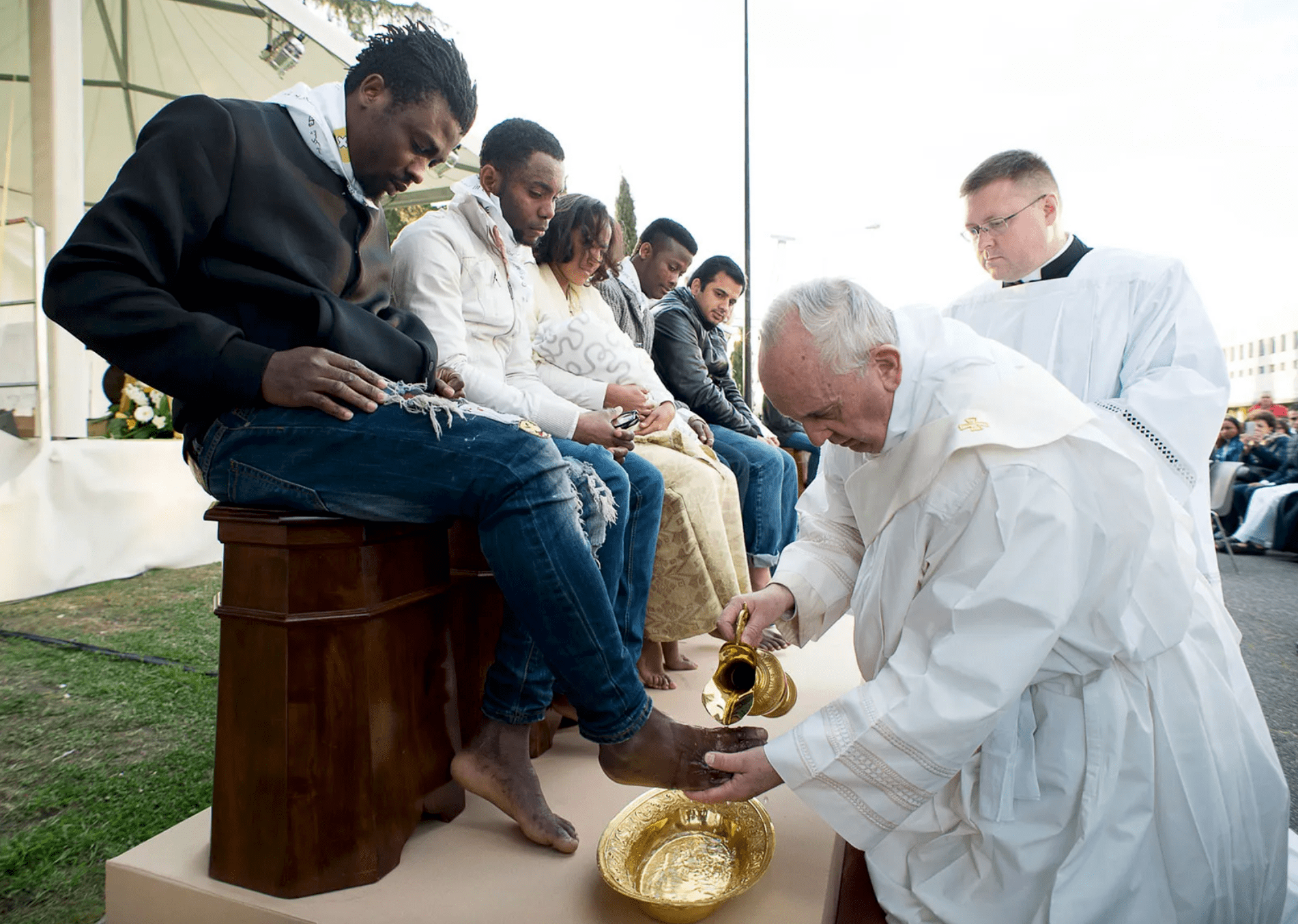
Pope Francis washing the feet of refugees during a Maundy Thursday Mass with Muslim, Christian, and Hindu asylum seekers at a shelter in Castelnuovo di Porto, outside Rome, March 24, 2016, Britannica. 

Click here to read today’s Sunday Mass Readings.

[Jesus said] “For every one who exalts himself will be humbled, but the one who humbles himself will be exalted.”         Luke 14:11.

Click on words highlighted in red for further information.

Last week I began with a story taken from personal experience many years ago. Today’s readings prompted another such memory. I once got a summer job in London when still a student with the Youth Employment Service. I was invited to dinner by one of the workers there, someone who lived in Chelsea, one of the wealthiest parts of the city. It was a grand apartment, way beyond my experience and rather overwhelming. I was invited to sit at the table, laid as I recall for about eight people. I sat at the head of the table, just like the poor soul in today’s gospel, and was quietly told by the host, “no, why don’t you sit there..” pointing to a lesser seat at the side. My mistake was born out of total ignorance as I guess it was the easiest seat to take (but never forgotten or repeated). That was in the 1960s, as was last week’s story, clearly a time for learning social morēs. As ever, Jesus was someone who followed his own advice to the letter, seen in the unforgettable moment when he washed the feet of the highly reluctant Peter (John 13:1-17). And as he said, it might well be that if you do take a humble place at table, you might well be mildly scolded and invited to a more prominent place.

Perhaps the key to today’s readings can be found in the first reading from the Book of Sirach: “What is too sublime for you, seek not, into things beyond your strength search not”. Sirach is a book in the school of Wisdom, meaning it contains advice on how to live properly, grounded in daily human experience. That can be seen clearly in the quotation just shown. It is a foundational principle for us all, namely to know our limits realistically and accept them. Even if we are superbly gifted in many areas, way beyond the normal, we are still human, living among humans, and each of us has the dignity of a child of God and hence deserving of respect and with the trust of being so treated. No matter how gifted we are by God, we live among God’s children, and on one essential level, we are equal in the eyes of God and should act accordingly. 

And then there is the gospel today. Jesus says quite clearly and with authority, “when you are invited, go and take the lowest place” with no ifs, ands, buts or maybes. Then there might be a correction from the host, and you be invited to a more honorable position – or not. But you will be spared the indignity of correction. On a grander sale, this same instruction can be seen in other areas too. For example, some with grand ideas of their singing or instrument-playing ability may not be quite at the level others place on it, and may open themselves to quiet – or open – ridicule. So a realistic appraisal of our abilities and skills or our place in society will save us from potential embarrassment and allow us to set appropriate self-goals of improved behavior. Remember that inappropriate pride is sinful, one of the seven deadlies in fact. And because it is self-inflicted makes it so much worse. That would suggest we are living in a self-made world of delusion and possibly incapable to making a good judgment on ourself or, indeed, anyone else. That would be a very chilly world. And note, if taken to an extreme, it leaves no room for God. And that would be the final point. Self has replaced The Other; there would be no room for anybody else. We have then condemned ourselves to ultimate loneliness and, in my opinion, eternal hell. Hell is yourself – for – ev – er. In eternal blackness, because all else is nothing compared to self. And there is only oneself to blame, despite every warning. 

They say great oaks from little acorns grow. That is certainly the case with what has been examined here. Beginning with the tiniest unjustified self-flattery, that little seed can grow into an imprisoning monster of our own creation, and we might not even know it! But others would know, and we would know it if we apply today’s readings with supreme honesty to ourselves as far as each one of us is able. So there is the point. If any of this rings true in our personal world, then we now know what we should do. And the ultimate test can be seen in the gospel: “Rather, when you hold a banquet, invite the poor, the crippled, the lame, the blind; blessed indeed will you be because of their inability to repay you”. And there you will find the complete death of pride and the birth of compassion, the importance of others, and discovering Christ in your midst. 

The Seven Deadly Sins in the Modern World, Aleiteia.

PLEASE FORWARD THIS TO A FRIEND WHO WOULD APPROVE OF THE THOUGHTS IT CONTAINS.

THANK YOU.

©SundayMassReadings.com

SUNDAY 24TH AUGUST 2025: THE TWENTY-FIRST SUNDAY IN ORDINARY TIME.

BetterYouLiving, Instagram, October 30, 2024.

Click here to read today’s Sunday Mass Readings.

[Jesus said], Strive to enter through the narrow gate, for many, I tell you, will attempt to enter but will not be strong enough.            Luke 13:29-30.

Click on words highlighted in red for further information.

Once in a while the Sunday Scripture reminds me of incidents in my life which, in one way or another, have made a deep impression. Today’s gospel is one of them. Picture it, summer 1967. In my last year of college in London I had become aware of an organization which offered graduates of “technical” subjects an opportunity to work abroad for a few months. My London degree is based on economics and geography, which qualified. I was offered positions in France (requiring fluent French), Germany (German) and Sweden (English). Remarkably enough I chose Sweden. Tailor shop in Stockholm or bank in Gothenburg (Sweden’s second city)? Where can one hide in a tailor shop? The bank please. I was told to arrive at the bank to pick up the key to my rooming house on 24th June, a Friday. Now remember those of my age, that all suitcases at that time were hand held, heavy and quite painful. I arrived at the railway station in Gothenburg (Göteborg, sounding something like “Yūterboree” in Swedish) on midsummer day, baking hot, clear blue sky. A public holiday…. But my letter from the bank clearly said 24 June…. I found my way to the bank, which, of course, was tight shut, with no-one around anywhere. At that point the handle of my suitcase broke and I had to carry it as if embracing it… Oh my – today’s Scripture floated up in front of me “Strive to enter through the narrow gate, for many, I tell you, will attempt to enter but will not be strong enough.” Amen brother! Despondent, just like the people in today’s gospel, I miserably struggled down the lane alongside the bank, and there was the narrow gate! With bell door button! Of course it was pushed and behold, the door opened! There was a young man there, taking care of the bank on a holiday weekend, actually answering the doorbell (this was clearly 1967 not 2025 when that would be unthinkable). I stammered out my desperation, he calmed me down, took me in, and we looked for any rooming house key lying around (none), and so he said his family could put me up for the weekend! Thinking of all that, I wonder if the Lord had such situations in mind? Well I had obeyed the bank’s instructions to the letter (just like we try to follow Scripture), despite a (Swedish pen-) friend actually telling me (tempting me?) that it was a public holiday in Sweden, but it was there in my letter in black and white – 24 June. I had resisted all inducement to reject the word (of the bank, not Scripture in this case), and had been saved! And by Monday I had a family base in a new city!

Of course I know that all this was sheer good luck and goodwill rather than religious conversion! But in today’s gospel we are offered a road map to the gates of heaven, and we know now exactly what to have to do in order to be invited in. There is no luck there, just a life lived in accordance with God’s plan. When the gospel says “We ate and drank in your company and you taught in our streets” and yet we have been excluded from entry into the kingdom, clearly there is a message there. Yes, they recognized Jesus’ presence among them (as we do today) but clearly have not undertaken the responsibilities required of a true Christian on a daily basis. Yes, eat and drink with the Lord – but were you charitable with the less fortunate? Did you help others as much as you were able? Were you seen as honest and generous with your time and your skills? Did you forgive when that was necessary? And so on and on. That is what gets entrance through the narrow gate!

And then there is the second reading about the discipline needed to achieve that goal. We are born into this world brand new. We have not the slightest idea of who we are, what we are and what it is all about. We know when we are hungry and uncomfortable, and that’s it! That’s the starting point for each one of us, and then the training begins, outlined in today’s second reading, which seems to be a tad sexist – are sisters and daughters exempt from this training? Er – no. And then there are  different schools of thought when it comes to discipline, but one thing is certain – it is critical and essential. And it is from our parents that almost all of us learn the basics. Hopefully they are good. If not, then we have a lifetime to learn better and correct any faults we may have learned from them. There is an extremely scurrilous Philip Larkin poem about exactly that which I won’t even name or point you to. But bear in mind that we all come to a time when we are totally responsible for who and what we are, and that will get us through that narrow gate – or not.

The first reading seems to suggest that all people are destined for this regime. Tarshish, Put and Lud, Mosoch, Tubal and Javan being – or once were – the limits of the Mediterranean area, essentially the “world” for most biblical peoples at that time. We are all taught at the earliest age what is essential and required for peaceful, communal living on some level but once those basics have been mastered we start taking control of ourselves. It is at that point we become aware of a greater reality than even ourselves and take the first step for or against recognizing it. And that reality seems to be reflected in today’s first reading,  So in a way we are all subject to this pattern of growth and development. Today’s readings, then, seem to be a huge mirror handed to us, and we can look at it and perhaps calculate where we stand in reference to ourselves, to others and to God. And what we intend to do about it.

The Last Judgement, Jean Cousin, Musée du Louvre, Paris, France.

IF YOU KNOW SOMEONE WHO MIGHT APPRECIATE THIS POST, PLEASE FORWARD IT TO THEM.

THANK YOU.

©SundayMassReadings.com