
Visual Impact Resources Ltd., 2008 (defunct).
Click here to read today’s Sunday Mass Readings.
[Jesus said to Nicodemus] …..and just as Moses lifted up the serpent in the desert, so must the Son of Man be lifted up, so that everyone who believes in him may have eternal life. John 3:14-15.
Click on words highlighted in red for further information.
First, I was intrigued that this feast day had outranked the 24th Sunday in Ordinary Time. On checking, this explanation appeared:
- Sundays during Advent, Lent, and Easter rank the highest and are never replaced by another feast day.
- Solemnities (the most important celebrations) and Feasts of the Lord (such as the Exaltation of the Holy Cross) are the next highest rank.
- Sundays during Ordinary Time are of a lower rank than Solemnities and Feasts of the Lord.
- Feasts of the Virgin Mary and saints are of a lower rank than Sundays in Ordinary Time.
- Memorials (obligatory and optional) are the lowest-ranking celebrations.
So now we know. Today’s feast combines an event in the Old Testament which happened as the Hebrews were making their way to the Promised Land having escaped slavery in Egypt. However, all was not well with them. They were even comparing the more comfortable life as slaves in Egypt with the discomfort of wandering through the desert worried where the next meal was coming from. It was a mind set that distrusted God, and that upset the Almighty who was keeping them alive, albeit uncomfortably in their opinion. That was the background for the strange happening recorded in the Book of Numbers, today’s first reading. I’m afraid God just lost it, and punished them in their disloyalty and distrust. “Seraph serpents” appeared among them. “Seraph” means burning, and, in this case, poisonous. Many died. The mood changed to one of panic, and, as ever, they went to Moses for him to beg forgiveness of God and to ask the Almighty to save them. This Moses did; God took pity on them. God instructed them to create an image of a seraph serpent and mount it on a pole. Those who had been bitten by the snake gazed upon the serpent and lived. (Now note that “seraph” can also mean a certain type of fiery angel, clearly not part of today’s reading!):

The Six-Wingèd Seraph, Br. Robert Lentz, OFM, 2023, Trinity Stores.
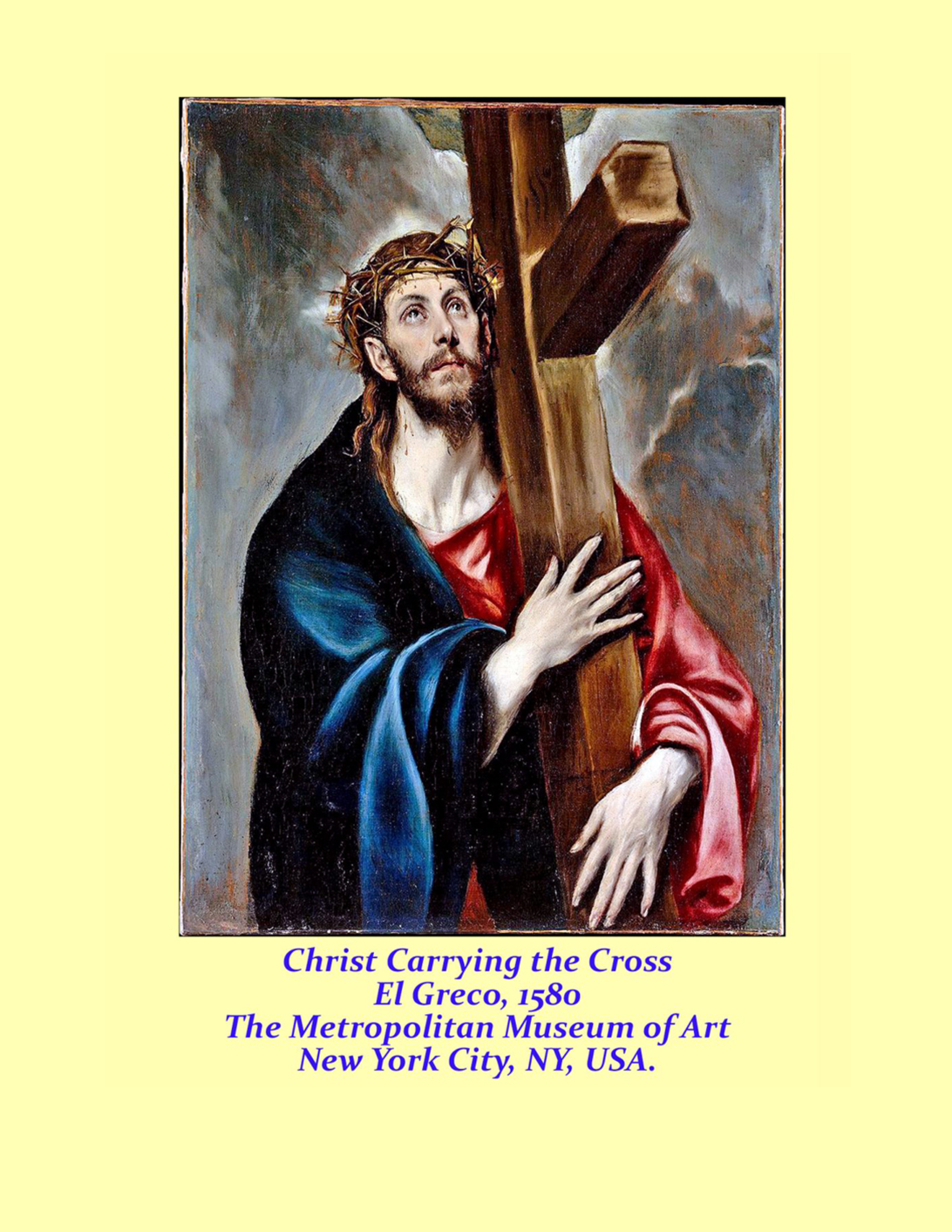
Jesus then compared this desert happening centuries before with something yet to come, namely the brutal moment when the cross, to which he would be nailed, was hauled up for all to see. Jesus was making a comparison between the therapeutic effects of the bronze serpent raised up for all to see – and be cured of the poison within them – and the effects of his supreme sacrifice which he would make, which would save all of those who respond from the wages of sin and the fires of hell to the joys of heaven. And there is the parallel with the desert drama and the crucifixion: The feast of the Exaltation of the Holy Cross is a celebration of Jesus Christ’s sacrificial love and God’s triumph over tragedy, transforming the instrument of death into a symbol of salvation and eternal life. Crucifixion was a deliberately brutal form of punishment. It was usually reserved to punish rebellious slaves who had risen against their masters: “This is what will happen to YOU if…..” This was most dramatically demonstrated with the rebellion of the slave Spartacus in 70-71 BC, when thousands of slaves revolted, even initially defeating Roman troops. But the revolt was ultimately crushed and up to 6000 slaves were crucified along the Appian Way, the ancient Roman road leading south out of Rome. That was the fate thrown at Jesus. Had he been a citizen of Rome (as St. Paul was), he would have been beheaded instead. But no: he was treated as a slave, cruelly executed for not denying who he was (the Son of God revealed at his baptism) and what he was (The Messiah, the Anointed of God when the Holy Spirit descended on him also at his baptism). So the crucifixion has become the supreme symbol of the extent that God loves us, and the promise of the resurrection, the eternal life of happiness in the presence of God.
Now this image came late in Christian iconography. For literally centuries Christians did not depict the savior on the cross. By far the most popular and earliest image of Jesus was as the Good Shepherd, which came from the lips of the Savior himself (John 10:11-18). One supposes that the image of Christ on the cross was too shameful for those earlier Christians to stomach. It was, after all, the ignominious death reserved mostly for slaves who had rebelled against authority. One of the earliest images of the crucified savior is this, dated about 420CE, over four centuries later, and in the British Museum:

The Crucifixion, carved ivory Rome, Italy c.420AD, The British Museum, London, UK.
So it took that long for Christians to begin to use what was to become the primary image of the Lord, and only after that to become the source of events such as today’s special commemoration.
But simply looking at the Crucified One would not bring eternal salvation (as simply looking at the seraph snake cured those infected by its bite); something more is required. Today’s gospel says “….everyone who believes in him might not perish but might have eternal life”. Belief requires action, and action along the lines taught by Jesus. And remember the command (no other word for it) to “love one another”. Hence love must be the source of all peace and happiness. It was for love of us that the Lord submitted to the agony of the cross. Remember he could have escaped all that by simply denying who and what he was (the reason he was condemned to death). But that would have negated his entire life’s mission. That he could not do. He had to show his complete belief in his message; he died to support it. If it was that strong an essential belief, then we his followers must do the same in our way, in our time and in our life situation. Which leads us to today’s second reading, the most beautiful passage in all of Paul’s writings and possibly all of Scripture:
Christ Jesus, though he was in the form of God,
did not regard equality with God something to be grasped.
Rather, he emptied himself,
taking the form of a slave,
coming in human likeness;
and found human in appearance,
he humbled himself,
becoming obedient to death,
even death on a cross.
and therefore:
…at the name of Jesus
every knee should bend,
of those in heaven and on earth and under the earth,
and every tongue confess that
Jesus Christ is Lord,
to the glory of God the Father.
as it was his Father who commanded that he declare his message of universal love and forgiveness no matter what. And that he did. No matter what.

The Adoration of the Name of Jesus, El Greco 1579, Chapter House, Monasterio de San Lorenzo, El Escorial, Spain. [Note that IHS are the first three letters of Jesus’ name in Greek: ΙΗΣΟΥΣ, IĒSOUS]
KNOW SOMEONE WHO WOULD APPRECIATE THESE THOUGHTS? THEN PLEASE FORWARD THIS WEBSITE TO THEM FOR THEIR CONSIDERATION.
THANK YOU.
Reflections on next Sunday’s Mass Readings will be posted on Wednesday.
Please send your reactions to: RogerJohn@aol.com
©SundayMassReadings.com
Discover more from Sunday Mass Readings
Subscribe to get the latest posts sent to your email.
 Sunday Mass Readings