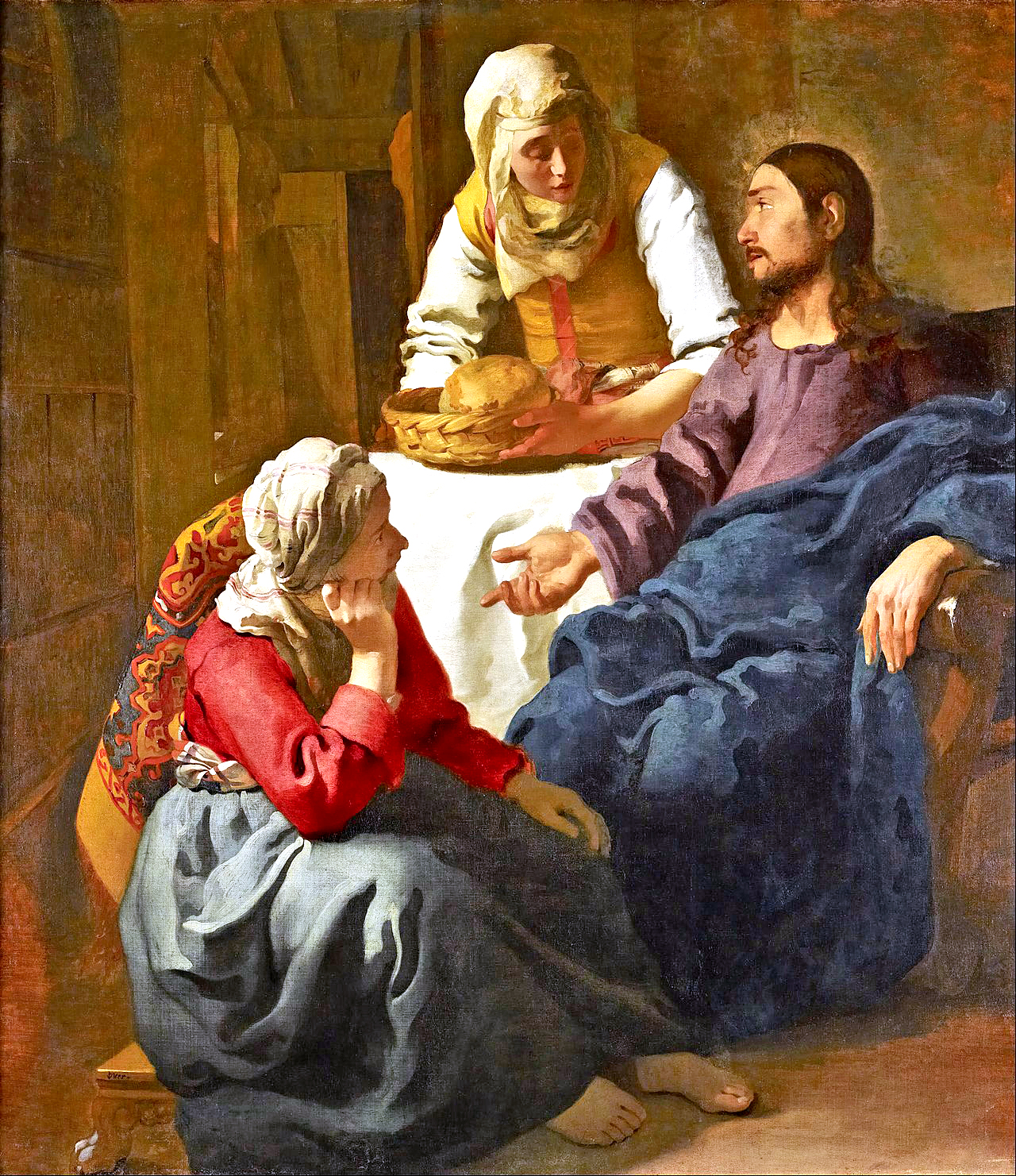
Christ in the Home of Martha and Mary, Johannes Vermeer 1655, Scottish National Gallery, Edinburgh, UK.
Click here to read today’s Sunday Mass Readings.
Click on words highlighted in red for further information.
There are elements in each of this Sunday’s readings that may be taken as indications of a much broader meaning, in addition to understanding what the original intention was. That mysterious “terebinth of Mamre” in the first reading, for example. What is a terebinth? Turns out that it’s a a small tree or large shrub, very sturdy, growing where most others cannot, such as in dry, rocky, inhospitable terrane, as there is around Mamre, a small settlement in the semi-desert south of Jerusalem. It is in the same family as the cashew. The word turpentine originated with it, but the modern paint-thinning liquid “turps” now comes from the resin of the pine tree. The terebinth has medicinal properties in addition to an edible fruit and its wood is good enough to be shaped into tools. An all around winner! Then, also in the first reading, there is an example of the well-known hospitality of the Levant, as Abraham and Sarah open their table to three total strangers. What was incredible about them is their prediction that the childless Sarah, then about 90 years old, would bear a son! Sarah overhead that and began laughing, but God rebuked her… Read all about it here, as unhappily it is not included in today’s reading. But Sarah argued with God – and even told God a fib (probably like many of us too)!
Then Paul, in the second reading, reminded me of a childhood exhortation that you rarely hear today. He clearly had plenty of health problems, “I rejoice in my sufferings for your sake” he says. He seems to liken his sufferings to the pains associated with the growing Christian community, hence to be accepted as they are useful. For those of my age, doesn’t that sound like “offer your pain up for the souls in Purgatory”? In other words it is a positive remedy for what could well become a very negative suffering experience. And finally, in the gospel, Jesus is staying with friends Martha and Mary, where poor Martha has taken on herself all the chores of dealing with a guest, rushing around and complaining about her lot. Mary on the other hand simply sits at the feet of the Lord listening to him. Where would each one of us want to be in that situation? No mention of their brother Lazarus in this passage, which presumably took place in Bethany, just outside Jerusalem.

Terebinth Tree, Mohand Azouze, Flickr.
So now, what were the promised points about today’s readings mentioned at the beginning of this reflection? The first passage begins, “the Lord appeared to Abraham”, but when he looked up, he saw three men, not one. Although the next chapter talks of two angels together, there is no explanation in this 18th chapter as to who they all were. Some theologians posit that this may have been a first inkling of the Trinity, reinforced by the use of the plural in Genesis 1:26: “Then God said, “Let us make mankind in our image, in our likeness“. It’s a pretty weak argument, but quite interesting. In the second reading Paul makes much of the Gentile readers he is addressing. Remember the huge distinction the Jewish people make between themselves and us Gentiles. The Council of Jerusalem, mentioned in the reflection of the Sixth Sunday in Ordinary Time, last 25th May, was necessary because of the crisis following the admission of Gentiles into the new Jewish/Christian, movement. Clearly Paul is at ease with that, expressing his desire that all Gentiles fully understand the meaning of the Messiah among us and that we must submit to him. And finally, the domestic fuss between Martha and Mary. Note what each is doing, and then compare that to the reality of the priesthood and the diaconate. Priesthood involves spreading the Word of God as received from Scripture, and the diaconate means service (deacon: “δεακονος deakonos” is the Greek word for servant). So Mary is doing what a priest would do, listen and absorb the Word of God, whereas Martha is being the deacon, the servant. In the present thinking about the possibility of women becoming ordained deacons, this passage almost certainly must have come under intense study.
Therefore each reading today may point, in one way or another, to a wider reality or possibility beyond the immediate confines of the scene presented. The first reading might represent the Holy Trinity suggested centuries before the revelation in the New Testament and be seen as a preparation of that revelation. The second reading can be seen as a prayer for the universal acceptance of Christ’s message of salvation, and the gospel as a possible example of a veiled message of universal acceptance into the ordained ministry of the church! Pretty controversial in many ways, not to say inflammatory, but intriguing or at least interesting. It is very human to be challenged and having to defend one’s position, and some clarity is a possible result. We should always be ready to defend what we consider to be right and just, and still be open to listening to and judging fairly someone else’s point of view. We don’t often get a set of three Sunday readings which prompt reflection and some challenge, but today’s do seem to offer that. We should never be afraid of prayerful thought and challenge even for our deepest beliefs. The result might be even greater strength. And isn’t there something in that for us all? Don’t we, sometimes, demonstrate a greater, holier more Christian self in certain moments? Perhaps that could be a call for some reflection, on how each of us can be a truer, better child of God. We surely have moments which point to that. Then why not deepen such moments, and become ever better disciples of the Lord?

Icon of the Hospitality of Abraham, Holy Monastery of the Dormition of the Theotokos, Mount Penteli, Greece. [Theotokos is Greek for “God-bearer” or Mother of God; ΦΙΛΟΞΕΝΙΑ, Philoxenia, is Greek for hospitality]
PLEASE SHARE THIS REFLECTION WITH ANOTHER WHOM YOU THINK MIGHT APPRECIATE IT. THANK YOU.
Reflections on next Sunday’s Mass Readings will be posted on Wednesday.
Please send your reactions to: RogerJohn@aol.com
©SundayMassReadings.com
Discover more from Sunday Mass Readings
Subscribe to get the latest posts sent to your email.
 Sunday Mass Readings