

The Good Samaritan, John Adam Houston, Royal Scottish Academy of Art & Architecture, Edinburgh, UK.
Click here to read today’s Sunday Mass Readings.
[Jesus asked] Which of these three, in your opinion, was neighbor to the robbers’ victim?” He answered, “The one who treated him with mercy.” Jesus said to him, “Go and do likewise.” Luke 10:36-37.
Click on words highlighted in red for further information.
Possibly the most famous parable in all the gospels, the Good Samaritan is an iconic example of Jesus’ teaching, clear, direct, and utterly convincing. To our ears, the message is totally clear and readily understood. Not so the first audience who heard it: very far from our understanding in fact. The biblical scholars call it the “Sitz im leben”, a German expression (as many early 20th century critical scholars of the Bible were German), meaning an attempt to set the passage in its original time and place. It seeks to recreate the understanding of a certain story or saying as it would have been heard and understood the first time it was proclaimed. And the part which would have stood out with greatest force on that original occasion would not have been ...they stripped and beat him and went off leaving him half-dead but would have been the word Samaritan. That would have been the part which brought those who first heard the story to full attention. It would have been an “Uh oh!” moment to them. They would probably have expected the Samaritan to finish the poor man off, give him a final kick and take what was left of his belongings! Instead, of course, the opposite was the result, the Samaritan going way beyond what might be expected, even to the extent of paying for the care of this wounded, despairing, unknown (and probably Jewish) man. So what was Jesus doing? The Samaritans were the people who lived in Samaria, the area of the Holy Land at that time just north of Jerusalem, and south of Galilee where Jesus grew up. They were Jewish too, but….
The parallel which occurs to me is the way Catholics and Protestants viewed each other when I was growing up in the 1940s. It was not pretty. All Protestants were going to hell if you were Catholic, and vice versa. This never sat well with me as my dear mother was Anglican, that is, Protestant (Episcopalian in the USA). There was no way she would end up in hell! But that perception was everywhere at that time. I even had to get permission from the priest in confession for permission to go to my cousin’s marriage in an Anglican church (the answer was yes, but I bet it was grudging). Well, transfer that way of thinking to 2000 years ago and to the Jews and Samaritans. They basically hated each other. The Samaritans even had their own holy hill (compare that to Mount Zion in Jerusalem), and their own temple on it. There was a whole history of distrust and conflict which has no place here, but, if you wish, you can find it here. They even played pretty horrible tricks on each other, just like scams do on us today. (There is still a small Samaritan community in the Holy Land). So when Jesus had the Samaritan discovering the man beaten up and left to die, completely ignored, rejected, by the much worthier priest and Levite (who would have been a servant in the Temple in Jerusalem, the holiest place on earth for the Jews), they expected even worse from the Samaritan. But no, they did not get that. And note at the end of the story when Jesus asks who was neighbor to the man – what would you say automatically? Now look at what the scholar of the law, the one whose question sparked the parable, said in answer to that question. Look at my caption above. Who was neighbor to the man….? Did you answer that way? The man could not even bring himself to say the word “Samaritan”!
There are other telling things about this parable. The traveler was on his way from Jerusalem to Jericho. Now did you know this: many scholars believe Jericho is one of, possibly the, oldest human settlements in the world, over 9000 years old! So it could be said that it represents mankind in its source and longevity. Then there is Jerusalem, now sacred to the three great monotheistic religions in the world. So if one would ask which is the holiest city in the world, it could possibly be Jerusalem, the city of God! Additionally, Jericho is about 800 feet below sea level, whereas Jerusalem is about 2500 feet above sea level. In other words, metaphorically, the traveler was going in the wrong direction! And it is a bleak landscape there. I took this picture near Jericho in 2018:
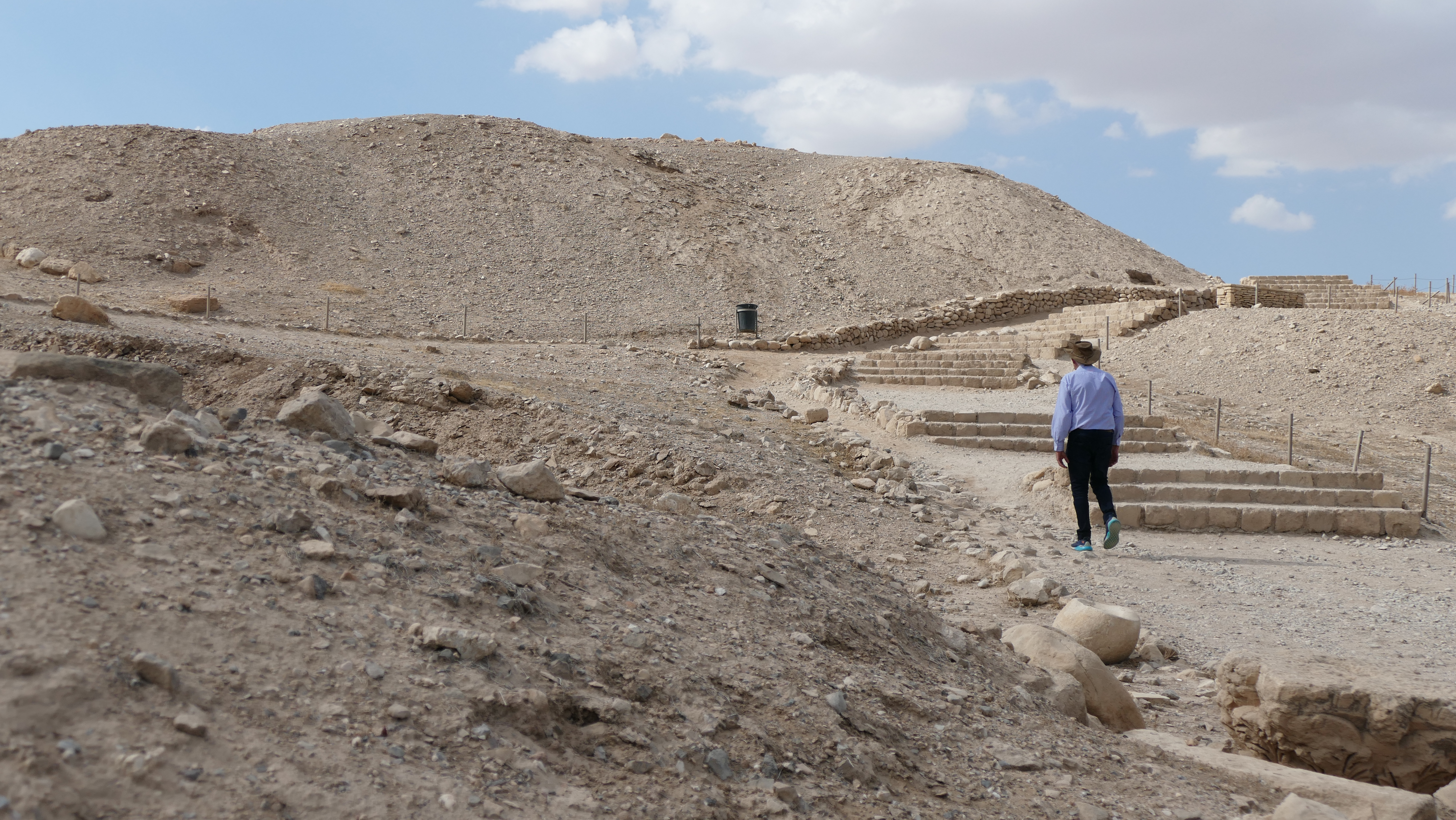
Excavations in Jericho, Palestine Authority, 2018.
And consequently it is an uphill trek to get to the City of God, but much easier to get to the city of (fallen) humanity. So this simple story is multifaceted, with each angle having its own story to tell. But ultimately, it is the Lord who is the Samaritan, and each one of us fallen and barely able to ask for help. Yet we need it so badly. But today at least we Christians of whatever tradition enjoy a much more healthy relationship with each other. We acknowledge that we all believe in fundamental truths, that Jesus is the Lord of all, who is always ready to help us when we ask for it. That love is the power of God, into which we are all invited. So, based on that, we can transform ourselves into that Good Samaritan, able to help whoever needs help. For our help comes from the ultimate Good Samaritan, always there and always ready. As we should also be. But that is no easy matter. The example set in this parable calls us to help on many levels, including financial, and are we ready to do that? For many of us today, that would be the acid test – the money in our pocket. But, of course, our Samaritan went way beyond that level of generosity. When Jesus was asked to deny his identity as God’s Son, and his title, Messiah – the Anointed of God – he declared this was who he truly was, and as a result was martyred for our benefit – so that we would believe in his mission and example! He died defending this so that we would believe in him. Our Samaritan loved us so much that he was not prepared to save himself by denying who and what he was, and what his vocation was, instead offering to save each and every one of us. So we have the ultimate example here of what each of us is called to be. Not to ignore the suffering around us, but to do what we can to minimize it. That would be a great step for us to become the Good Samaritan! And one final exercise: If you have a pet irrational dislike of some nationality or race or skin color or indeed anything which another person has been born with and has no control over, substitute that for the Samaritan and give yourself an “Uh oh” moment to make this parable come really alive!

The Good Samaritan: A Children’s Catechism, Fr. Michael Shanbour, Ancient Faith Store.
IS THIS REFLECTION SOMETHING WHICH MIGHT HELP SOMEONE ELSE? BE GOOD ENOUGH TO SEND IT TO THEM. THANK YOU.
Reflections on next Sunday’s Mass Readings will be posted on Wednesday.
Please send your reactions to: RogerJohn@aol.com
©SundayMassReadings.com
Discover more from Sunday Mass Readings
Subscribe to get the latest posts sent to your email.
 Sunday Mass Readings