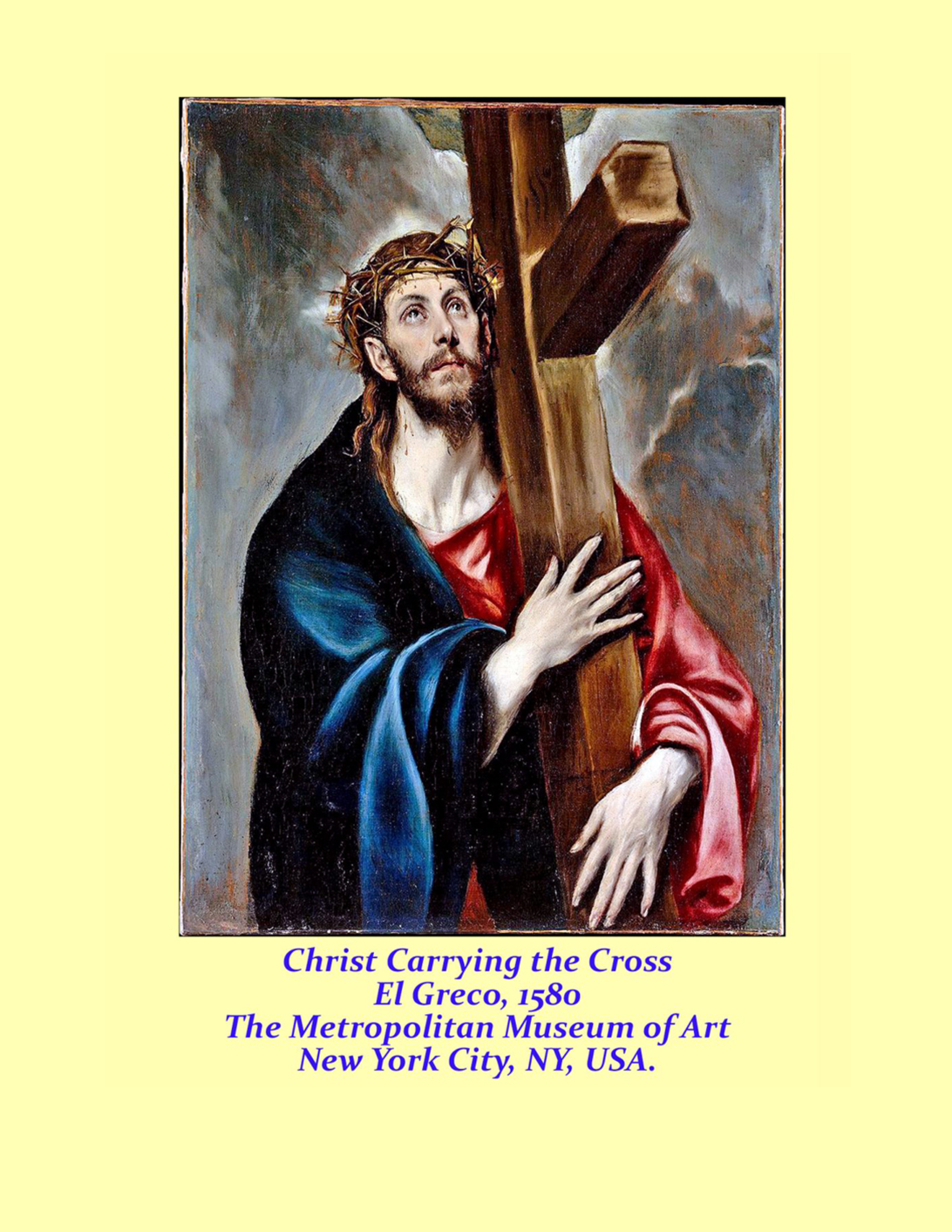

Pentecost, El Greco c. 1600, Museo del Prado, Madrid, Spain.
When the time for Pentecost was fulfilled, they were all in one place together. And suddenly there came from the sky a noise like a strong driving wind, and it filled the entire house in which they were. Then there appeared to them tongues as of fire, which parted and came to rest on each one of them. Acts of the Apostles 2:1-3.
Click here to read today’s Sunday Mass Readings.
Click on words highlighted in red for further information.
First, you could make a case for this event to be the most important happening ever in the church’s history, save for the Resurrection itself. Why? Because without it there would be no church, no Christianity, no saving message of Christ to each of us today. Remember John’s gospel states twice that the entire small Christian community trembled behind locked doors “for fear of the Jews”. But this was the Jewish Feast of Pentecost, 50 days after Passover, the reason why Jerusalem was packed with Jewish pilgrims (Pentecost is the Greek word for 50th πεντηκοστός – pentēkostós). Today it has a Hebrew name, Shevuot, to distinguish it from the now better-known Christian Pentecost. For the Jewish people, it was at that time one of the three pilgrimage feasts, when those who could, would travel to Jerusalem and worship in the Temple. (The others were Passover and Sukkot). Originally Shevuot was the Feast of the First Fruits of the Harvest, a sample of which you would bring and offer there. Later it became the Feast of the Law, because by tradition, the Hebrew people arrived at Mount Sinai 50 days after leaving slavery in Egypt, and where God gave Moses the 10 Commandments. But whatever it was, Jerusalem was packed with devout Jewish pilgrims intent on giving thanks to God at the holiest place on earth, the Temple (which was completely destroyed by the Romans in 70AD), but not before the first fruits of the Descent of the Spirit had shown themselves!
But before that, the earliest Christians trembled in their upper room, fearful they too would suffer the same fate as the Lord, especially with the city packed with devout Jews. Then it happened, as reported in the Acts of the Apostles stated above. These cowering mice suddenly became fearless lions, rushing out into the streets proclaiming the Good News to anyone who would listen! Now, in the absence of the Lord, but with the promised strength of God’s Holy Spirit, the Christian message was, for the first time, proclaimed in the streets of the Holy City itself without any fear of the consequences. Hence it was indeed the truly miraculous Birthday of the Church! What else but a miracle could explain this sudden, permanent and inexplicable change in outlook? Those, by the way, are the hallmarks of a true miracle to this day! It was the inaugurating moment of the Age of the Holy Spirit of God, in which we all live at this moment. The red vestments at Mass today reflect the mystic fire of the Holy Spirit descending on the heads of those first true Christians, now fearless, and intent on spreading the Good News. And spread it has, to the estimated 2.4 billion believers today, the world’s largest religion, of whom 1.3 billion are Catholic. And note also, that the disciples miraculously spoke in many tongues to the pilgrims from throughout the Roman Empire. Theologians say that this cancelled out, at long last, the curse of confused tongues at the building of the Tower of Babel, built by humans to ensure that if God ever sent another flood, they would overcome it.
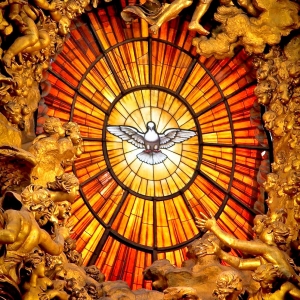
God’s Holy Spirit appeared on that wonderful day “as of fire”. You will recall that at the Baptism of Jesus, God’s Holy Spirit came upon him “like a dove”. I cannot resist repeating the following, which appears in almost all my messages concerning God’s Holy Spirit. The words dove, יוֹנָה yonah, wind, spirit, breath (in Hebrew the same word) רוּחַ ruach, and wisdom, חָכְמָה, chokmah are, each and every one, feminine in gender in Hebrew and Aramaic. Each one of those words, whenever they appear in Scripture, reflect God’s power. The “dove” anointed Jesus as the Messiah (the “Anointed One”), giving him the power of God. When God “breathed” into the handful of mud in Genesis 2:7, Adam was created. The feminine “wind” allowed the Hebrews to escape from the Egyptians at the Red Sea and gave courage to the timorous Christians in the Upper Room, and they received a double dose of spiritual power as they also had fire, אֵשׂ esh, also feminine in gender, descending on them, changing them into fearless Christian missionaries. Unhappily for us, all our Christian writings are in Greek, and in Greek the word for Spirit is neuter: πνευμα, pneuma. Now technically that means we have to refer to the Holy Spirit as “it”, which is completely unacceptable. So when the Greek Scriptures were translated into Latin, where the word for Spirit is Spiritus, the -us ending makes it a masculine noun, and so the Holy Spirit has been referred to as “he” evermore. But in Hebrew and Aramaic, the language of Jesus himself, the correct pronoun is “she”. Look at this short passage from the Book of Proverbs: Wisdom shouts in the street, she lifts her voice in the square (Proverbs 1:20). Now this is not to say that wisdom was a woman once sitting in judgment at some place and time in the Old Testament. But it does apply a quality to this word and all the others just mentioned. And above all, you could make a case that God’s Holy Spirit has as much claim to “she” as does the Father and Jesus himself to “he”. Put it this way, Jesus would be just as surprised, shocked even, to hear of God’s Spirit referred to as “he” as we would be to hear the Holy Spirit addressed as “she”. Note that in most European languages words have meaningless genders: in French a table and a chair are feminine but the carpet and sofa are masculine; meaningless. But in English that does not apply. Almost everything is “it” if not referring to people where it is definitely he or she. So gender means something in English, hence this argument. And so, as an interesting exercise, how would you alter the Creed, said each Sunday at Mass, to reflect this argument:
I believe in the Holy Spirit, the Lord, the giver of life,
who proceeds from the Father and the Son,
who with the Father and the Son is adored and glorified,
who has spoken through the prophets.
So we celebrate the church’s birthday on this day which, I believe, is a Judeo-Christian feast which has more names than any other, at least six by my reckoning. It is the sine qua non of our faith. Amen. Alleluia!

IF YOU THINK OTHERS WOULD BENEFIT FROM THIS REFLECTION, PLEASE FORWARD IT TO THEM. THANK YOU.
Reflections on next Sunday’s Mass Readings will be posted on Wednesday.
Please send your reactions to: RogerJohn@aol.com
© SundayMassReadings.com
Discover more from Sunday Mass Readings
Subscribe to get the latest posts sent to your email.
 Sunday Mass Readings