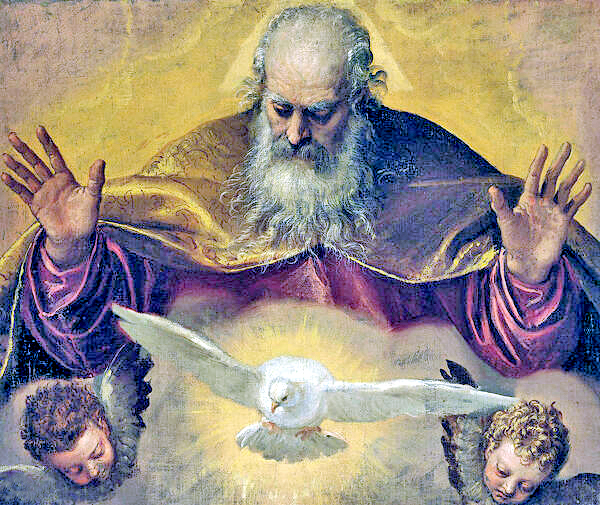
The Eternal Father, Veronese (undated), Hospital Tavera, Toledo, Spain.
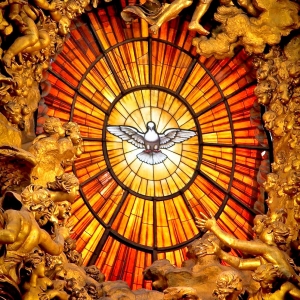
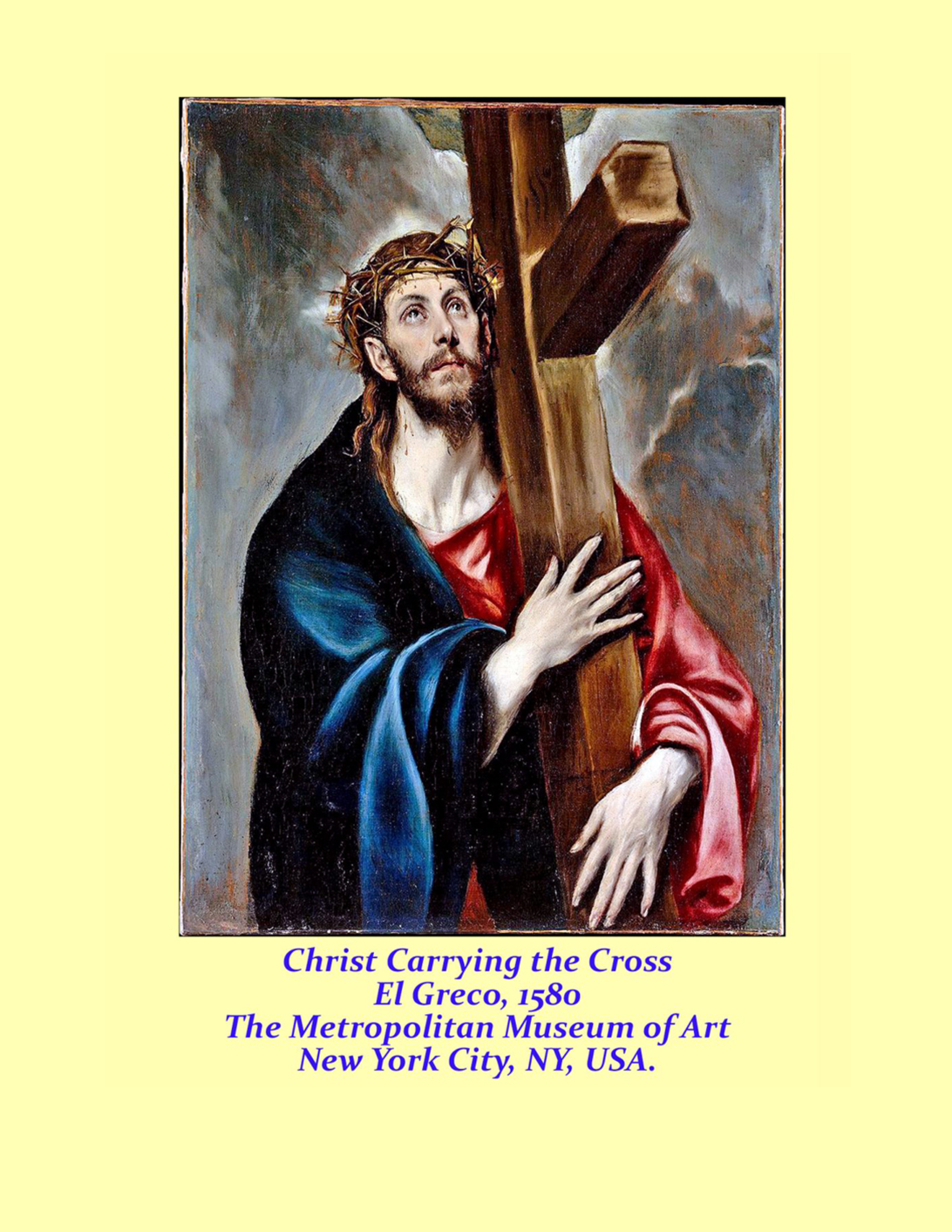
[Jesus said] “I have told you this while I am with you. The Advocate, the Holy Spirit, whom the Father will send in my name, will teach you everything and remind you of all that I told you. Peace I leave with you; my peace I give to you.” John 14:26-27.
Click here to read today’s Sunday Mass Readings.
Click on words highlighted in red for further information.
It cannot be by coincidence that the first major crisis in the brand new Christian community, described in today’s first reading, has been linked with today’s gospel. Word was spreading among the earliest Christian communities that pagan men who had expressed interest in following the Lord had to be circumcised to become Christian. Now all Jewish boys, following God’s orders as stated in Genesis 17:11-12, had been made to follow that command for hundreds of years. So it was not too surprising that such a thought had occurred to the new Christians (who had not yet had that name applied to them; before then we were “Followers of The Way”) especially the ones who had converted from Judaism, probably the majority. Today’s first reading describes that first controversy in the fledgling church. Not surprisingly, it threatened to tear the infant community to pieces unless it was addressed. So, what theologians now call the Council of Jerusalem, namely the “apostles and elders”, met together and decided that it was not necessary for men to submit to that Jewish tradition in order to follow “The Way”. And so it was proclaimed. As such it has never been a condition for boys to be circumcised in order to become Christian. And so it was the first time that Jesus’ prophetic words in today’s gospel were put to the test.
And it is even more interesting if you apply that ultimate requirement of the 16th century Reformation for changes in Church teaching, the “sola scriptura” test. This states simply that if you cannot prove your case from Scripture, then it fails. Both the Catholic and the Orthodox churches reject this teaching. Indeed, this Council of Jerusalem event today supports this rejection. The early Christians were forced to decide what needed to be done for a man to become Christian. For generations the Hebrew people had circumcised all boys, following the clear command recorded in Genesis. Now the Christians had changed that rule. But Scripture clearly proclaimed that this was an absolute requirement if you took the Christian community to be Jewish; after all, it proclaimed Jesus to be the long-awaited Jewish Messiah! However, the apostles and elders said it was not, and so, no circumcision. Looking at today’s gospel, Jesus had clearly stated that his followers would be guided by God’s Holy Spirit if and when this became necessary. Today’s first reading demonstrates the reality of Jesus’ promise, and the apostles and elders stated without hesitation that “It is the decision of the Holy Spirit and of us” not to require circumcision for men wanting to become Christian. Such a conviction has been present in the church ever since that time. In fact, the 1871 First Vatican Council proclaimed the logical extension of this belief that when the pope speaks “ex cathedra” his proclamation is infallible, meaning it must be accepted by Catholics as true and without fault. Apart from that papal infallibility statement, only two further teachings have been declared to be infallible. One was at that Council, with the proclamation that the Virgin Mary was conceived without sin, the Immaculate Conception. The only other time was in 1950 when Pope Pius XII declared the Assumption of the Blessed Virgin Mary body and soul into heaven to be a doctrine of faith, to be accepted as true by all Catholics. Both those teachings had been present in the church from very early times. And so, even though they are not in Scripture, they are articles of faith to be accepted by all Catholics. No other teaching has been declared ex cathedra since 1950.

The First Vatican Council 1870, image located in the Library of Congress.

The Proclamation of the Doctrine of the Assumption of the Blessed Virgin Mary by Pope Pius XII, 1950.
Today’s readings are therefore really an object lesson in the ability of the church to handle questions of faith whenever they arise. Although teachings ex cathedra are extremely rare, the church does have the ability to discern between levels of acceptable belief. For example, the church accepts that St. Bernadette was especially privileged to receive visions and messages from the Blessed Virgin Mary, but it does not require any of us to accept such as essential to our faith: we can accept or reject Bernadette’s experience as we wish; the church simply states it is “worthy of belief”. But, in contrast, the church does, for example, expect us to accept the Real Presence of Christ at Mass in exactly the same way Jesus expected such from his followers at the Last Supper. “This is my body” he said, and he meant it, ordering us for ever to “do this in memory of me”. And what will be our reward, if you like, for accepting God’s word and living God’s Way? Take a look at the second reading today describing our ultimate destination, our home: “The city had no need of sun or moon to shine on it, for the glory of God gave it light, and its lamp was the Lamb”. Amen.

The Sacrifice of the Mass, unknown attribution.
IF YOU KNOW OTHERS WHO MIGHT BENEFIT FROM THIS REFLECTION, PLEASE FORWARD IT TO THEM. THANK YOU.
Reflections on next Sunday’s Mass Readings will be posted on Wednesday.
Please send your reactions to: RogerJohn@aol.com
© SundayMassReadings.com
Discover more from Sunday Mass Readings
Subscribe to get the latest posts sent to your email.
 Sunday Mass Readings