
*****************************************************************************************************
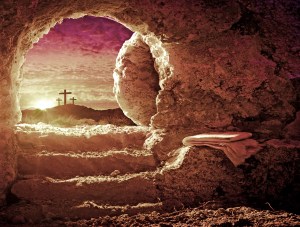
The Empty Tomb, Amazon BtsAn
On the first day of the week, Mary of Magdala came to the tomb early in the morning, while it was still dark, and saw the stone removed from the tomb. John 20:1.
Click here for the readings of Holy Thursday, for Good Friday, the Easter Vigil and Easter Sunday. Today’s Reflection will be based mostly on the Easter Sunday readings.
Click on words highlighted in red for further information.
This week we remember and celebrate the most important event in the history of the world. This was the event where death itself was conquered, the conquest of the ultimate enemy of us humans, all animal life, all that we know, and, indeed, the entire universe. The Sacred Triduum (three days) records all the events leading up to this momentous event, with the repercussions and the consequences. Today’s gospel comes from John’s gospel, but remember that Mark’s gospel, in the opinion of most scholars, ends with the empty tomb and nothing more! Mark asks us to draw our own conclusions from that situation and ponder the words of the angel encountered by Mary Magdalene and other women with her:
“Do not be alarmed. You seek Jesus of Nazareth, who was crucified. He has risen; he is not here. See the place where they laid him. But go, tell his disciples and Peter that he is going before you to Galilee. There you will see him, just as he told you.” And they went out and fled from the tomb, for trembling and astonishment had seized them, and they said nothing” (Mark 16:6-8).

The Resurrection, Sebastiano Ricci 1715, Dulwich Picture Gallery, London, UK.
Those simple words: “He is risen” says it all. So how did those three days come to that point? Jesus knew he was playing into the hands of those who hated him. The most recent event, which certainly sealed his fate, was the raising of Lazarus from death (John 11:38-44). That took place in Bethany, very close to Jerusalem. It was certain that word of that event reached Jerusalem at lightning speed, and was almost certainly the cause of the rapturous welcome Jesus received when entering the city shortly after (commemorated last Sunday). Only the Messiah of God could ever have done such a thing! So Jesus knew that once it became known that he was not the kind of Messiah everyone expected, there would be a huge negative reaction. Look at this clip from the Zeffirelli film of Jesus of Nazareth, made in 1977, with an imaginary meeting of Jesus with Barabbas in the Temple area at that time. Once word got around that Jesus was not the type of Messiah the people had longed for over the centuries, his fate was sealed.
That certitude set the tone of the Last Supper, remembered on Maundy Thursday. On that occasion, Jesus recalled the events of the Passover, which the Last Supper commemorated, where God not only made possible the enslaved Hebrews to escape Egypt forever, but also gave the 10 Commandments to Moses, and, more importantly, created a covenant with the people that made them the Chosen People of God. It is all described in Exodus 24: Following God’s orders, a stone altar was built, representing God, surrounded by 12 stones representing the 12 tribes of Israel. Animals were sacrificed as fellowship offerings. Half the blood of the animals was sprinkled over the altar, and the other half over the people. Remember that the blood of sacrificed animals represented life, not death. This was the symbolic representation of the life of the people linked with the life of God. It was this event Jesus paralleled in the Last Supper, but took it to an unimaginably higher level. He stated that the wine of the Supper was his blood, the new covenant, which his disciples were told to take and drink. Jesus linked his life with those of his friends in the most intimate possible way: they took his life blood into themselves. This is why, in Luke’s account of the Last Supper, “Jesus gave them the cup after the supper, saying, “This cup is God’s new covenant sealed with my blood, which is poured out for you”. Not only that. The Passover meal, which celebrated the release of the Jews from slavery in Egypt for the promise of a land flowing with milk and honey, meant they had to prepare for a hasty exit, so unleavened bread, quickly made without yeast (which takes time to rise), was the hallmark. That would be their sustenance for the journey. Jesus took that unleavened bread at the Last Supper and declared it to be his body, which would sustain us for our life journey (the reason why communion bread is unleavened). Then his order, or mandatum in Latin, hence “Maundy”, was to “Do this in memory of me”, which is considered to be the establishment of the ordained ministry, to celebrate this event in his memory forever. Hence he would be with us forever, until the end of time.

The Last Supper, The Predella 1435-1440, St. Elizabeth’s Chapel, Basilica Co-Cathedral of St Mary, Gdansk, Poland.
Good Friday recalls the dread events of Jesus’ death, sealed by his answer to the high priest’s question, “Are you the Messiah, the Son of God?”. Mark reports Jesus’ answer “I Am” to that question, very close to the most sacred name of God, Yahweh, I AM WHO AM. He was condemned for blasphemy. The high priest was not empowered to condemn him to death, but the Roman governor was. With the embittered people crying for his death as they thought themselves betrayed by this so-called Messiah, Pilate gave in and Jesus was killed in the most deliberately brutal way. He took the pain and suffering for all our sins on his shoulders willingly, paying for what we have done and asking nothing in return, save belief in him.
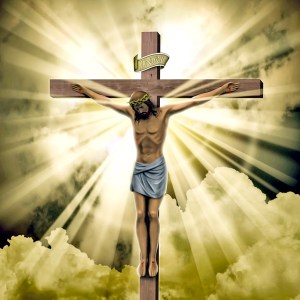
The Cross of Jesus, Pixars.us.
Jesus’ dead body was taken down from the cross and laid in a stranger’s tomb and left, awaiting anointing once the Passover Day was ended. No person witnessed the resurrection, but there might be the most extraordinary possible witness to that event. The artifact, the most studied in the world, the Shroud of Turin, is, perhaps, the most fascinating witness to this unique, world-changing event. It displays all the marks of a crucified man. It dates from the time of Christ, has the nail wounds which differ from almost all the pictures of Christ crucified, but which experts say would have to be those on a crucified body. There are many other elements of this piece of linen which point to that all-important event. The scare some years ago that it was a fake have been swamped by evidence that it was deeply flawed in the way it was obtained. Ultimately there is no way to prove it is the burial cloth of Jesus, but just look at what has been discovered from this one piece of material. And gaze at the serene face imprinted on it…
And then the event itself, Jesus’ conquest of death. The Shroud may be the moment that happened, a photograph, if you like, of that most significant moment, but ultimately it is a question of faith: Do YOU believe that Jesus conquered death itself? Our Greek Christian brothers and sisters greet each other today with the statement “Χριστός Ανέστη” (Christos Anestē – “Christ is Risen”) and the response is “Aληθώς Aνέστη” (Alithōs Anestē – “Truly He is Risen”) which is much more appropriate to the day than “Happy Easter”, where Easter is, in fact, a pagan word coming from the Old English word Auston or dawn, towards the sunrise, the east. Most European words for Easter parallel the Jewish word for the feast of Passover when all this happened (Spanish Pasqua, Italian Pasqua, Swedish Påsk, Greek Πάσχα (Páscha), and so on). However we English speakers can console ourselves with the thought that the dawn of a new, eternal life of happiness with God dawned with Jesus conquering death on this day.
Χριστός Ανέστη!

Adoration of the Holy Trinity, Albrecht Dürer 1508, destroyed in the Second World War, Vienna, Austria.
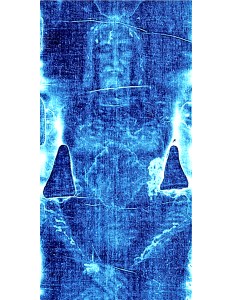
The crucified figure on the Shroud of Turin.
PLEASE FORWARD THIS AN AN ACQUAINTANCE WHO MIGHT FIND IT HELPFUL, REASSURING AND FULL OF HOPE. THANK YOU AND HAPPY EASTER!
Reflections on next Sunday’s Mass Readings will be posted on Wednesday.
Please send your reactions to: RogerJohn@aol.com
© SundayMassReadings.com
Discover more from Sunday Mass Readings
Subscribe to get the latest posts sent to your email.
 Sunday Mass Readings