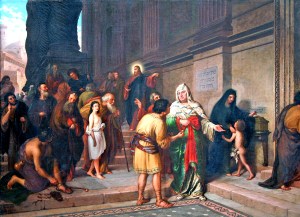
The Widow’s Mite, João Zeferino da Costa 1876, Museu Nacional de Belas Artes, Rio de Janerio, Brazil.
A poor widow also came [to the Temple treasury] and put in two small coins worth a few cents. Mark 12:42.
Click here to read today’s Sunday Mass Readings.
Click on words highlighted in red for further information.
I’m guessing that very few of us have a clue what a widow’s mite actually is. No doubt we have heard of it many times, but where does it come from? So I looked it up. It was the smallest coin in circulation at the time of Jesus, and it was Jewish, not Roman. And the word mite is English rather than Jewish, a translation of the Latin word minitum, itself translated from the Greek word λεπτὸν, lepton, a small coin of the lowest value. But we do use the word in another sense, perhaps referring to a newborn as a “little mite”. But the sense with which Jesus uses it in today’s gospel is that the widow’s donation to the running of the Temple in Jerusalem was enormous. She gave from her essential funds, whereas the rich merely shaved a little of their wealth to give to the Temple funds, something they would not miss. She, on the other hand, would. All this was duly noted by the Lord, and by God. Remember that the Temple in Jesus’ time was the center and heart of the Jewish faith. It was here that the Ark of the Covenant used to be located, inside which the stone tables of the Law were kept, the 10 Commandments given to Moses by God. The Ark completely vanished when the Babylonians conquered Jerusalem and destroyed the Temple (which was later rebuilt). The area where the Ark was once kept was called the Holy of Holies, and only the High Priest could enter it once a year, even though it was empty. That was at the holiest time of the year, Yom Kippur, and he would sprinkle the room with the blood of a bull representing his own sinfulness, and of a goat, signifying the sins of the people. He would then burn incense, symbolic of prayer rising to God, a kind of mediator between the people and God. Today, the symbolic heart of Judaism is the Western Wall, thought to be the foundation of the Temple. Almost all trace of the Temple vanished after a second destruction following a Jewish revolt against the Romans in AD70. And recall it was in the Temple that Jesus lost his temper at the merchants who degraded the sacred building for their profit; in a sense, the widow’s mite in today’s gospel was the mirror opposite of that moment, with its shining example of generosity and sacrifice.
Today’s first reading also recalls a widow’s generosity, offering nourishment to the prophet Elijah apparently in the midst of famine, the last food she had kept for herself and her son. That too did not go unnoticed. And our second reading today alludes to the Holy of Holies also, contrasting the sinfulness of the high priest with that of the Lord, whose own blood sanctifies our own Holy of Holies, the altar of the Mass. And note that the Lord offered himself, spotless as he was, for our sinfulness as an eternal remedy for our evil, offering us forgiveness and and reunion with himself when we have come to our senses, or, as it says in today’s reading, “to bring salvation to those who eagerly await him”. Hence it would seem that generosity is the major theme for today’s readings. Each of the two impoverished widows was incredibly generous, and the Lord himself, offering himself for our salvation, gave his own life as payment for our sins. So we are called to be incredibly generous at all times and in all situations. It is a hallmark of the true Christian, though as a priest I have to admit that I do not recall the sin of greed ever being confessed – ever! We must give! Now how we do that is entirely up to each individual, but it is perfectly clear that to be truly Christian, it is necessary. So I ask myself – and you – how generous have I been over the last year (as we approach the end of the church year on November 24)? If lacking, what am I going to do about it? Ah…..

The Paradox of Generosity, Smith & Davidson 2014, Oxford University Press.
IF YOU FIND THIS REFLECTION RINGING TRUE, PLEASE SHARE IT WITH OTHERS. THANK YOU.
Reflections on next Sunday’s Mass Readings will be posted on Wednesday.
Please send your reactions to: RogerJohn@aol.com
© SundayMassReadings.com
Discover more from Sunday Mass Readings
Subscribe to get the latest posts sent to your email.
 Sunday Mass Readings
