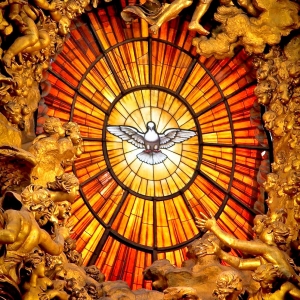
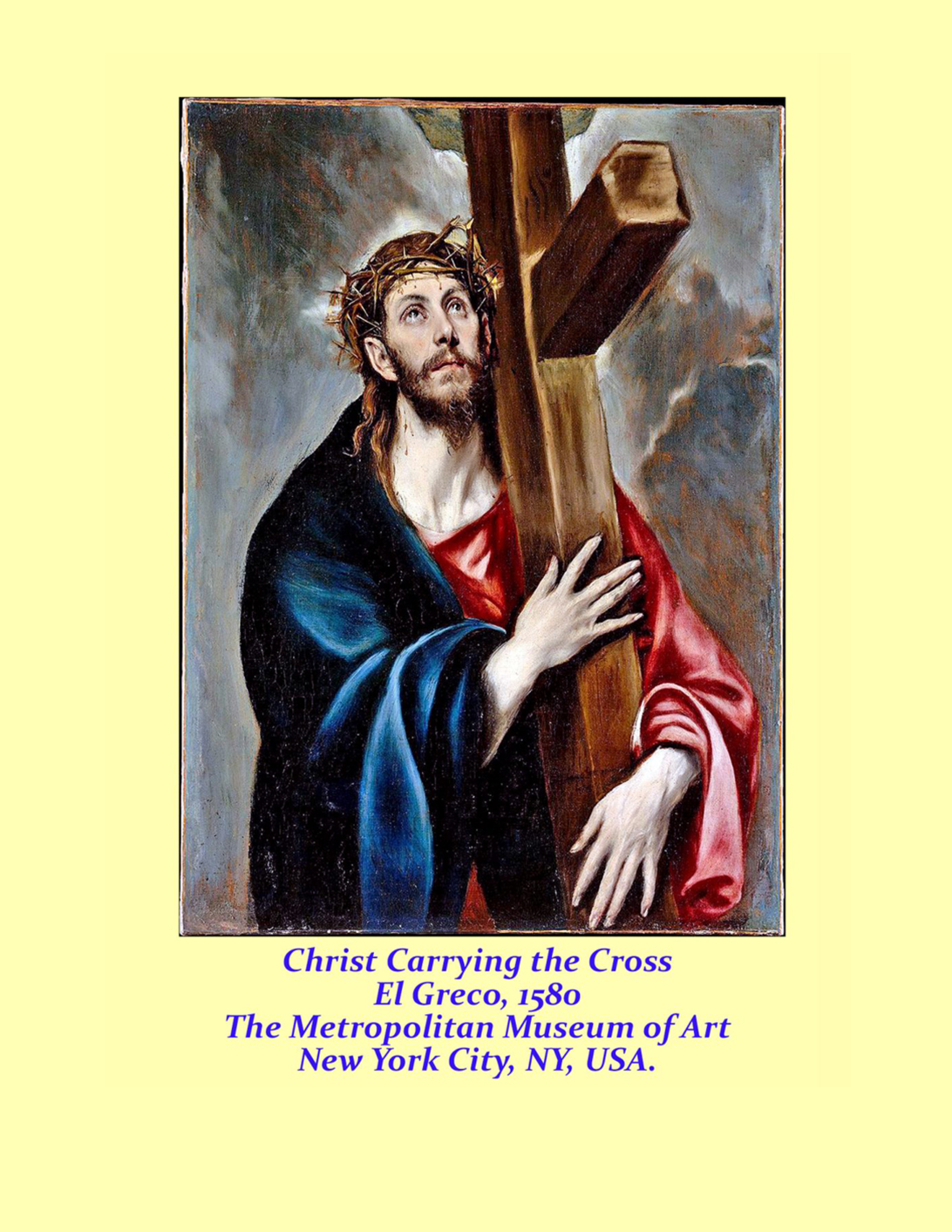

Christ Blessing (The Saviour of the World), El Greco c.1597, National Galleries of Scotland, Edinburgh, UK.
There is no one who performs a mighty deed in my name who can at the same time speak ill of me. For whoever is not against us is for us. Mark 9:39-40.
Click here to read today’s Sunday Mass Readings.
Click on words highlighted in red for further information.
I grew up in London many years ago. At that time it was pockmarked with bomb sites galore, there was very little money to spend on anything except essentials, and it is a wonder how my mother, and the millions like her, managed to bring children up at all. But my childhood was additionally difficult in that I was Catholic in a predominantly Protestant country. I felt this especially on Ash Wednesday. I had that black mark on my forehead (and no-one else did at that time) and had been told it was NOT to be removed (mortal sins flew around in those days like leaves in autumn) and so I had to endure grown-ups looking at me as if in pity because I had a mother who didn’t care, who let her son out with a filthy face. It was agony. But at least I had the consolation knowing that they were all going to hell because they weren’t Catholic! Except my Protestant mother, of course. It was one of the givens back in those days. I’m sure it wasn’t strict church teaching, but there was (as far as I could tell at the age of 10) a widespread acceptance of that belief. There were certainly echoes of it even in pontifical letters. Pope Pius XI, for example, responding in 1928 to the ecumenical movement which was then gaining ground, had this to say in his encyclical Mortalium Animos:
Let, therefore, the separated children draw nigh to the Apostolic See, set up in the City which Peter and Paul, the Princes of the Apostles, consecrated by their blood; to that See, We repeat, which is the root and womb whence the Church of God springs, not with the intention and the hope that the Church of the living God, the pillar and ground of the truth will cast aside the integrity of the faith and tolerate their errors, but, on the contrary, that they themselves submit to its teaching and government.
There was little room for movement there, and needless to say, not one non-Catholic group responded to the Pope’s invitation. I wonder what Pope Pius would say about this gathering in the shadow of the cathedral at Assisi in 2016, sponsored by Pope Francis, with, among many others of Abrahamic and non-Abrahamic faiths, Bartholomew, the Orthodox Ecumenical Patriarch, Aphrem II, Syro-Orthodox Patriarch and Justin Welby, the Protestant Archbishop of Canterbury, praying for world peace:

So we seem to have come quite far in recognizing that God can be worshipped in many different ways, not just “our” way, even if there are doctrinal differences with others. Today’s second reading from the letter of St. James seems to condemn those who lord it over lesser mortals, perhaps in some way condemning those who stand in power or judgment over others who have done no wrong yet suffer at their hands. Indeed Jesus seems to be especially harsh on those who force others to act, for example, against their consciences. Remove from yourself, he seems to say, those elements which, though precious to you, cause suffering in others. He even seems to say that hell awaits such perpetrators (Gehenna being an image of hell, the name taken possibly from the Hinnom Valley outside Jerusalem, where the city garbage was once incinerated and child sacrifice once conducted). So maybe intolerance can be reckoned as utterly condemned by the Lord, hence along with it, racism, discrimination, sexism, homophobia, xenophobia, ageism, and all the other unhappy examples of my way or the highway. Note that the Lord himself practiced what he preached, helping the Roman centurion (who would have encountered hatred from the Hebrews over whom he ruled), who appealed for help for his servant (Matthew 8:5-13), talking to the Samaritan woman, considered a heretic, (John 4-26) and even to a pagan woman whose daughter was, in her words, possessed (Matthew 15:21-28) and of course promising the repentant thief crucified with him that he would be with him in Paradise, relayed in three gospels (Matthew 27:38, Luke 23:32-43 and Mark 15:27). So, sinners, the despised, with women, to the Lord these were people crying for help, and he recognized their suffering, in one way or another. It mattered not what they were, it was WHO they were! And there is our example of simple kindness, acceptance and warmth which we are all encouraged to reflect. Let us all pray that we are indeed capable of such acceptance.

Peter and the others refusing to enter the house of Levi the tax collector when Jesus had dinner with him and his friends. Levi was an excommunicated Jew who collaborated with the pagan Romans. A Jew who entered his house would become ritually unclean. Yet Jesus entered his house and dined with him. Levi became Matthew and followed Jesus thereafter. Zeffirelli (brilliantly) has Jesus tell the story of the Prodigal Son here, with Levi the prodigal, and Peter the outraged older brother. Jesus of Nazareth 1977, Directed by Franco Zeffirelli.
IF YOU LIKED THIS REFLECTION, PLEASE LET OTHERS KNOW.
Reflections on next Sunday’s Mass Readings will be posted on Wednesday.
Please send your reactions to: RogerJohn@aol.com
© SundayMassReadings.com
Discover more from Sunday Mass Readings
Subscribe to get the latest posts sent to your email.
 Sunday Mass Readings