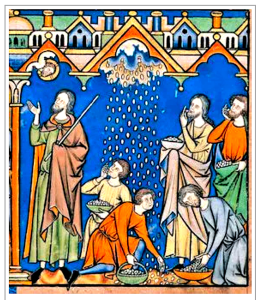
The Manna from Heaven, The Crusader Bible MS M.638, fol.9v c.1254, The Morgan Library and Museum, New York City, USA.
Click here to read today’s Sunday Mass Readings.
Jesus said to them, “I am the bread of life; whoever comes to me will never hunger, and whoever believes in me will never thirst.” John 6:35.
Click on words highlighted in red for further information.
Firstly, what precisely is manna? We have heard about it from childhood, the mystic food from heaven which kept the Hebrews alive in the 40 years exile in the desert after their grumbling and moaning that they would have been better off if they had stayed slaves in Egypt. God was not happy with them: “For forty years I was wearied of these people. I said : “Their hearts are astray, these people do not know my way. Then I took an oath in my anger: ‘Never shall they enter my rest'” (Psalm 95, vv.10-11). But God did respond, even though angry with them, hence the manna from heaven (and the quail which also arrived). But what is it? Well there has been some argument about that question for a long time. The generally suggested explanation is to do with (forgive this) mealybugs, trabutina mannipara. This insect, found in the Middle East, excretes a sweet substance which can be consumed and may well be the manna collected by the Hebrews. In today’s first reading, Moses said to them that “This is the bread that the LORD has given you to eat” even though it was, apparently, nothing like our idea of bread. But bread seems to be the overall theme for today’s readings, with the second reading talking about accepting a new self, taking on new spiritual food, perhaps, linking that in with Jesus’ statement that he is the bread of life. So variation in the concept of life-giving food, in varied forms, which will lead to eternal absence of hunger and thirst, is today’s theme.
Which got me to thinking about bread. It is found throughout the world. Every culture on earth has some form of basic bread. It appeared early in the beginning of the earliest civilization, perhaps 14,000 years ago or even more. That would make it even earlier than agriculture. So in some way, human development was founded, to some extent, on the knowledge of how to make bread. Not surprisingly, it is closely linked to religious ritual. The Greek goddess Demeter was the patron of the harvest, grains and agriculture, and, coincidentally though not surprisingly, she is one of the Twelve Olympians. She is Ceres in the Roman pantheon. Sufism, a tradition within Islam, holds that our need for basic bread parallels the spiritual need we have for divine sustenance. Judaism is strongly linked to bread especially the unleavened bread of the Exodus. Christianity, of course, is familiar with today’s gospel statement, and above all, with the bread of the Last Supper, hence at every Mass. So what has always been a basic staple of physical life became a basic staple of the spiritual life by the Lord: “I am the bread of life” which has parallels in other spiritual traditions. So we conclude with the Lord’s final words, “whoever comes to me will never hunger, and whoever believes in me will never thirst.” It sums up the Christian life. Taking the Lord into ourselves, not simply figuratively but literally in the Eucharist, we carry an internal light which will guide us in the way of the Lord. Like any light, it needs continual refreshment, Mass on Sunday or more frequently, so that it stays bright, unwavering and sure. It shows the way, the truth and the life as Jesus says elsewhere (John 14:6). With that guidance, we are surely on the right pathway to heaven.
There is at least one other dimension which can be mentioned here. Throughout the generations before the arrival of the Son of God, God the Father gradually revealed essential qualities which revealed the character of God – who was God? One of the very first qualities was power, essential in the early days of civilization when divine power was constantly being requested by those early civilized humans who had little control over the environment in which they lived. But what an early revelation that was! God revealed divine power not by conquering enemies or banishing hurricanes, but by fulfilling a promise to the childless, 100-year old Abraham that he would have a child by his 90-year old wife Sarah! Isaac was the promised result! Other divinely revealed qualities through the Old Testament were listening, forgiving, love of freedom, mercy, loyalty and, finally, personal relationship. That last was, perhaps, the greatest revelation. The gods of the pagans were more often than not infinitely superior to humans; in Mesopotamia, “a household may own slaves, all citizens are slaves to the king, and all humans are slaves to the deities” (The Origins of Social Justice in the Ancient Mesopotamian Religious Traditions). With the Abrahamic God, however, this was clearly NOT the case. Look at the third chapter of the Book of Exodus. Moses, in exile and while tending sheep, saw a burning bush which the fire was not consuming. Approaching it, he heard the voice of God calling him by his name. God gave Moses a command, to free the Hebrew people from slavery and lead them to a promised land. Moses wanted a little more than this: “When I go to the Israelites and say to them, ‘The God of your ancestors sent me to you,’ they will ask me, ‘What is his name?’ So what can I tell them?’ God said ‘I AM WHO AM, You must tell them: ‘The one who is called I AM has sent me to you’ (Exodus 3:13-14). This was the first time ever that God had revealed the Divine Name to anyone. To do that meant a relationship had been established between Moses – representing all the Hebrews – and God, very different from any other human-divine interaction ever. When Jesus walked our earth, he revealed exactly the same divine qualities as revealed through the centuries by God to the prophets and people. But, especially with relationship, and to an infinitely higher level. At the Last Supper, Jesus took lowly, every-day bread, gave thanks for it, blest it and gave it to his disciples saying “Take and eat, this is my body”. Hence the relationship between the divine and Christians has become utterly intimate, utterly personal. Think about it: a union such as that could not be more personal – the Lord and each of us become one! We incorporate the Lord, the consecrated bread, into our very selves. The relationship is total! So a truer claim could not be made: “I am the Bread of Life”!

This my Body…. Juliadangarrison.com
PLEASE LET OTHERS KNOW OF THIS REFLECTION OR, PERHAPS, FORWARD IT TO THEM.
THANK YOU.
Reflections on next Sunday’s Mass Readings will be posted on Wednesday.
Please send your reactions to: RogerJohn@aol.com
© SundayMassReadings.com
Discover more from Sunday Mass Readings
Subscribe to get the latest posts sent to your email.
 Sunday Mass Readings