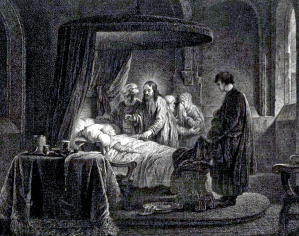
 The Resurrection of the Daughter of Jairus, Gerbrand van den Eeckhout 1767, The British Museum, London, UK.
Click here to read today’s Sunday Mass Readings.
So [Jesus] went in and said to them, “Why this commotion and weeping? The child is not dead but asleep. And they ridiculed him. Mark 5:39-40.
Click on words highlighted in red for further information.
Note the curious parallels in the longer gospel today. The woman with the hemorrhages had suffered with them for 12 years. The daughter of Jairus was 12 years old. Jesus calls the woman “daughter” and the little girl is clearly Jairus’ daughter, but this is the one and only time Jesus calls anyone “daughter”, the same in the three synoptic gospels. So the intriguing question is, what does it mean? Note that the woman, suffering from the unnatural flow of blood, would be considered unclean and unworthy of living in the community – excommunicated, in other words, not unlike lepers. Remember there was an ancient belief back then that such individuals were being divinely punished as they were considered sinful in some way. Touching the hem of Jesus’ garment would make it unclean – but she was prepared to risk it; being discovered, however, was a very unpleasant surprise, hence the “fear and trembling” she exhibited. The community would turn on her as a result; remember anyone or thing she had touched would have been rendered ritually unclean. But Jesus knew power had gone out of him – to cure her. So he turned to find out who was responsible. Of course, far from condemning her, his compassionate response was, “Daughter, your faith has saved you. Go in peace and be cured of your affliction”. So one action resulted in a new life for an outcast, and the other, a new life for an infant, both of them owing their new life to the Lord, now his daughters.
Two other interesting points in today’s gospel. One, that Jesus knew the girl would be hungry, and told her parents to give her something to eat. People who are the happy recipients of a curing miracle, as recognized by the church, are frequently ravenously hungry (search for “hungry” or “hunger” in that long article from the National Library of Medicine on miracles). Not surprising as their bodies, now cured, have been starved of nourishment for a long time. The other point is the Aramaic quotation “talitha koum” (little girl, get up) as quoted in Mark’s gospel. Although the gospels of Matthew and Luke also talk of this miracle, only Mark quotes Jesus’ actual words in the language he spoke. It can also be translated “little lamb, get up” something you would expect of The Good Shepherd! As Mark is considered to be the earliest gospel to be written down, it is also closest to the actual event, and might well be quoting a witness to the event.
Now, finally, consider the people involved in this gospel passage. Jairus was a synagogue official, hence a leader of society, and presumably wealthy. The outcast woman was from the lowest of the low, unclean and no doubt familiar with rejection in all its terrible forms. Yet Jesus treated them equally, with compassion and care. He loved both ends of this societal spectrum. No-one is excluded from Jesus’ outstretched arms. We are all welcome: no exclusions anywhere. If you are ever tempted to think of yourself as too bad, awful, sinful, rejected, or anything like that, it is your own judgement, not the Lord’s. Jesus never rejected anyone – including those who killed him. All are welcome, anytime, anywhere. It is in his loving embrace that we are cured, restored to the dignity of God’s children.

The Sacred Heart of Jesus, Responding to Love with Love.
PLEASE FORWARD THIS REFLECTION TO THOSE YOU THINK WOULD APPRECIATE IT.
THANK YOU.
Reflections on next Sunday’s Mass Readings will be posted on Wednesday.
Please send your reactions to: RogerJohn@aol.com
© SundayMassReadings.com
Discover more from Sunday Mass Readings
Subscribe to get the latest posts sent to your email.
 Sunday Mass Readings