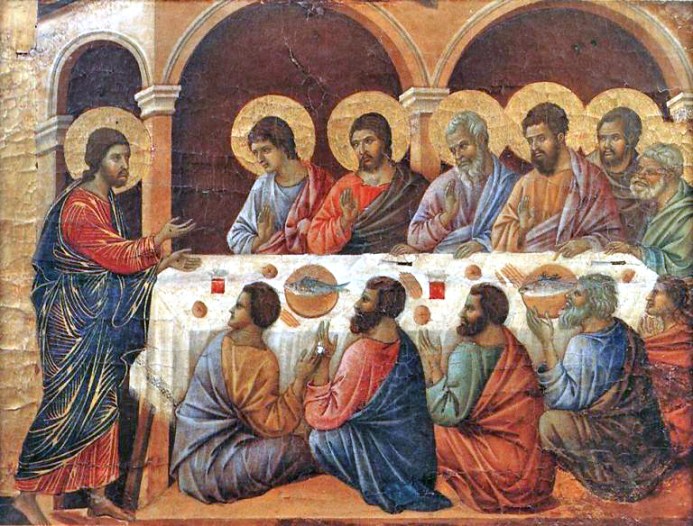
 Appearance While the Apostles are at Table, Duccio c. 1311, Museo dell’Opera del Duomo, Siena, Italy.
Click here to read today’s Sunday Mass Readings.
He is expiation for our sins. 1 John 2:2.
Click on words highlighted in red for further information.
Click here to reflect on a Passiontide hymn which seems linked to today’s first reading.
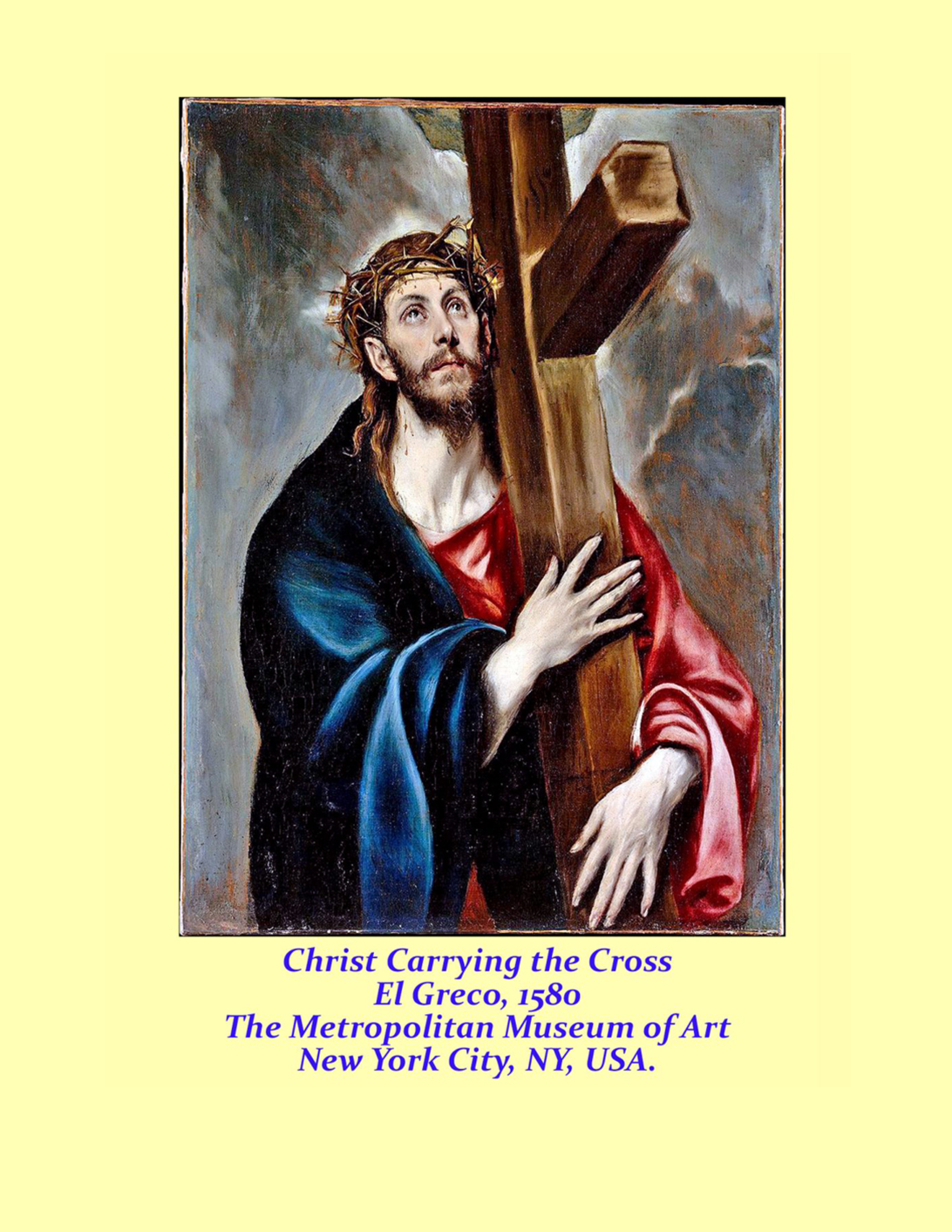
I chose a line from today’s second reading: “He is expiation for our sins” because it has one of those ecclesiastical terms (expiation) not used in everyday speech, and hence a bit of a challenge to understand. It means that we offer to God something to reduce the justifiable anger God has when we deliberately and cold-bloodedly go against his strongest wish – that we be good people, that we obey the Lord’s command to love one another. Well, too often we do not. Saying sorry is easy. Shouldn’t we do something to prove our sorrow, as it were? But someone has already done that for us in the most dramatic, devastating and total way possible – Jesus offered himself to his father for forgiveness of our sins. That’s what the Passion was all about. He had done nothing wrong – ever! Yet he was taken for a fraud, ruined the people’s incorrect hope that he was to be the final victor over the Romans, and be hailed as the new King David. That did not happen, so he was murdered, saying nothing against his killers, indeed, forgiving them. This was the expiation of the Lord, a sacrifice which could not be rejected by God, as many of ours probably are, with their hidden elements of self-justification. For all that, and much more, Jesus freely offered his very life to his Father as payment – expiation – for our sinfulness. And today’s gospel puts all that in total perspective. No self-glorification of any sort, just a simple, direct and human moment, the risen Lord saying “have you got anything to eat?” Having wiped out the lamentable history of evil with his sacrifice and invited all of us to become children of God, he simply settled down to a healthy fish meal. Then he stated “Thus it is written that the Christ would suffer and rise from the dead on the third day and that repentance, for the forgiveness of sins, would be preached in his name to all the nations.” He, the sinless one, gave himself as an offering to God for the sinfulness of all of us, wiping our slates clean, as it were, simply because he loves us.
It is clear, therefore, that the forgiveness of sins is the central theme of today’s readings. Sin is not a topic that comes up in everyday speech, but it is mentioned at the beginning of every Mass: Let us call to mind our sins…” with the object of asking forgiveness of the God of forgiveness and thereby worthy to celebrate the goodness of God together. The meaning of the word “sin” is intriguing. It is thought to come from the Old English synn, syn meaning a violation of divine law, an offense against God; moral wrongdoing, also injury, mischief; enmity, feud; guilt, crime, misdeed. Hence anyone guilty of such acts is a sinner. And Jesus is the only person who ever lived who committed not a single sin; if each of us looks clearly into our own thoughts and actions, we will find sin, like sand in a fine engine. Sin degrades us and we become less human. So the often offered excuse “I’m only human” is to degrade all of us. We are not made for sin; we are made for holiness. And Jesus’ sacrifice was to free us from that burden of heavy conscience, guilt and self-loathing: Jesus loves us all despite our wayward nature. But we do have to acknowledge that we have done wrong, and ask forgiveness, and, as it was said in the old days, make a “firm purpose of amendment”, that is to say, make every effort not to sin again. Anything other than that is to make ourselves less than human… We have the responsibility of upholding the dignity of the human person, and never contributing to its debasement, beginning with ourselves. To have the Son of God make amends for our sins is surely sufficient grounds for us to at least attempt to not sin again. And with God’s help that should be our constant goal. There is an ancient prayer: “Lord Jesus Christ, have mercy on me, a poor sinner”. You breathe in for the first half, breathing in Jesus as it were, and out for the second half, banishing all sin with your breath. Hence a prayer with every breath.
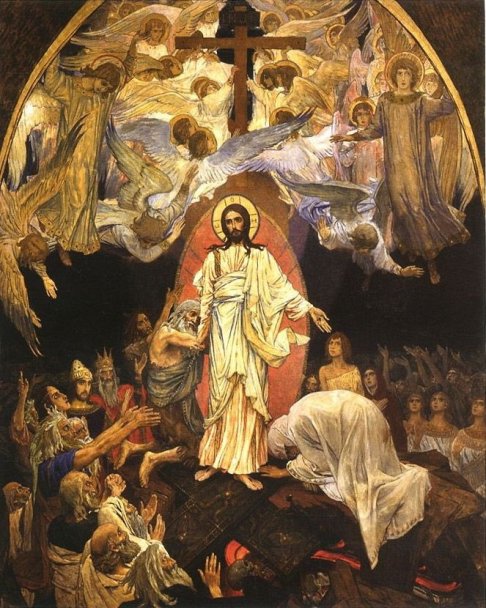
The Harrowing of Hell, Viktor Vasnetsov 1905, The State Museum of the History of Religion, St. Petersburg, Russia.
The “Harrowing of Hell” refers to the statement “He descended into hell” mentioned in the Apostles’ Creed.
PLEASE FORWARD THIS REFLECTION TO THOSE YOU THINK WOULD APPRECIATE IT.
THANK YOU.
Reflections on next Sunday’s Mass Readings will be posted on Wednesday.
Please send your reactions to: RogerJohn@aol.com
© SundayMassReadings.com
Discover more from Sunday Mass Readings
Subscribe to get the latest posts sent to your email.
 Sunday Mass Readings