
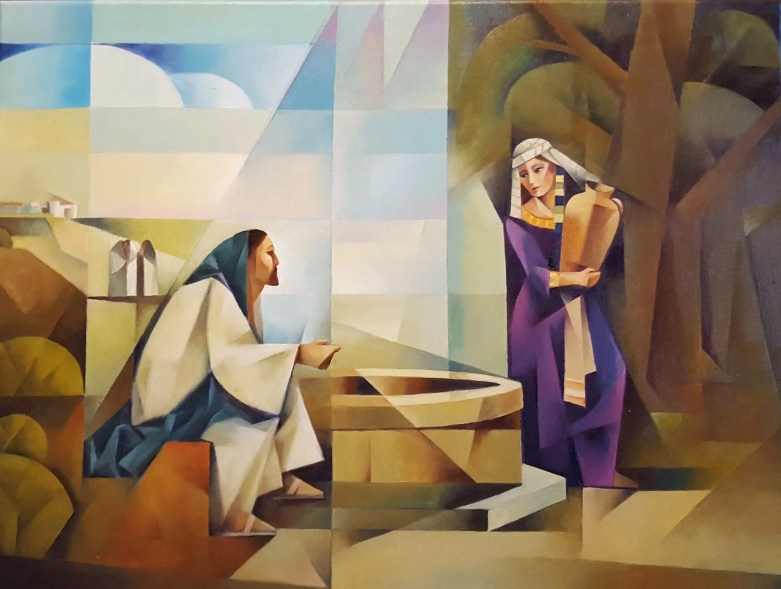
Jesus and the Samaritan Woman, Jorge Cocco, no date, Museum of Biblical Art, Dallas, Texas, USA.
Click here to read today’s Sunday Mass Readings.
These are for the Mass for those preparing for Baptism at the Easter Vigil, the “Scrutinies”.
The woman said to him, “I know that the Messiah is coming, the one called the Anointed; when he comes, he will tell us everything. Jesus said to her, “I am he, the one who is speaking with you.” John 4, 25-26.
Click on words highlighted in red for further information.
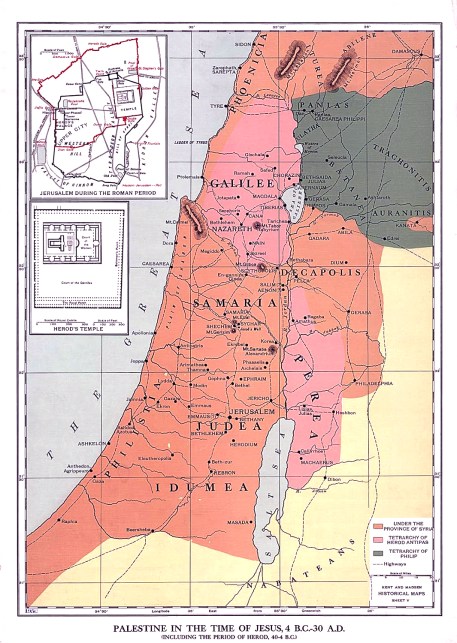
This is one of the most memorable encounters in the New Testament, also one of the most unlikely. Jesus and his disciples were traveling through Samaritan country. Now remember that there was no love lost between Jews and Samaritans. Although they were both fundamentally Jewish, the Samaritans held, for example, that the Temple of God was located at Gerizim, in their territory, whereas the Jews knew it was in Jerusalem. And just take it from there… It is safe to say that, at the very least, there were differences between them. At worst it was outright hostility. Jesus played with that, for example, with his parable of the Good Samaritan. He knew that would be provocative (and it was: his Jewish listeners almost certainly would be shocked that a Samaritan would help anybody!) but it also meant he did not share the prevailing bitterness between the the two groups. And that is seen abundantly in today’s gospel. Also remember that Jesus was traveling from Galilee in the north to Jerusalem in the south, and the Samaria was located between the two. To the east was the desert, to the west the Mediterranean Sea. Samaria could not be avoided. And, on top of all that, the Samaritan was a woman, another no no in that society: a strange man talking to a strange woman? Uh, no.
Hence the unlikely setting. Jesus’ friends had gone off to the village for supplies. The Lord stayed and rested by a well. It was, the gospel says, about noon, hence approaching the hottest time of the day. That is not the time locals go to get their water for the day and carry it back home, yet there she was, the woman. So something was wrong, and indeed there was. Jesus knew, somehow, that she had had five (five!) husbands, plus she was currently living with a sixth man who was not her husband (there are no secrets from God). Yes, she was certainly an outcast. She might have a bit of a problem even today with a history like that (and clearly not being the equivalent of a 1st century film star). Not only that but it seemed that she fancied herself as a bit of a theologian, disputing the location of the Temple in Jerusalem. Perhaps Jesus was a little stunned at this, as he launched into an apologia stating that salvation comes from the Jews, not the Samaritans, hence disputing their claims to be the true Hebrews. So Jesus takes her seriously, with a theological to and fro going on when the disciples returned and were astonished (to put it lightly) at what they found. All sorts of tabus were being broken here, with their leader in what was perhaps a heated debate. The woman was clearly very impressed with the Lord as she vanished back to the town to tell everyone about him. And she was one of the very first to whom Jesus revealed his mission, his identity, the quote from today’s gospel at the top of this page.
Clearly water is the theme today, as the first reading from Exodus also talks of water, but in a very different context. It was at Massah-Meribah that the wandering Hebrews in the desert after their release from slavery in Egypt started grumbling about many things, especially water, a prized commodity in the desert, and especially, to them, God’s seeming indifference to their troubles. Beware of “grumbling” however, especially in Scripture. It was because of this grumbling episode that the Hebrews were condemned to wander in the desert for 40 years, the length of a generation. Read this and see why. God, having rescued them from slavery expected a little gratitude; but grumbling was the result, a lack of trust that they would always have God with them.
In fact to a modern eye, all this seems very Lenten. We have the raw material, which is a lack of acknowledgement that God was, is and always will be with us, and an opportunity in this season to take a good look at that to find out any obstacle that might block our belief in that reality. God is always with us, through thick and thin, bad times and good. It’s as if God has married us! Our vows, taken at Baptism, in the waters of eternal life (hence way beyond Massah and Meribah) if we live up to them, for they give us a rock-solid foundation which will get us through any challenge. Remember Jesus’ words at the end of Matthew’s gospel: I am with you all days until the end of time. So this Lenten time is an opportunity to reflect on that promise. Do we believe it? Do we act on it? Do we trust it? What is our appropriate response? Good questions for Lent.

Sacred Waters…, Jorge C. Lucero, no date, Saachi Art.
PLEASE FORWARD THIS REFLECTION TO THOSE YOU THINK WOULD APPRECIATE IT.
THANK YOU.
Reflections on next Sunday’s Mass Readings will be posted on Wednesday.
Please send your reactions to: RogerJohn@aol.com
© SundayMassReadings.com
Discover more from Sunday Mass Readings
Subscribe to get the latest posts sent to your email.
 Sunday Mass Readings