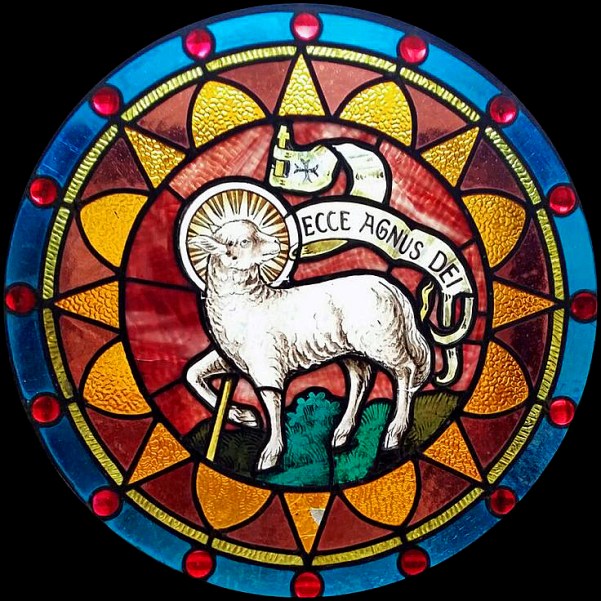
Ecce Agnus Dei (Behold the Lamb of God), unknown artist, Heritage Hall, Saint Meinrad Seminary and School of Theology, St. Meinrad, Indiana, USA.
Click here to read today’s Sunday Mass Readings.
John [the Baptist] was standing with two of his disciples, and as he watched Jesus walk by, he said, “Behold, the Lamb of God.” John 1:35.
Click on words highlighted in red for further information.
All Catholics are very familiar with the words “Behold the Lamb of God, behold him who takes away the sins of the world”. They are said at every Mass, just before communion. It could be said that they represent a final reminder of God’s love, and our own willingness to ask forgiveness for sins, before receiving the Lord. The Latin Mass states those words as “Ecce Agnus Dei…” and many of us will be familiar with that, found as mosaics or artwork in many Catholic churches to this day, and also in the picture above. John the Baptist was the first to confer that title on Jesus, the Lamb of God. So far, so good. But why “lamb”? It’s not the first image that occurs to one when seeing a holy man. In fact, it is strange applying this to any man. What was in John’s mind?
Not being a sheep farmer or anything like it, I rely like many others on the Internet. There I found this. You will find there a picture of utter innocence, energy and love of life, all of which certainly applies to our Savior. Then there is the lamb of the Passover. You will recall God’s instructions to Moses on the night before the death of all first born males, the 10th plague: An unblemished lamb was to be killed and its blood spread on the doorposts of all the Hebrew homes. In that way the Angel of Death would pass over their houses, hence protecting life. But also, they must eat the prepared lamb in readiness for their journey to the Promised Land, beginning that night, as sustenance. And finally there is the image of the lamb from Isaiah: “He was led like a lamb to the slaughter. And as a sheep is silent before the shearers, he did not open his mouth.” (Isaiah 53:7). Remember that many lambs were slaughtered in the Temple in Jerusalem as an offering to God at Passover time. Indeed, it is thought that was happening as Jesus, Lamb of God, was hanging upon the cross, as Passover was beginning. Remember that the previous night, at the Last Supper, Jesus had given them his own body as sustenance, under the guise of unleavened Passover bread, for the journey through this life. The parallels are simply breathtaking.
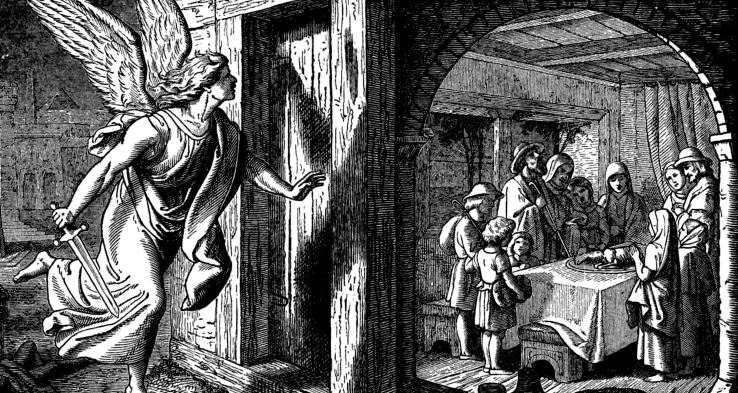
The Angel of Death and the First Passover, Foster 1897, Bible Pictures and What They Teach Us.
But the other readings follow a different route. The first reading, from the first book of the prophet Samuel, concerns his vocation, his literal call from God, which is the meaning of the word vocation. And the second reading, Paul writing to the Christians in Corinth, is a blueprint on how to run our lives, and so be open to God’s call, and to conduct ourselves based on the model of the life of the Lord himself. So today’s readings, taken together portray the perfect Christian life, well-lived, vibrant with goodness and purity, open to God’s call to each of us, and centering on the source of all life and happiness, the Lamb of God himself.

The Adoration of the Mystic Lamb, Hubert and Jan van Eyck 1432, St. Bavo’s Cathedral, Ghent, Belgium.
PLEASE SEND THIS REFLECTION TO THOSE YOU THINK WOULD APPRECIATE IT.
THANK YOU.
Reflections on next Sunday’s Mass Readings will be posted on Wednesday.
Please send your reflections to: RogerJohn@aol.com
© SundayMassReadings.com
Discover more from Sunday Mass Readings
Subscribe to get the latest posts sent to your email.
 Sunday Mass Readings
