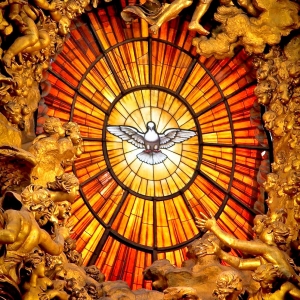
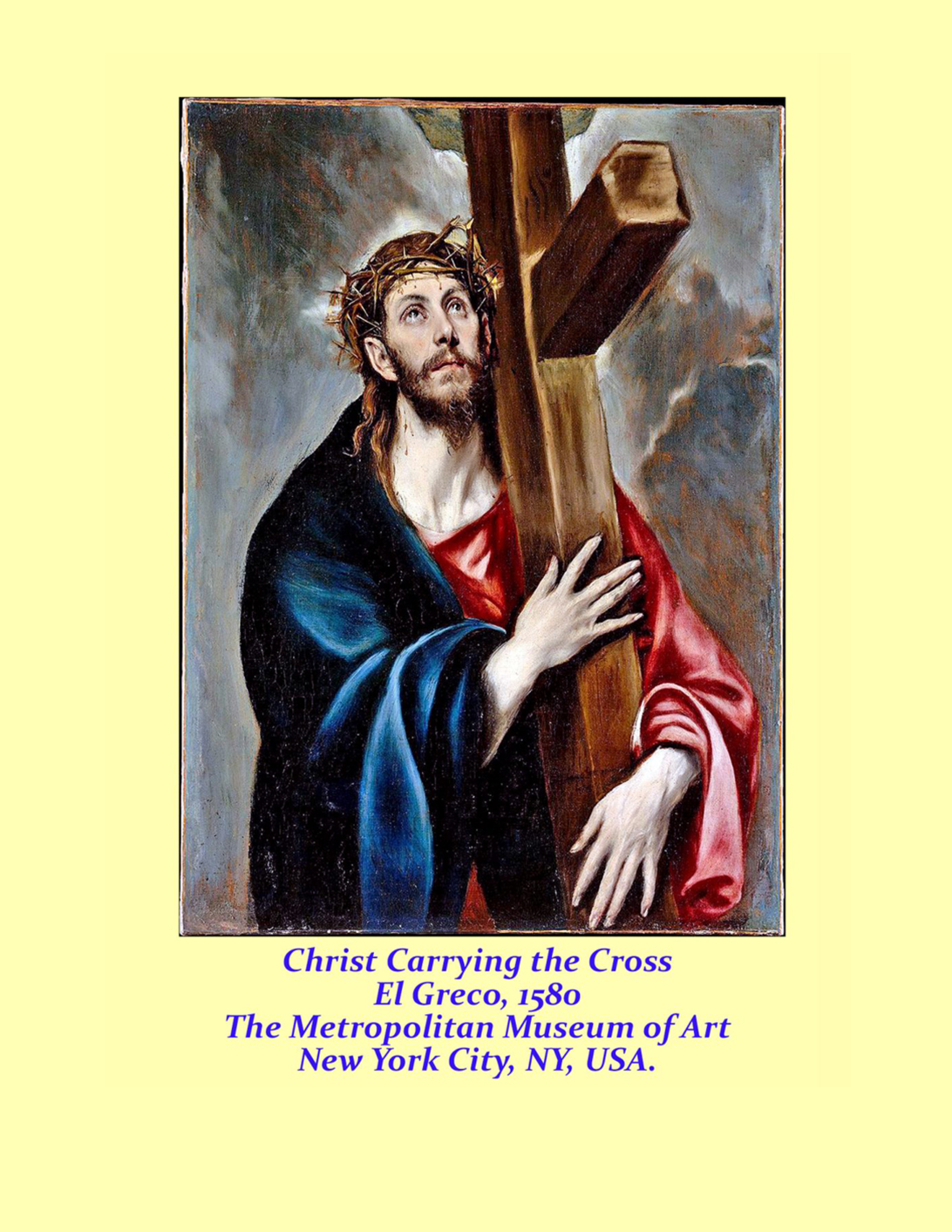

The Adoration of the Magi, da Fabriano 1423, Uffizi Gallery, Florence, Italy.
Click here to read today’s Sunday Mass Readings.
[The Magi from the east] prostrated themselves and did him homage. Then they opened their treasures and offered him gifts of gold, frankincense, and myrrh. Matthew 2:11.
Click on words highlighted in red for further information.
That word, epiphany, is possibly a word most of us are aware of, but might have a problem defining. Yes, for many it signals the day when Christmas decorations are taken down. For others, it means the visit of the three kings to the newborn Christ child. And for others, I suspect, it is a total mystery. But today the universal church celebrates it as part of the entire Christmas event when God became one like us in all things but sin. It is “Little Christmas” to many people. So the word epiphany has several definitions depending on whom you ask. The meaning at root, however, is both simple and complex all at once. It comes from Greek, ἐπιφάνεια, epiphaneia, an appearance, and, for the ancient Greeks, a manifestation of their gods. So from the start the word seems to have taken on a value beyond the normal world. In literature it often means that the main character (or someone else) had had a moment of insight that had not been experienced before. In today’s gospel all of these apply directly to those men from the east who entered the place where Jesus was born in Bethlehem to witness the culmination of their journey. They were from the east, hence non-Jewish. They were wealthy, as seen from the three gifts they presented to the Holy Family. And they were wise enough to realize that something momentous had happened in that land which was foreign to them. To them this was an epiphany, the manifestation of the divine to mere humans. For us, it means that all people, Jews and Gentiles, old, young, gay, straight, dark-skinned, light-skinned, male, female, theist, atheist, everyone is welcomed into the arms of the Savior. No exceptions.
And some more interesting notes here: there is no mention of how many Magi arrived. The assumption has always been three, from the number of gifts – but that is an assumption: there are traditions which number them at 12. Also, the tradition that they were kings is also questionable. We have even given them names: Caspar, Melchior and Balthasar! But the gospel simply calls them Magi, with no personal names anywhere. What does that mean? The original Greek word is μάγοι, magoi, which is not Greek but Persian, maguŝ. Going further back, this term refers to the priestly caste in Persia into which Zoroaster (sometimes spelled Zarathustra) was born. I will say but one thing here: he propagated the first monotheistic belief in the world. He still has followers in the world today. So it is almost as if the two monotheistic religions, Zoroastrianism and Judaism, seen when the shepherds and then the wise men came to worship the newborn Jesus, were uniting in adoration of the God-man. That is a true epiphany. Also, as an aside, it is no coincidence that Magi and magic seem almost the same. For more, look here.
So today’s feast symbolically sees Jews and Gentiles, in other words the whole world, uniting in recognizing and accepting Jesus as sent by God to redeem the world. The three gifts allow us to make that claim. Gold, or wealth, state that Jesus is king, sovereign, of the world. Frankincense states he is the supreme priest, the intermediary between us and God, and myrrh, used, among other things, to prepare a body for burial, meaning Jesus is also victim or sacrifice. Jesus’ whole vocation is therefore revealed in these three offerings. And it was three Gentiles who revealed the identity and the life-work of the babe-in-arms. That is an epiphany. So the Magi represent us making a long and undoubtedly hazardous journey to reach the source of that magical (as it were) star which led them to the source of life, light and love. They made it, and so can we, buoyed up by faith, hope and love, as they undoubtedly were.
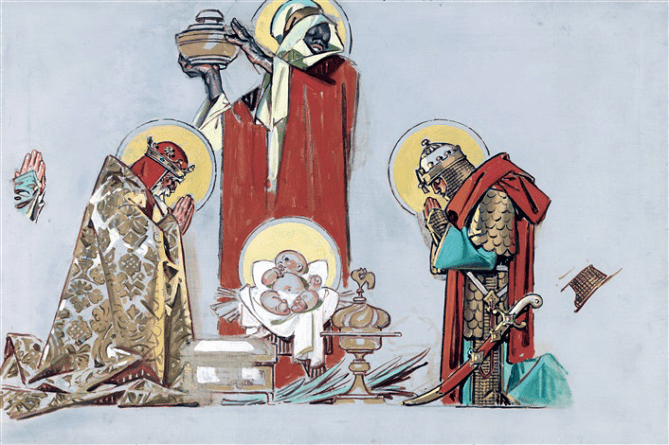
The Three Wise Men, Leydendecker c.1900, private collection.
PLEASE SEND THIS REFLECTION TO THOSE YOU THINK WOULD APPRECIATE IT.
THANK YOU.
Reflections on next Sunday’s Mass Readings will be posted on Wednesday.
Please send your reflections to: RogerJohn@aol.com
© SundayMassReadings.com
Discover more from Sunday Mass Readings
Subscribe to get the latest posts sent to your email.
 Sunday Mass Readings