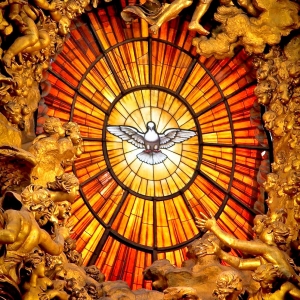

Parable of the Talents, Holy Trinity Orthodox Church, Parma, Ohio, USA.
Click here to read today’s Sunday Mass Readings.
A man going on a journey called in his servants and entrusted his possessions to them. To one he gave five talents; to another, two; to a third, one, to each according to his ability. Matthew 25:14-15.
Click on words highlighted in red for further information.
We have today another gospel parable which, I believe, is all about the gifts God has given us to get through life according to God’s divine plan. Last week it was the virgins with their lamps, some fueled up, others empty when they should have been fueled, and I suggested the lamp represented the gift God gives everyone to light his/her way through life, ending up in the bridegroom’s banquet. The fuel in them is the effort we have done through life to make sure the lamps stay lit and functioning. Today we have a much more familiar parable concerning talents, which was the actual Roman money of the day, but is where we get our modern, different, idea of a talent. In Jesus’ day a talent was a weight, or could be an amount of money, and a significant amount, some scholars saying over 50 lbs of silver! So the meaning is not clear, so perhaps it was the perfect word for Jesus to use in his parable. It was through this story that the word came to mean an ability or skill, our modern understanding. And the finale of both this parable and last week’s is the same – reward or condemnation and punishment. Jesus is really really strict about that. It is at our peril that we ignore or forget the gifts we have been given. Every single human being has been gifted by God. Some have more, some have less – that’s life. But we all have them. It’s what we do with them that counts. In today’s parable, an employer went away having given his employees different amounts of money to keep safe. Two employees doubled the value of the master’s money through careful management, even though they were given different amounts. The third employee buried it and returned it to the employer essentially untouched. The first two were rewarded: “Come, share your master’s joy”. The third was utterly condemned: “You wicked, lazy servant!” Two used their talents in the best way; the third ignored his talent and left it undeveloped. The lesson is crystal clear. Our gifts are given to us on the understanding we develop and use them!
Education is probably the best way to reveal what our talents are. I am sure each one of us got a decent idea of what we are good at and what we are hopeless in when we were young. I was hopeless in sport (the only soccer goal I ever scored was into my own goal… After that I was toxic when it came to choosing teams. My talents lay in other, very different, fields…). I used to ask my students when still teaching if they could remember what they were complimented on before the age of ten. A difficult thing to ask, but it provided some insight into possible areas of talent. I even set them a task, which was to interview their parents and other grown-ups about their work. It was to find out who got the greatest satisfaction and happiness in what they did for a living, and, more importantly, why they found satisfaction there. A strong majority were, indeed, happy in their work. And the main reason? Because they said they were helping other people. That was the heart and soul of their work, and based on today’s gospel, who would be surprised? And that, I think, is the reason for Jesus’ condemnation of those who have ignored or rejected the divine gifts they have been given. Look at the consequences of not developing God’s gifts:
– the useless servant is thrown into the darkness outside.
– where there will be wailing and grinding of teeth.
– where the the door is locked allowing no-one else in (from last week’s gospel).
– where the Lord does not know you (from last week’s gospel).
There seems to be a case for saying that the failure to develop God’s gifts brings down one of Jesus’ greatest condemnations. Add that to the lack of generosity as seen in the different parable of the ungrateful servant (Matthew 18:21-35), forgiven a great debt but persecuting another who owed him a much smaller debt, was then handed over to the torturers until his original debt was repaid (see the gospel of 17 September 2023). It seems we are at the heart of God’s nature here: be generous in all things, including how we identify, accept and generously or wholeheartedly develop the gifts God has given each of us to help others. Without that attitude we will surely stand condemned before the Lord, and it will absolutely be our own fault. With the approach of Advent and the feast of Christmas almost upon us, we are near the perfect time to demonstrate such qualities and attitudes fully.

Helping Hands, Good in Every Grain, Onyario, Canada.
PLEASE MAIL THIS REFLECTION TO THOSE YOU THINK WOULD APPRECIATE IT.
THANK YOU.
Reflections on next Sunday’s Mass Readings will be posted on Wednesday.
Please send your reflections to: RogerJohn@aol.com
© SundayMassReadings.com
Discover more from Sunday Mass Readings
Subscribe to get the latest posts sent to your email.
 Sunday Mass Readings