
The “Tribute Penny” or δηνάριον (dēnarion), the probable coin shown to Jesus in today’s gospel, bearing the likeness of the Emperor Tiberius.
Click here to read today’s Sunday Mass Readings
Knowing their malice, Jesus said, “Why are you testing me, you hypocrites? Show me the coin that pays the census tax.” Matthew 22:18-19.
Click on words highlighted in red for further information.
We are now reading from the 22nd chapter of Matthew’s gospel. Clearly, from today’s gospel, Jesus by now had few friends among the pharisee governing class. This is clear from the deadly question they threw at him. It was a double-edged sword, damned if he did and damned if he didn’t. What does that mean? They asked him an apparently innocent question: “Is it lawful to pay the census tax to Caesar or not?” Had he answered “yes, it is lawful”, he would have been denounced as a collaborator of the Romans, supporting a pagan, uncircumcised, false idol-worshipping authority and consequently not as a true, Jewish, believer. Had he said “no”, he would have been denounced to the Romans as a dangerous rebel flouting the Roman law, clearly to be put down. His brilliant response was classic, even invoking the Jewish abhorrence of images when he asked them to identify the image on the coin (a denarius, called such in the Greek original, a coin showing the Emperor Tiberius as shown above). Clearly, then, he said, it belonged to the emperor, as his image was engraved on it! As the saying goes, they were hoist on their own petard!
Today’s other readings require some mind-bending to link them together. In the first reading, Cyrus the Great was King of the Persians who conquered the Babylonians in 539BCE. They were the people who had conquered the Hebrew people in 587BCE and exiled them to Babylon. Unlike them, Cyrus permitted subjugated people to return home if they desired. Hence, from that moment, the Jews considered Cyrus to be God’s envoy, the one prophesied by name over 100 years earlier by Isaiah 44:24-48. So, even though he too was in the eyes of the Jews a pagan unbeliever, he was, unlike Tiberius, an unwitting agent of God and praised as such in today’s first reading.
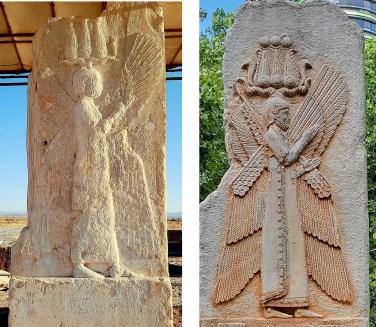
King Cyrus the Great, relief in the residence of Cyrus in Pasargadae, Iran. Reconstruction located in Sydney Olympic Park, Sydney, Australia.
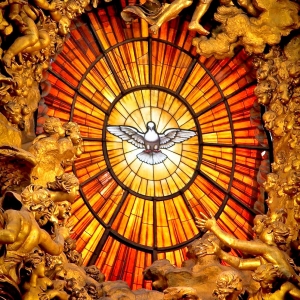
The second reading, where Paul was writing to the new Christians in Thessaloniki, “brothers and sisters loved by God” (just as Cyrus was) “….our gospel did not come to you in word alone, but also in power and in the Holy Spirit and with much conviction”. That possibly suggests that God sometimes seems to prepare unbelievers for the revelation of truth, a thought perhaps included in Karl Rahner’s controversial concept of the “anonymous Christian”. Is it possible that those first Christians had been prepared by God to receive the Word from God’s servant Paul? It is a comforting thought that God would be so active in the world that many begin to think and act in ways acceptable to the divine majesty, even though they might not be aware of the actual guidelines for a fulfilled and hopeful lifetime preparing for eternal happiness in the Lord. The thought of God’s Holy Spirit roaming the world searching for a receptive soul is very comforting. We are all in need of comfort and consolation, and here is the universal Spirit going wheresoever she will, hoping to find a receptive, cooperative soul open to responding positively and well, accepting the source of happiness and life.
Let’s hope.
****************************************************************************************************
************************************
*******************************************************************************************************
And now, with only the slightest connection to today’s readings, this:
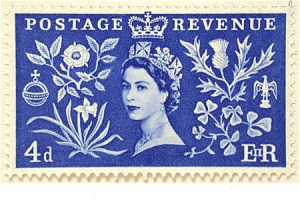
The word denarius, the coin with which Jesus responded to his critics, lived on for centuries in the coinage of the United Kingdom. Here you have a stamp issued for the coronation of Queen Elizabeth in 1953. Its value was four pence, but note it has “4d” as its value. That stood for denarius, four denarii meaning pennies or pence in this case. That all vanished in 1970, when decimal coinage came in, and with it probably the last living link to the Roman Empire disappeared. Note also, there is no country name on this stamp. As the UK created and hence was the first in the field with postage stamps, it has the unique privilege of not being required to put its country name on its stamps. But there are country symbols on this special stamp: the rose for England, the thistle for Scotland, the shamrock for Northern Ireland and the daffodil for Wales. Also there are coronation symbols, the orb symbolizing Christ’s universal rule and the ampulla containing the sacred oil of coronation anointing in the shape of an eagle, along with EIIR, Elizabeth II, Regina (Queen).
PLEASE FORWARD THIS REFLECTION TO THOSE YOU THINK WOULD APPRECIATE IT.
THANK YOU.
Reflections on next Sunday’s Mass Readings will be posted on Wednesday.
Please send your reflections to: RogerJohn@aol.com
© SundayMassReadings.com
Discover more from Sunday Mass Readings
Subscribe to get the latest posts sent to your email.
 Sunday Mass Readings