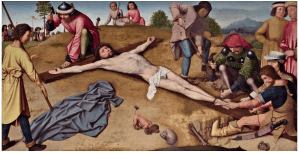
Christ Nailed to the Cross, Gerard David c.1481, The National Gallery, London, UK.
Click here to read today’s Sunday Mass Readings.
I forgave you your entire debt because you begged me to. Should you not have had pity on your fellow servant, as I had pity on you?’ Matthew 18:32-33.
Click on words highlighted in red for further information.
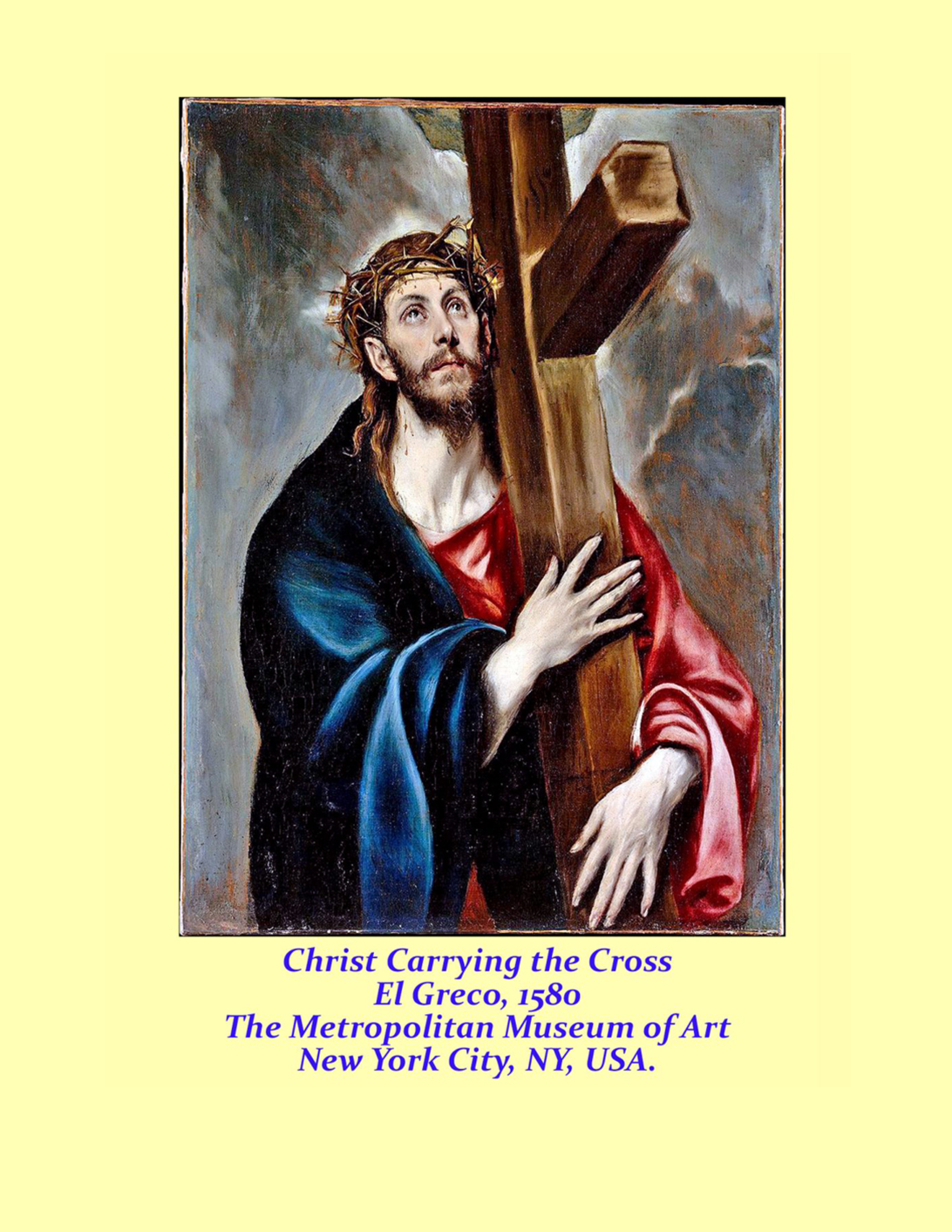
Any gospel passage with the word “forgive” in it always brings me back to Jesus forgiving the people who had crucified him, an utterly innocent victim of hatred and disordered hope. If he can forgive such people, then we should be able to forgive whatever hurt has been done to us, as it could never approach the injury done to our Savior. However, that is easier said than done. I get the impression that any forgiveness that is voiced in a court of law for someone who has done something really terrible to another person seems to make the headlines, whereas cursing, recrimination and blurted out hatred for a perpetrator are, I fear, so common as to make the newspapers only rarely. Jesus emphasizes forgiveness so strongly as to be breathtaking. Peter innocently asks if he has to forgive a hurt more often than once; say even as much as seven times? No, says Jesus; try seven times seventy times…. (strongly implying that even that number, whatever it is, might have to be surpassed). In other words, we must always forgive, no matter what (just as he did in agony on the cross). So forgiveness has to be so inbred in a Christian that it is not even a question Must I forgive? Always and under all circumstances. It is the truly Christian way.
Looking a little closer at this total blanketing (that we must always forgive, as seen in today’s gospel), there is a fascinating message from doctors, psychologists and health workers of all strains, that forgiving some hurt we may have suffered, “can reap huge rewards for your health, lowering the risk of heart attack; improving cholesterol levels and sleep; and reducing pain, blood pressure, and levels of anxiety, depression and stress. And research points to an increase in the forgiveness-health connection as you age” (Johns Hopkins Medicine). So there! Am I surprised that Jesus’ teaching coincides with this finding, from modern doctors, that it is good for you? No. And is it surprising that refusal to forgive may result in “numerous changes in heart rate, blood pressure and immune response [and] increase the risk of depression, heart disease and diabetes, among other conditions” (ibid). Persistent anger is extremely unhealthy and damaging to the body on many levels.
So does that mean forgiveness is easy to do? Well, you know the answer to that one. When is true Christianity easy? We have to work our way to heaven! It is so easy to put ourselves in Peter’s shoes when he heard that command from the Lord: seventy times seven times….“Whaaat??” Today’s first reading is crystal clear: “The vengeful will suffer the LORD’s vengeance” which seems to be another version of that very familiar saying “Vengeance is mine, I will repay” (Deuteronomy 32:35). Pretty tough on a thousand Hollywood movies if they obeyed this divine teaching. But we are not of Hollywood. We are the children of God, trying hard to obey his commands, even to the extent of swallowing our pride and crushing our anger and actually forgiving those who have wronged us. And there are many very inspiring examples as you can see here and below.

September 4, 1957, Little Rock Central High School, Arkansas, USA.
PLEASE FORWARD THIS WEBPAGE TO THOSE YOU THINK WOULD APPRECIATE IT.
THANK YOU.
Reflections on next Sunday’s Mass Readings will be posted on Wednesday.
Please send your reflections to: RogerJohn@aol.com
© SundayMassReadings.com
Discover more from Sunday Mass Readings
Subscribe to get the latest posts sent to your email.
 Sunday Mass Readings