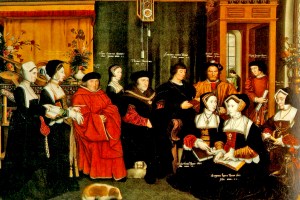
Thomas More and his Family, Lockey, after Holbein, Nostell Priory, Wakefield, U.K.
Click here to read today’s Sunday Mass Readings.
[Jesus said,] “Whoever loves father or mother more than me is not worthy of me, and whoever loves son or daughter more than me is not worthy of me…” Matthew 10:37.
Click on words highlighted in red for further information.
St. Thomas More, said by some to have been the greatest Englishman who ever lived, was beheaded on the order of King Henry VIII in 1535 for the crime of treason. Although totally innocent of the charge, he was perjured at his trial, the perjury was believed, and More was a dead man. He had refused to accede to a new law, passed by Parliament and signed by the king, that Henry VIII had legally divorced his wife, married another, and was now the head of the church in England, not the Pope. As a lawyer, More was prepared to legally accept the king’s new wife, but not that he was now the head of the church. To say that the pope was the head of the church was now treasonable under the new act, and the penalty for treason in those days was to be hung, drawn and quartered; (the king commuted that to beheading after the rigged sentence of “guilty” in court). More was a lawyer, and knew that keeping silent meant in law that you acceded to the legislation (the maxim being “Qui tacet consentire videtur” The perjury wiped that defense out). In the (Tony-winning) play, and later the (Oscar-winning) film, “Man for All Seasons”, our hero is seen struggling with his conscience, his family, his professional colleagues and even at one point, the king. He refused to bend to any of them, and on the scaffold he declared that he died “the king’s good servant, but God’s first”. And he was executed. And one wonders if today’s gospel was on his mind when he said that. At one point in the play, his highly gifted daughter Margaret urges him to sign on to the new law and its required oath and “say the words of the oath and in your heart think otherwise”. And More replies: “When a man takes an oath, he’s holding his own self in his hands. Like water. And if he opens his fingers then – he needn’t hope to find himself again. Some men aren’t capable of this, but I’d be loath to think your father one of them”. So it was to protect his conscience, to preserve his integrity, that he refused to bend to the Act. He held the Act to be repulsive and sinful, so rather than indulge in casuistry, and wriggle out of the problem dishonestly, he refused to acquiesce. If he had done that, he would not have been able to hold himself upright, a good servant of the Lord. In other words he would have become a traitor to himself and to God. Only in upholding his conscience could he continue to live as a good man. And that is what Jesus is talking about today. Be totally true to him, the God of Love itself, and your love of family, friends and all will be utterly genuine, pure and true, because that is what God wants of us because that is what God is! To love in such a way is to participate in the life of God. So we are not diminished by Jesus’ words today, but in accepting and living them, we are made manifestly Christian in all things; we are genuine, decent, good and true followers of the Lord, who commanded us to love one another, enemies and all, no matter what. In that we reflect our love of God, and God’s love of us: true, unblemished, beautiful and eternal.
The second reading today reaches deeper into this Christian mystery, “If, then, we have died with Christ, we believe that we shall also live with him”. Today’s gospel asks us to die to the conditional values of this world and take on the new life of absolute values as demonstrated by Jesus and lived, as we have seen, by Thomas More. Today, thankfully, we are usually not faced with such stark demands. We are faced with more subtle temptations, equally as deadly, such as total love of money, drugs, sex, power, etc, all capable of destroying us in one way or another. Jesus asks us to reject all that as well. In the very earliest church, baptism was more often than not an adult affair, baptizing adults who had converted. The sacrament was much more graphic in that there was total immersion in the water, symbolically stepping down three steps until completely under water, then stepping up three steps, hence symbolically dying to the things of this world, and rising to the new life in God. All sins washed away, a new life of love of God and others forever. And that set the tone for the new Christian’s life! Consequently, as today’s reading says, we “must think of ourselves as dead to sin and living for God in Christ Jesus”.
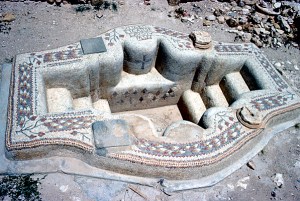
6th Century Byzantine Baptistry, Sbeïtla, Morocco.
PLEASE FORWARD THIS WEBPAGE TO THOSE YOU THINK WOULD APPRECIATE IT.
THANK YOU.
Reflections on next Sunday’s Mass Readings will be posted on Wednesday.
Please send your reflections to: RogerJohn@aol.com
© SundayMassReadings.com
Discover more from Sunday Mass Readings
Subscribe to get the latest posts sent to your email.
 Sunday Mass Readings