
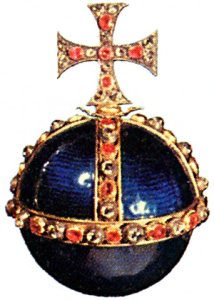
The Imperial Orb of Austria, Schatzkammer, Hofburg Palace, Vienna, Austria.
At the sight of the crowds, Jesus’ heart was moved with pity for them because they were troubled and abandoned, like sheep without a shepherd. Then he said to his disciples, “The harvest is abundant but the laborers are few; so ask the master of the harvest to send out laborers for his harvest.” Matthew 9:36-38.
Click here to read today’s Sunday Mass Readings.
More information will be given if you click on words highlighted in red.
You may have seen the coronation of King Charles III which was broadcast all over the world on 6 May 2023. Of special interest were the symbols of power and authority with which the king was invested. Along with the crown and scepter was the orb, a globe covered in gold, with a cross standing on top, symbolizing the world beneath the hope and glory of Christ.

Such an object can be found in almost all the royal treasuries of Europe, the example at the very top of this page being in Vienna and used long ago in a Habsburg coronation. In a way, it displays the profound wish of Jesus in today’s gospel, for workers, few in number, to go out into the world and invite all people to accept the salvation that he offers to each of us. In that, we are promised, can be found our deepest happiness and satisfaction. The Christian heroes who have obeyed that command and have indeed gone out as servants of the Lord down through the centuries are our saints. They are the ones who have obeyed the Lord’s command totally, even, in many cases, to the death. And what a vast witness they have been, from every culture and tradition, all ages, married, unmarried, unlettered and educated. They were and are supreme examples to us of what the human spirit is capable, in good times and bad.
For example, St. Charles Lwanga, born in 1860 in what is now Uganda in Africa, was tortured and martyred at the age of 25. The pagan king at that time was threatened by the growth of Christianity in his land, and ordered the death of many who refused to bend to his licentious will. Charles and 21 others who died for the faith were declared saints by Pope Paul VI in 1964. The 23 Anglicans who had been martyred with them were also acknowledged by the Pope at that time.

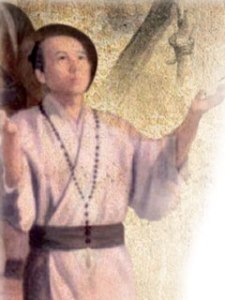
Christianity came to Japan through the missionary work of St. Francis Xavier in 1549. After two years of activity, he left the seeds of what was to become a flourishing new philosophy and practice. So successful was the growth of this new religion that the authorities became alarmed at its growth and the threat it posed to traditional practice. In 1614 it was outlawed, but persecution had begun years earlier. Over 1000 Christians were put to death, including Blessed Francis Toyama Jintaro, who was a samurai warrior. In 1624 he was beheaded in his own home in Hiroshima for refusing to denounce his new faith, which had caused the conversion of many Japanese. For this witnessing to the faith, he was beatified by Pope Benedict XVI in 2008. He was 24 years old.
On a more peaceful note, the first Australian saint, St. Mary McKillop, died in her bed aged 62. She had founded Australia’s first order of sisters, the Sisters of St. Joseph of the Sacred Heart. Their initial work was educating youngsters, which grew into establishing an orphanage and a refuge for women released from prison. St. Mary was a strong-willed woman however, and did not take to being silenced, especially when she revealed instances of sexual abuse by an Irish priest. The approval of her order of nuns by Pope Pius IX strengthened her hand, and her work flowered, even through continued criticisms from inside the church. She was canonized by Pope Benedict XVI in 2010.

North America, a land totally unknown to the Hebrews in Jesus’ day, has also produced great men and women obedient to the call of the Lord. St. Kateri Tekakwitha, for example, was born in Ossernenon, a native American settlement, now the town of Auriesville in New York State. That was the site of the martyrdom of the Jesuits St. Isaac Jogues, St. René Goupil and St. Jean de Lalande in the 1640s. St. Kateri was born in 1656 when it was a little more peaceful. She converted and became a Catholic at the age of 19, to the distress of her adoptive parents and her neighbors. She was destined to live a short life, and died aged 24. In that time she was a devoted virgin of Christ, the “Lily of the Mohawks”, contrary to the Mohawk tradition of getting married. For this total dedication to Christ despite much pressure to change, Kateri (the Mohawk form of the name Catherine, inspired by the story of St. Catherine of Siena) was canonized a saint of the church in 2012 by Pope Benedict XVI.

Finally, from South America, we have the inspiring story of St. Martin de Porres from Peru. He was born in 1579, the illegitimate son of a Spanish grandee, who abandoned his family early on, and a freed slave of African and native Peruvian descent. Given to prayer and meditation, despite his grinding poverty, Martin applied to the Dominicans to become a monk. Not possible; at that time, Africans and Native Americans under Peruvian law were barred from becoming full members of religious orders due to the relations between the state and the church. He entered the Dominicans as a “donado”, basically an unpaid laborer who could live in the monastery. The Dominican community however began to trust him with more and more responsibilities, even including care for the sick because of his early training (under the care of a barber) in medical procedures, clearly a leftover from earlier centuries when “barber-surgeons” were often the go-to for poorer people. Despite his constant care of the sick, whether wealthy or slave, he endured endless ridicule because of his status and birth. He was admitted as a full lay brother into the Dominicans at age 24, the superior choosing to ignore the law banning such. He died aged 59 after a year of very painful illness. He was declared a saint in 1962 by Pope John XXIII. This portrait was painted of him prior to or just after his death in 1639:

I have excluded Europe from this list of continents because martyr-saints began to appear there just a few years after Pentecost. The other continents were either unknown or little-known to the first followers of the Lord, so their stories of dedication and, indeed, martyrdom, usually tell a later story of extreme faith and dedication, placing the Cross over each continent just as Jesus had hoped and prayed for. It is now up to us to ensure that the cross stays wherever we live through our works of Christian charity and action.

The Saviour, Studio of Van Cleve, Museo del Prado, Madrid, Spain.
PLEASE FORWARD THIS WEBPAGE TO THOSE YOU THINK
WOULD APPRECIATE IT. THANK YOU.
Reflections on next Sunday’s Mass Readings will be posted on Wednesday.
Please send your reflections to: RogerJohn@aol.com
© SundayMassReadings.com
Discover more from Sunday Mass Readings
Subscribe to get the latest posts sent to your email.
 Sunday Mass Readings
