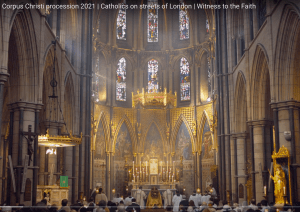
Our Lady of the Assumption and St Gregory Church, London, UK: Corpus Christi Procession 2021.
Click here to read today’s Sunday Mass Readings.
Jesus said to the Jewish crowds: “I am the living bread that came down from heaven; whoever eats this bread will live forever; and the bread that I will give is my flesh for the life of the world.” John 6:51.
Click on any word highlighted in red for further information.
If there is any feast of the church in the year that stirs up memories of displaying one’s faith to full public view, it is the Feast of Corpus Christi. I remember walking through the streets of London’s Notting Hill (yes, the Notting Hill of film legend, but this was in the 1940s and early 50s when it was very poor and not remotely glamourous) and walking at the end of the procession where we would be singing the middle of a hymn verse when at the head they had already completed it, the procession being so long. And apparently this continues: the video above shows a procession going through the center of London, near Piccadilly Circus – much more dramatic than my experience! So what is it in this feast that literally moves people into public action? You can read its history here, but clearly the feast of the Body and Blood of the Lord goes back to the earliest pages of the church’s history, indeed to the Last Supper itself, when Jesus declared that the bread and wine on the Passover table were his body and blood, no doubt to the stunned reaction from his followers seated with him. How could that be? What did it mean? Such questions have been asked ever since, especially at the time of the Reformation when it became a source of bitter dispute rather than joyous unity. But for Catholics it remains the sacred center of all belief, the actual presence of Jesus with us, now and forever. It is the fulfillment of his promise to be with us until the end of time. That is why we bend the knee in his presence in the consecrated bread of wine: he is really with us as he promised.
Ironically, this very belief was the source of gigantic opposition from the pagan Roman authorities in the first three centuries of church history. Not for nothing do we call this belief one of the sacred mysteries of our faith. For one thing, the Mass was never talked about outside the early church, so then, as now, all sorts of conspiracy theories circulated as to its meaning. It was insultingly called a “Thyestian feast” by critics, lifted from a terrible page of Greek history (or legend) which I do not intend to talk about here. Suffice it to say it was the result of Christians calling for us all to love our brothers and sisters as we assembled to celebrate the feast of the Body and Blood of the Lord or, in their terms, to be incestuous men and women celebrating a cannibal feast. The Christian belief in one God also led to accusations of atheism (one god was virtually the same as no god, and the gods and goddesses were the ones who protected the Roman Empire; to refuse to worship them was considered the same as treason…). So ignorance, then as today, can result in incredible misunderstanding and possible hatred and violence; it certainly did in the early church. The belief in the real presence of Our Lord, therefore, was one of the central core beliefs, or strengths, which saw the early church through huge persecution and suffering as it was at the same time a source of supreme ignorance, fear and violence.
Now the Pew Research Center conducted a survey in 2019 of what Catholics believe. It found that 69% of Catholics believe the consecrated bread and wine at Mass is symbolic of Jesus’ body and blood, not the real thing. I am certain that every priest from the poorest parish in the world to the Pope himself at the high altar of St. Peter’s Basilica in Rome was astounded on reading that. The “Real Presence” of Christ in the consecrated bread and wine is, simply, the most important, central, essential Catholic belief there is. All Catholic and Orthodox Christians have this belief at the center of their faith. When Jesus took a piece of bread at the Last Supper with his friends and announced that it was his body, the reaction must have been utter shock, compounded when he announced that the wine there present was his blood. Then he said to take and eat, and, critically, to do this in remembrance of him. There was no mention of “symbolic” flesh and blood, no watering down, as it were, of those critical words. He meant it, and we have obeyed the instruction literally ever since. On this occasion, the church becomes fundamental and accepts those key words as fundamentally, utterly true. So strange, because many fundamentalist Christians, taking every word of the Bible literally, become very queasy at those words and oftentimes state that they must be taken as symbolic of Christ’s presence, not real. At the Reformation, this became a red hot focus of controversy with some Protestants rejecting the 1500 year old doctrine of Real Presence, and many to this day will hold a symbolic eucharist perhaps each Sunday, perhaps just several times a year. Look here to see a vast trove of World Council of Churches’ teachings on this and many other subjects. Jesus did say “Do this in remembrance of me” and so we Catholics do, every day, everywhere. You hear those words at every Mass, which is a re-enactment of the Last Supper, with the ordinary bread and wine becoming the Lord’s body and blood at the central Eucharistic Prayer spoken by the priest. It explains why some coming up to communion, will have their pyx, a small gold or silver round container, to place a consecrated host inside to take home to a sick friend or relative who cannot get to Mass. Then it is the Lord himself entering their house and making it holy. No, there is nothing symbolic about the consecrated bread and wine: it is the Lord actually present in those elements, present to us as he promised before he ascended to heaven. And that is why, on the feast of the Body of Christ, Corpus Christi, that same consecrated bread is enthroned in a glorious monstrance and taken around the neighborhood, making it holy and blessed, inviting all people to come to him and be saved.

Corpus Christi Procession, Holy Family Church, Duxbury, MA, USA.
Reflections on next Sunday’s Mass Readings will be posted on Wednesday.
Please send your reflections to: RogerJohn@aol.com
PLEASE FORWARD THIS WEBPAGE TO THOSE YOU THINK
WOULD APPRECIATE IT. THANK YOU.
© SundayMassReadings.com
Discover more from Sunday Mass Readings
Subscribe to get the latest posts sent to your email.
 Sunday Mass Readings